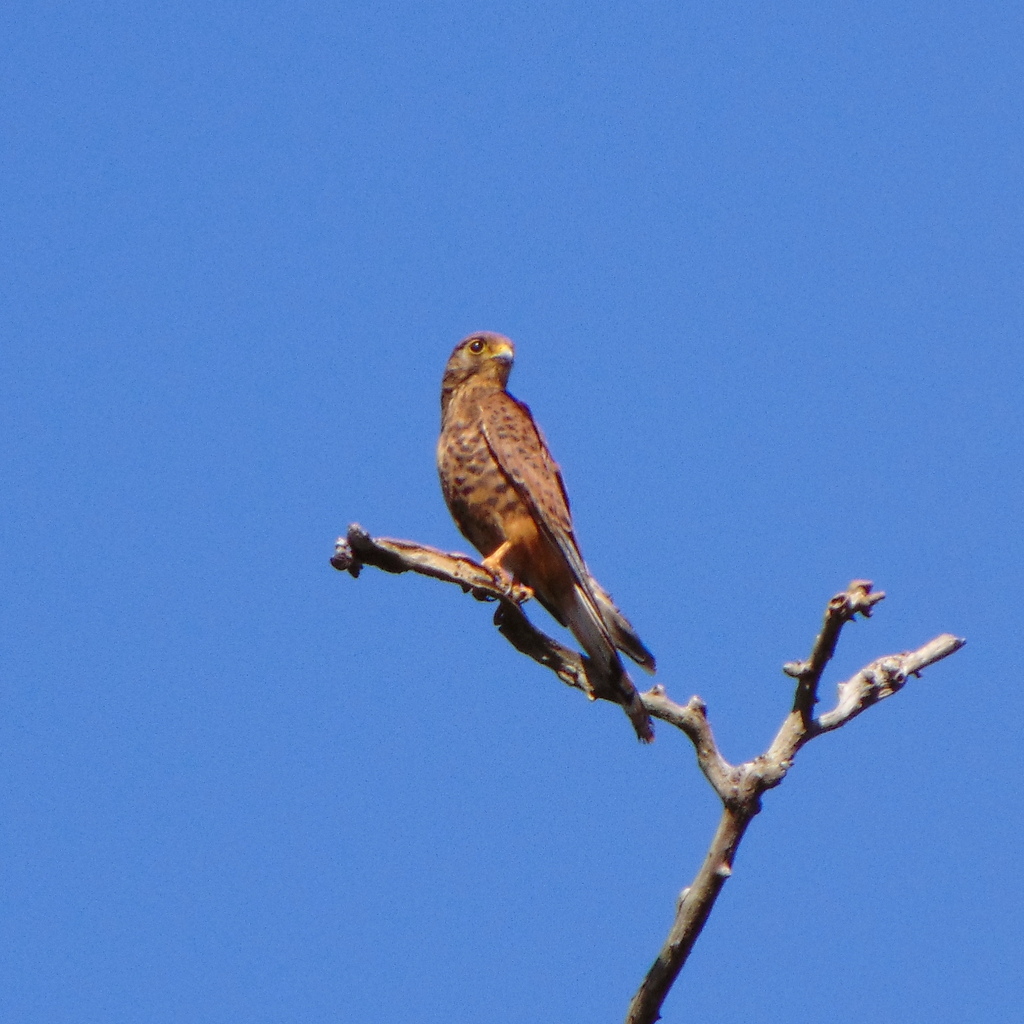
Spotted Kestrel
Photo © Hamas Fathani
Photo © Hamas Fathani — CC BY-SA 4.0 — Source: iNaturalist #134958286Identification
The spotted kestrel is a small falcon measuring 26–32 cm in length with a wingspan of 59–71 cm and an average weight of 162 g. Sexual dimorphism is less pronounced than in the common kestrel. Males display grey tails with a single broad subterminal band and white tips, while females have grey tails with white tips marked by nine dark bands. Juveniles resemble females but appear darker and more heavily marked overall.
Range & Habitat
Found throughout Indonesia and Timor-Leste, the spotted kestrel inhabits grasslands with scattered trees, lightly wooded cultivation, and forest edges. It occasionally penetrates primary and tall secondary forests along logging roads and inhabits clearings within forested areas, sometimes venturing into human settlements. The species is believed to maintain relatively small habitat ranges and moves seasonally between wet and dry season territories, displaying more sedentary behaviour compared to the common kestrel.
Behaviour & Diet
Little documented information exists about the spotted kestrel's behaviour, though it displays similar habits to the common kestrel while remaining more sedentary. Based on its closest relative, the nankeen kestrel, the spotted kestrel is assumed to feed primarily on small mammals, birds (particularly waterfowl and doves), lizards, and insects. The species may breed during both wet and dry seasons, with pre-breeding behaviour observed in June–July and December–January, though breeding has been confirmed in August. Clutch sizes are likely 3–5 eggs with incubation periods around 28 days and fledging periods of 31–35 days.
Best Time & Places to See It
Spotted kestrels are most active during their breeding season from March through September or October. Look for them in open grasslands with scattered trees, along forest edges, and in lightly wooded agricultural areas throughout the Indonesian archipelago and Timor-Leste. They may also be observed perching on traditional house roofs or palm tree crowns, particularly in rural areas where they hunt for prey.
Photography Tips
Early morning is ideal for spotting and photographing these small falcons as they hunt over grasslands. Use a telephoto lens (at least 400mm) to capture detailed plumage patterns without disturbing the bird. Position yourself with the sun behind you to illuminate the subtle grey and white markings on the tail and body. Patient scanning of open areas with scattered trees will often reveal perched individuals, offering excellent opportunities for portrait shots and behaviour documentation.
Aketajawe Lolobata National Park
Bogani Nani Wartabone National Park
Komodo National Park
Lore Lindu National Park
Manusela National Park
Mount Merapi National Park
Mutis Timau National Park
Taman Nasional Baluran
Taman Nasional Meru Betiri
Nothing matches these filters.
No community photos yet. Log in to add the first one.
No community observations of this species yet.