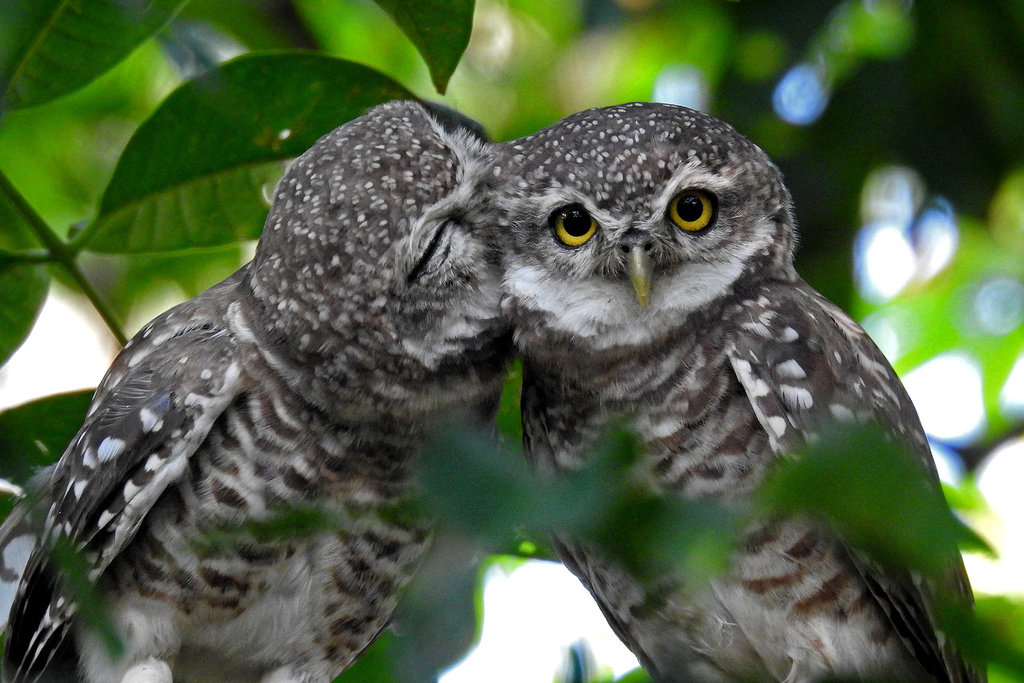
Spotted Owlet
Photo © Ananya Mondal
Photo © Ananya Mondal — CC BY-SA 4.0 — Source: iNaturalist photo #89909173Identification
The spotted owlet is a small and stocky owl, barely 21 cm (8.3 in) in length, making it easy to overlook despite its vocal presence. Its upperparts are grey-brown, heavily spotted with white, while the underparts are white streaked with brown. A distinctive pale facial disc frames yellow eyes, and a white neckband and supercilium add character to this diminutive hunter. The sexes are similar in appearance. In flight, the spotted owlet displays a deeply undulating pattern. Geographic variation is notable: the nominate form is darker than paler forms found in drier regions, and size decreases from north to south across its range.
Range & Habitat
The spotted owlet breeds throughout tropical Asia from North Pakistan to Southeast Asia, with several recognized subspecies distributed across this vast region. It is a common resident of open habitats including farmland and human habitation, and has proven remarkably adaptable to urban environments, making it one of Asia's most accessible owl species for travellers and photographers. The species is absent from Sri Lanka but occurs throughout the Indian mainland, even at its southern tip. No single boundary divides northern and southern populations—they intergrade naturally across the continent.
Behaviour & Diet
Though nocturnal, the spotted owlet is often visible during daylight hours, particularly when small birds mob it at its daytime roost. When disturbed, it characteristically bobs its head and stares intently at intruders. Its presence is frequently betrayed by the commotion of mobbing birds around perched individuals. The call is distinctive: a harsh, loud churring and chuckling "chirurr-chirurr-chirurr" ending with "chirwak-chirwak," delivered mainly during early dawn or just after sunset. These owls hunt a varied diet of insects and small vertebrates including rodents, bats, toads, small snakes, scorpions, and molluscs. Nests near human habitations often show higher breeding success due to increased rodent availability for feeding young.
Best Time & Places to See It
The breeding season, from November to April, is an excellent time to locate spotted owlets, as increased calling activity aids detection. Look for them in farmland, gardens, and urban areas where they roost in small groups in tree hollows, rock cavities, and building crevices. Early dawn and dusk are prime viewing times. Listen for their characteristic churring calls and watch for gatherings of small birds mobbing perched owlets during daylight—this behaviour often reveals their daytime locations. Their adaptation to cities and human habitation makes them particularly accessible in populated areas across their range.
Photography Tips
Photograph spotted owlets during early morning or late afternoon when light is soft and the birds are more active. Their small size (21 cm) demands careful approach and patient positioning. Daytime roosts in trees and buildings offer the best opportunities for stationary photography. The bird's characteristic head-bobbing behaviour and intense stare provide compelling photographic moments. Use a telephoto lens to avoid disturbing roosting groups, and be aware that mobbing flocks of smaller birds often congregate around owlets, creating dynamic compositional opportunities. The pale facial disc and distinctive white spotting photograph well in soft, directional light.
Langtang National Park
Helambu, Nepal
+364 birds+14 mammals
Where the southern slopes of the Himalayan highlands descend toward the subtropical valleys of central Nepal, Langtang National Park sprawls across one of the subcontinent's most…
VIEW NATIONAL PARKOrang National Park
Rangagarapathar, India
+298 birds+1 mammals
Where the Brahmaputra's floodplains meet the foothills of Assam, Orang National Park unfolds across a mosaic of riverine grasslands, forests and wetlands that pulse with the…
VIEW NATIONAL PARKRanthambhore National Park
Sawai Madhopur, India
+294 birds+20 mammals
Granite ridges and ravines carved through the Aravalli Range frame this protected landscape in eastern Rajasthan, where deciduous forest mingles with open scrubland and seasonal water…
VIEW NATIONAL PARKKhao Yai National Park
Prachantakham District, Thailand
+377 birds+46 mammals
Evergreen dipterocarp forest blankets the rolling terrain of this national park in eastern Thailand, where limestone hills rise abruptly from the forest floor and seasonal streams…
VIEW NATIONAL PARKKanha Tiger Reserve
Kanha Kisli F.V., India
+321 birds+23 mammals
Where sal forests give way to emerald meadows and crystalline streams carve through ancient valleys, one of India's finest wilderness reserves unfolds across the Maikal Range.…
VIEW NATIONAL PARKTadoba National Park
Palasgaon Singru, India
+270 birds+20 mammals
Where sal forests meet open grasslands and rocky outcrops rise from red laterite soil, central India's landscape unfolds in raw, untamed beauty. Ancient teak woodlands and…
VIEW NATIONAL PARKBandhavgarh National Park
Garhpuri, India
+285 birds+17 mammals
Where granite ridges rise dramatically above sal and bamboo forests, one of India's most pristine tiger reserves unfolds across the Vindhyan plateau. Ancient rock formations tower…
VIEW NATIONAL PARKPanna National Park
Badgadi Kalan, India
+271 birds+17 mammals
Where granite gorges slice through central India's Vindhyan plateau, a landscape of stark beauty unfolds across nearly six hundred square kilometers. The Ken River carves through…
VIEW NATIONAL PARKKaziranga National Park
Kohora, India
+422 birds+26 mammals
Dawn breaks over the floodplains of the Brahmaputra, where tall grasslands stretch endlessly beneath monsoon-heavy skies. This sprawling wilderness of northeastern Assam is a mosaic of…
VIEW NATIONAL PARKKeoladeo National Park
Shreenagar Rural, India
+326 birds+14 mammals
Where shallow wetlands shimmer beneath vast Rajasthani skies, one of Asia's finest bird sanctuaries pulses with extraordinary life. This former maharaja's hunting reserve, now spanning 29…
VIEW NATIONAL PARKPampadum Shola National Park
Vattavada, India
+258 birds+14 mammals
Where misty shola forests cling to the high plateaus of the Nilgiri Mountains, ancient evergreen remnants create a world apart. This 2,316-hectare reserve protects one of…
VIEW NATIONAL PARKBandipur National Park
Hirehalli, India
+302 birds+19 mammals
Where the Western Ghats descend into the Deccan plateau, ancient deciduous forests blanket a landscape carved by the Nugu River. Bandipur unfolds across 880 square kilometres…
VIEW NATIONAL PARKNagarahole Tiger Reserve
Nalkeri Forest, India
+323 birds+23 mammals
Where granite escarpments rise above dense deciduous forests and the Kabini River carves through pristine wilderness, one of India's most biodiverse landscapes unfolds across the Western…
VIEW NATIONAL PARKGir National Park
Asundrali, India
+258 birds+13 mammals
Dry deciduous forests cloak the rolling hills of western Gujarat where the Gir landscape rises as a final sanctuary for one of the world's rarest felids:…
VIEW NATIONAL PARKNo community photos yet. Log in to add the first one.
No community observations of this species yet.