Identification
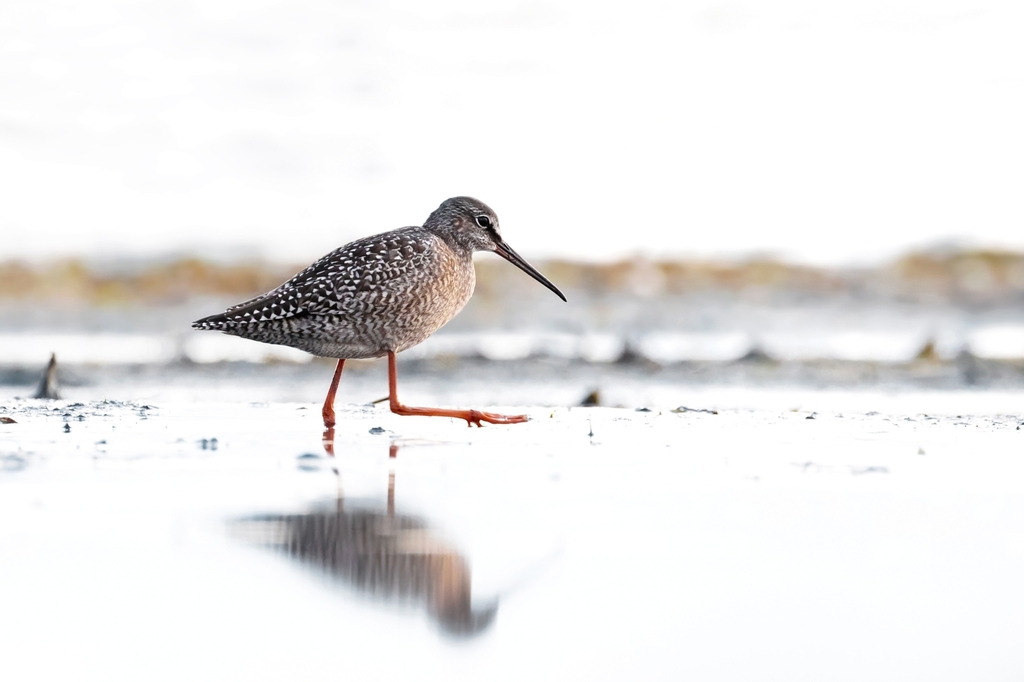
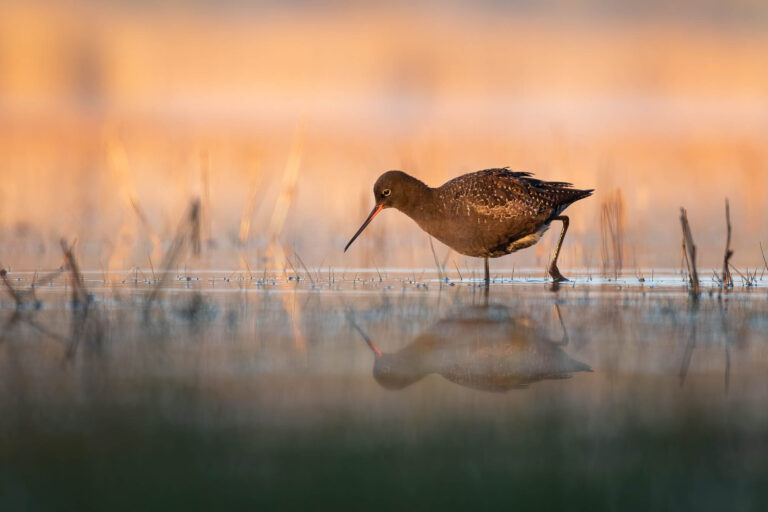
The spotted redshank is a large wader measuring 29–31 cm long with a wingspan of 61–67 cm, making it a distinctive shorebird within its family. The most striking feature is its red legs and bill, which remain visible year-round. In breeding plumage, the bird becomes predominantly black with white spots, though during these months the legs turn dark grey. Non-breeding birds are very pale, presenting a dramatic seasonal contrast. In flight, look for the characteristic white oval visible on the back. Juveniles appear grey-brown finely speckled with white above, with pale, finely barred underparts that can aid identification of younger birds in mixed flocks.
The bird undergoes complete moults between July and October, with an additional spring moult of body plumage between March and May. Juveniles undergo a partial moult between August and February. The spotted redshank's call is a distinctive creaking whistle, described as "teu-it," somewhat similar to a roseate tern's call, with a sharp "kyip-kyip-kyip" alarm call that can help with identification in the field.
Range & Habitat
The spotted redshank breeds across the Arctic Palearctic, from Lapland in the west to Chukotskaya in the east, inhabiting open boggy taiga environments. It is a highly migratory species, abandoning its northern breeding grounds to winter across a vast range including the Mediterranean, the southern British Isles, France, tropical Africa, and tropical Asia. The bird is an occasional vagrant to Australia and North America, appearing outside its normal range with irregular frequency.
Behaviour & Diet
Like most waders, the spotted redshank feeds on small invertebrates, which it hunts in shallow wetlands and mudflats. During the breeding season, it nests on open boggy taiga habitats, laying four eggs in a simple ground scrape. The bird's complete moult cycle reflects its dual lifestyle as an Arctic breeder and tropical migrant, allowing it to shift between the dark breeding plumage suited to northern summers and the pale winter plumage that serves it well in winter quarters.
Best Time & Places to See It
Migration periods offer the best opportunities to encounter spotted redshanks outside the Arctic breeding range. Spring and autumn migrations bring birds through temperate regions, particularly around coastal wetlands, estuaries, and inland water bodies. Winter visitors can be found throughout the Mediterranean, the southern British Isles, France, and across Africa and Asia. Travellers seeking breeding birds must venture to the Arctic Palearctic during summer months, where open boggy taiga provides essential nesting habitat.
Photography Tips
The spotted redshank's dramatic seasonal plumage changes offer compelling photographic opportunities. Capture breeding birds in their striking black plumage with white spots against Arctic landscapes, or photograph the more subtle pale winter birds in Mediterranean and tropical wintering grounds. The red legs and bill provide strong colour contrast that photographs well against natural backgrounds. The bird's white back oval, visible only in flight, requires anticipation and quick reflexes to capture. Photograph birds during migration for maximum diversity of plumage variation within a single location.