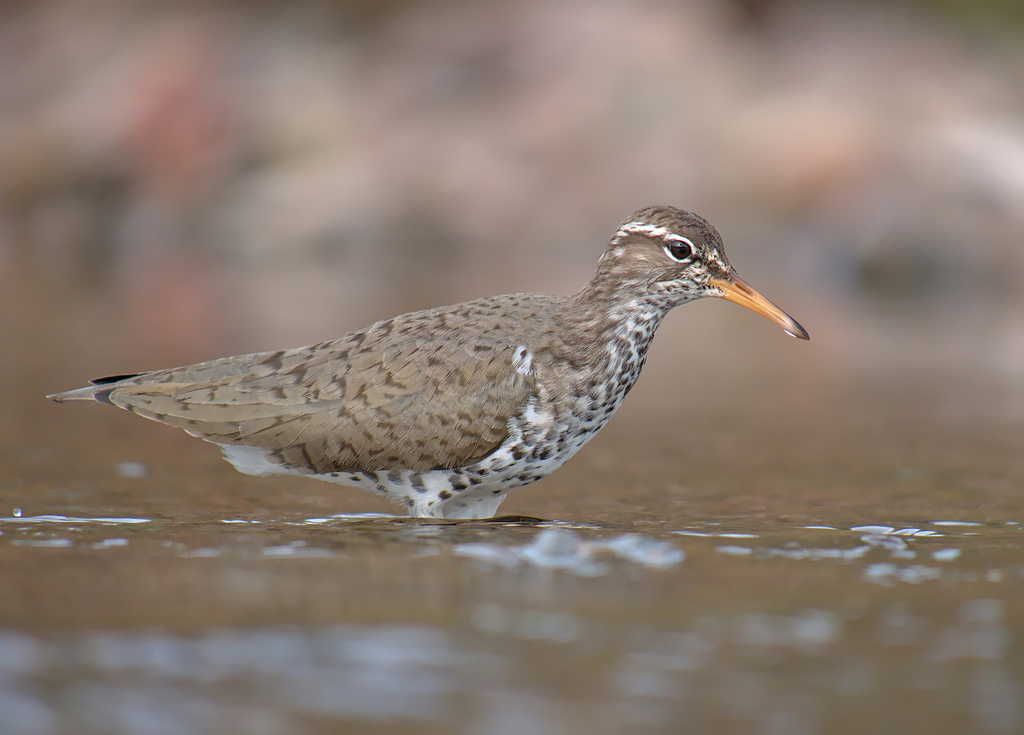
Spotted Sandpiper
Photo © Blake Ross
Photo © Blake Ross — CC BY 4.0 — Source: iNaturalist photo #198183635Identification
The spotted sandpiper is a small shorebird measuring 7.1–7.9 inches in length with a wingspan of 14.6–15.8 inches. Adults display short yellowish legs and an orange bill with a dark tip, with brown upperparts and white underparts marked by distinctive black spots. These spots are particularly prominent during the breeding season and may indicate an individual's overall health, especially in females. Spot size decreases and shape becomes more irregular with age. A white supercilium (eyebrow stripe) is also visible. Non-breeding birds lack the spotted underparts and closely resemble the Eurasian common sandpiper, though spotted sandpipers show a more washed-out wing pattern in flight and normally have lighter yellow legs and feet. Females tend to be about 20–25% heavier than males despite similar measurements.
Range & Habitat
Spotted sandpipers breed near fresh water across most of Canada and the United States, making them the most widespread sandpiper species in North America. They migrate to the southern United States, the Caribbean, and South America during non-breeding seasons, and are very rare vagrants to western Europe. These birds are philopatric, meaning they return to the same breeding areas year after year. They are not gregarious and are seldom seen in flocks, preferring solitary or paired lifestyles. Successful breeding sites are typically located near bodies of water with vegetation cover and may be reused repeatedly until physical changes or predation pressure force abandonment.
Behaviour & Diet
Spotted sandpipers exhibit remarkable breeding behavior centered on polyandry: females may mate with and lay clutches for multiple males within a single season, leaving incubation and chick-rearing duties to the males. This system allows them to produce more offspring than other sandpiper species. Males incubate eggs for approximately 20–23 days and experience dramatic testosterone level drops during this period. Females establish territories before males arrive and compete intensely for multiple mates. These birds forage on the ground or in water by sight and may also catch insects in flight, constantly nodding and teetering as they hunt. Their diet consists of insects (flies, beetles, grasshoppers, mayflies, midges, crickets, caterpillars), crustaceans, other invertebrates (spiders, snails, mollusks, worms), small fish, and carrion.
Best Time & Places to See It
Spotted sandpipers are present throughout their North American breeding range during the summer breeding season, particularly near freshwater lakes, rivers, and streams with vegetative cover. Breeding habitat selection occurs early in summer, with females arriving and establishing territories before males. During migration periods, they can be found in the southern United States, the Caribbean, and South America. These solitary birds are easiest to locate near their preferred freshwater habitats where they remain relatively stationary during breeding season, though their secretive nature and tendency to stay singly or in pairs means patient observation is required.
Photography Tips
The spotted sandpiper's characteristic bobbing tail and distinctive teetering walk provide excellent behavioral photography opportunities. Their stiff-winged, low flight over water creates dynamic action shots. Look for the spotted underparts during breeding season for the most visually striking images, as non-breeding plumage is more subdued. The white supercilium and contrasting bill color are useful field marks to capture. Early morning near freshwater habitats offers the best lighting and activity levels. Patience is essential as these birds are solitary and not gregarious, so finding them requires careful scanning of shorelines and banks. The bird's constantly nodding and teetering behavior as it forages provides distinctive identification features worth documenting photographically.
Tombstone Territorial Park
Acadia National Park
Alaska Maritime National Wildlife Refuge
Algonquin Provincial Park
Alligator River National Wildlife Refuge
Amacayacu National Park
Anavilhanas National Park
Antisana National Park
Arches National Park
Nothing matches these filters.
No community photos yet. Log in to add the first one.
No community observations of this species yet.