Stark’s Lark
Photo © scaup
Photo © scaup — CC BY 4.0 — Source: iNaturalist #198775994Identification
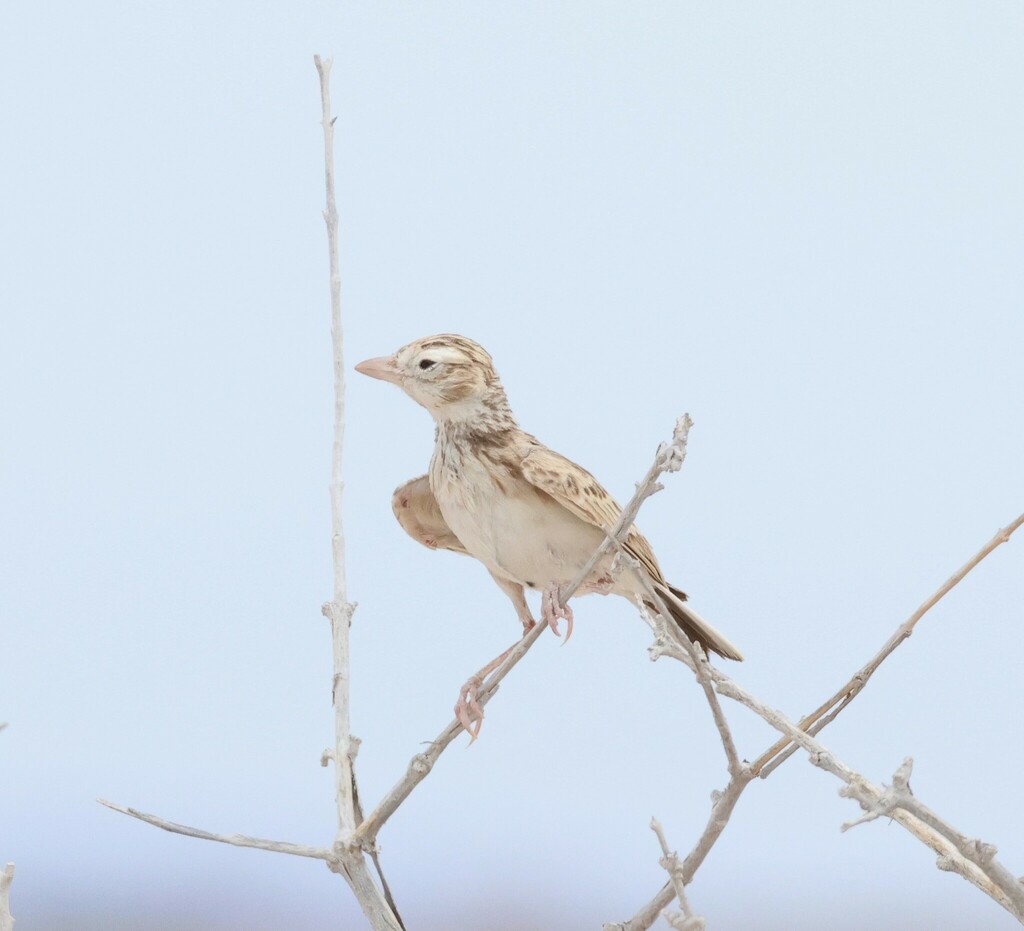
Stark's Lark is a pale, medium-small lark with distinctive features that make it recognizable in its arid habitat. The bird displays a pale, stout bill that appears slightly swollen, and its sandy-brown upperparts show a subtle streaky pattern. A distinct pale eyebrow stripe is a key identifying mark, while the underparts are whitish with faint streaking. One of the most characteristic features is the raised, streaked crest that the bird often displays, giving it a distinctive silhouette even from a distance.
Range & Habitat
Stark's Lark is found across southern Africa, with its range encompassing Angola, Botswana, Namibia, and South Africa. The species favors dry savannah and subtropical or tropical dry shrubland environments, showing a marked preference for arid grasslands with gravel substrates. Interestingly, these birds actively avoid sandy areas, making their habitat choice quite specific within the broader arid landscape.
Behaviour & Diet
Stark's Larks are highly mobile birds exhibiting nomadic behavior, which means they do not maintain fixed territories but move in response to environmental conditions. Following rainfall events, they may form flocks that range from small groups to large congregations, and they occasionally associate with other species such as sparrow-larks or buntings. This social flexibility suggests they are opportunistic in their interactions with other grassland birds.
To cope with the high ambient temperatures of their arid habitat, these larks employ remarkable behavioral adaptations. They seek shade during the hottest parts of the day and adopt a distinctive heat-stress posture characterized by an elevated crest, open mouth, partially closed eyes, and drooped wings. During courtship, males perform impressive aerial acrobatics accompanied by a varied repertoire of vocalizations including trills, whistles, and chirps, demonstrating their vigor and fitness to potential mates.
Best Time & Places to See It
The best opportunities to observe Stark's Larks come following rainfall events, when these nomadic birds are most likely to congregate in flocks and be more visible and active. Throughout their range in Angola, Botswana, Namibia, and South Africa, focus your search on dry savannah and arid grassland habitats with gravel substrates rather than sandy areas. Traveling through these regions during the wet season may increase your chances of encountering flocks, as the birds respond to improved feeding conditions by gathering together.
Photography Tips
To photograph Stark's Larks effectively, position yourself in open grassland habitats with gravel substrates where these birds forage. Early morning light can beautifully illuminate the pale plumage and highlight the distinctive pale eyebrow stripe and crest. When photographing males in courtship, watch for their aerial displays accompanied by vocalizations—these moments offer dynamic shooting opportunities. Remember that these are nomadic birds, so patience and flexibility in your location may be necessary. The subtle streaking on the upperparts and the characteristic raised crest are key features to capture that will help identify the species in your images.
Mokala National Park
Siyancuma Local Municipality, South Africa
+246 birds+35 mammals
Across the semi-arid savanna of the Northern Cape, where red earth meets sparse acacia woodland and open grassland punctuated by rocky outcrops, lies a landscape shaped…
VIEW NATIONAL PARKAugrabies Falls National Park
Kai !Garib Local Municipality, South Africa
+176 birds+20 mammals
Where the Orange River cuts a dramatic scar through the Northern Cape's arid interior, Augrabies Falls National Park sprawls across nearly 1,200 square kilometers of raw,…
VIEW NATIONAL PARKSperrgebiet National Park
Barcelona, Namibia
+181 birds+18 mammals
Where the Namib's ancient gravel plains meet the Atlantic coast, one of Africa's most remote and geologically austere landscapes unfolds across more than 56,000 square kilometres.…
VIEW NATIONAL PARKDorob National Park
Henties Bay, Namibia
+230 birds+13 mammals
Where the Skeleton Coast meets the Namib Desert's inland reaches, Dorob National Park sprawls across 34,021 square kilometres of one of southern Africa's most austere and…
VIEW NATIONAL PARKSkeleton Coast Park
Barcelona, Namibia
+143 birds+7 mammals
Where the Atlantic's cold Benguela Current collides with one of Africa's most hostile coastlines, the Skeleton Coast Park sprawls across more than 104,000 square kilometres of…
VIEW OBSERVATION POINTNamib-Naukluft National Park
Namibia
+217 birds+33 mammals
Across nearly 94,000 square kilometers of southwestern Namibia, a landscape of extremes unfolds where towering sand dunes meet rugged mountain ranges, and ancient riverbeds carve through…
VIEW NATIONAL PARKEtosha National Park
Namibia
+356 birds+58 mammals
Across northern Namibia's stark semi-arid plateau, a vast shallow depression transforms seasonally into one of Africa's most dramatic wildlife theaters. Etosha National Park, encompassing more than…
VIEW NATIONAL PARKNamibRand Nature Reserve
Hammerstein, Namibia
+107 birds+12 mammals
Where rust-coloured dunes surrender to sculpted granite outcrops and vast plains stretch toward an endless horizon, one of southern Africa's most pristine wilderness areas unfolds. The…
VIEW NATURE RESERVENo community photos yet. Log in to add the first one.
No community observations of this species yet.