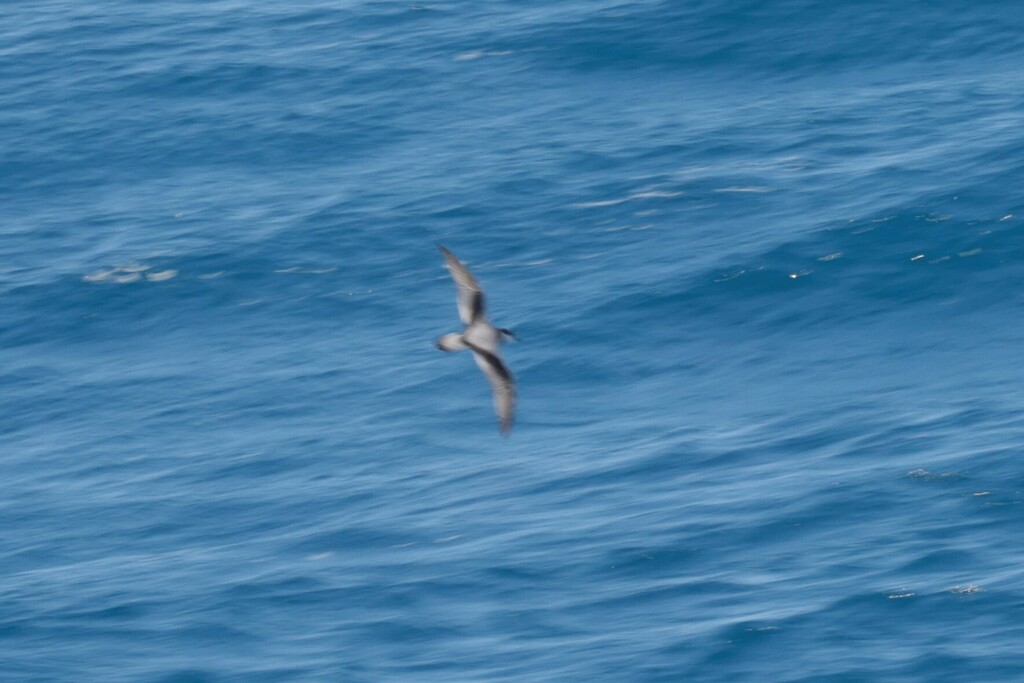
Stejneger’s Petrel
Photo © russnamitz
Photo © russnamitz — CC0 1.0 — Source: iNaturalist #255835045Identification
Stejneger's petrel is a medium-sized, rather elegant seabird with distinctive plumage patterns that make it recognizable at sea. The bird displays greyish upperparts contrasting sharply with white underparts. Most notably, it features a striking dark "M" pattern across the upper wings and body, along with an extensive white forehead that contrasts boldly with its dark grey crown. A lighter grey back and a frequently visible white notch at the posterior end of the cap add to its refined appearance. The underwing is predominantly white with small black marks at the metacarpals, while the tail shows an extensive black tip. The species is named for its notably long bill, which is longer than that of related petrel species.
Range & Habitat
Stejneger's petrel is a highly pelagic species that spends most of its life far from land, only approaching shore to breed. It is found across the Pacific Ocean, with the breeding population restricted to the Juan Fernández Islands off Chile, specifically nesting on Cerro de Los Inocentes. These seabirds nest in burrows located on mountain slopes within tree fern forests at elevations between 700 and 1,120 metres, alongside adjoining grasslands.
Outside the breeding season, Stejneger's petrels undertake remarkable migrations to the north-west Pacific waters off Japan. Between April and June, they migrate along a corridor running south-east of Hawaii, with some individuals recorded as far south as New Zealand's North Island. The return migration appears to follow a clockwise route across the northern Pacific in late summer and autumn, with sightings recorded off California.
Behaviour & Diet
Stejneger's petrels are colonial nesters that form mixed-species breeding colonies alongside the larger Juan Fernández petrel. Within these colonies, Stejneger's petrels typically occupy small single-species groups of burrows in shallow soils, nesting separately from their larger neighbours. The breeding season commences in November, with single eggs laid in late November to early December. Eggs hatch in late January to mid-February, and chicks fledge by May.
At sea, this species forages in pelagic waters, where its diet consists primarily of squid and small fish. The birds' long bills are well-suited to capturing these prey items during their oceanic wanderings.
Best Time & Places to See It
The Juan Fernández Islands off Chile are the only confirmed breeding location for Stejneger's petrels, making this the primary destination for observers hoping to encounter this species reliably. The breeding season, from November through May, offers the best opportunity to locate birds at their nesting sites. For pelagic birders, the north-west Pacific waters off Japan provide excellent chances during the non-breeding season, particularly along the migration corridor south-east of Hawaii between April and June.
Photography Tips
Photographing Stejneger's petrels presents challenges typical of pelagic seabirds. The species' preference for remote oceanic habitats means that seabird boat trips in the Pacific, particularly near Japan and the migration corridors, offer the most practical opportunities. During breeding season visits to the Juan Fernández Islands, photographers should expect birds in lower light conditions within forested nesting habitat. The contrasting plumage patterns—particularly the white forehead, dark crown, and "M" wing pattern—provide striking compositional elements. Fast shutter speeds and high ISO settings will be necessary for birds in flight over open ocean or in shadowed forest environments.
Chile: Fuegian Snipe & Juan Fernandez
No community photos yet. Log in to add the first one.
No community observations of this species yet.