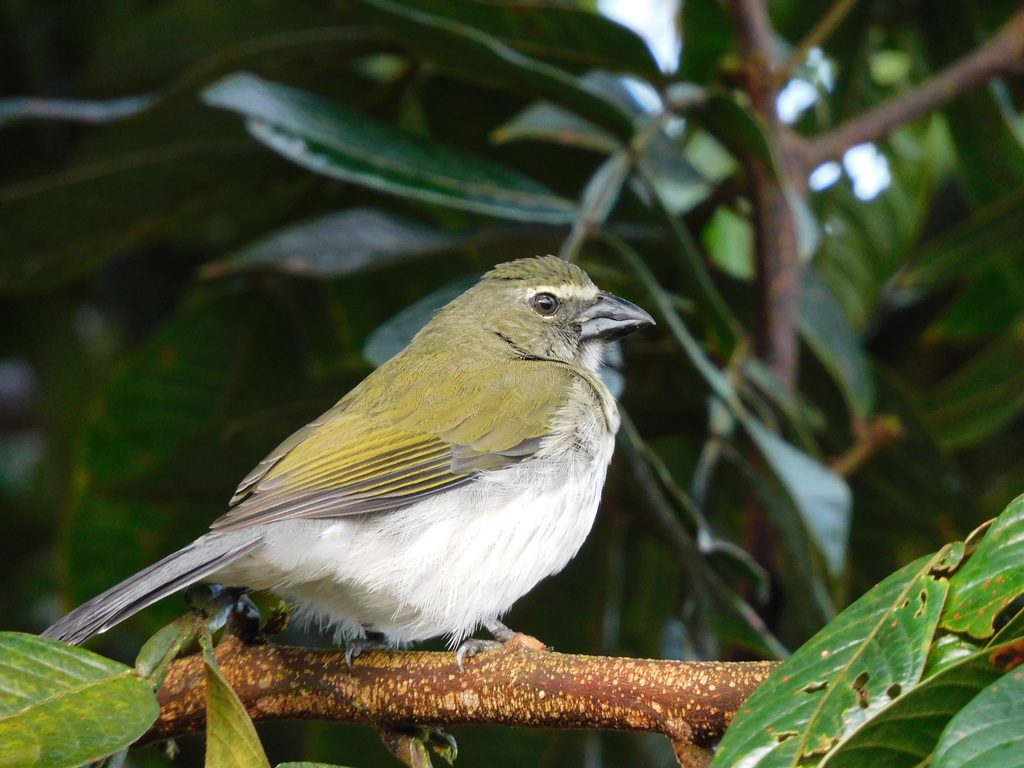
Streaked Saltator
Photo © Álvaro Rivas Godin
Photo © Álvaro Rivas Godin — CC BY 4.0 — Source: iNaturalist photo #109933886Identification
The streaked saltator is a small passerine measuring 19 to 20.5 cm long and weighing 30 to 40 grams. Both sexes share identical plumage. The nominate subspecies displays a grayish-green crown and nape, a thin buffy-white supercilium, whitish eye-arcs, and a dusky malar line. The upperparts are predominantly green, with the rump appearing grayish. In flight, blackish feathers with olive-green outer-web edges are evident. The underparts are off-white to buff-white, with diffuse dark streaking across the breast and flanks. All subspecies share a brown iris, a blackish bill (sometimes with a yellow tip), and dark gray to black legs.
Ten recognized subspecies occur across the bird's range, varying subtly in plumage intensity and coloration. Some subspecies are noticeably darker or more heavily streaked than others, while a few show more greenish or yellowish tones on the underparts. The immaculatus subspecies is notably paler with minimal streaking, while perstriatus shows heavier streaking extending to the vent.
Range & Habitat
The streaked saltator is found across Central and South America, from southwestern Costa Rica through Panama, Colombia, Venezuela, Ecuador, and Peru. Its distribution is notably disjunct, with different subspecies occupying separate geographical regions and even island populations. The species occurs from sea level to 2,500 meters elevation, though specific altitude preferences vary by region.
This adaptable bird inhabits diverse landscapes including arid to dry scrublands and woodlands, forest edges, deciduous woodlands, brushy pastures, gardens, and agricultural areas. In western Ecuador and Peru it favors arid to dry scrublands and gardens, while in northeastern Colombia and Venezuela it prefers dry to moist woodland edges and brushy habitats. The species is generally a year-round resident throughout its range.
Behaviour & Diet
The streaked saltator is an omnivorous forager, feeding on insects, fruits, seeds, flowers, and buds. It typically forages in pairs or small groups, moving through all levels of its habitat from ground level to the canopy. This social feeding behavior makes it relatively conspicuous and approachable in suitable habitat.
Breeding occurs across an extended season varying by location: April to June in Costa Rica, January to September in Colombia, April and May in Panama, and February and March in Ecuador. The species builds open-cup nests from plant materials, constructed with a coarse outer layer, dried grass middle layer, and fine fiber lining. Nests are typically placed in shrubs or trees 1 to 3 meters above ground, occasionally reaching double that height.
Best Time & Places to See It
The streaked saltator's extended breeding season and year-round residency mean it can be encountered throughout the year across its range. The species is most accessible in open woodlands, scrublands, and gardens where it forages in pairs at accessible heights. Its preference for edges and semi-open habitats makes it more visible than many forest canopy species.
Regions offering good opportunities include southwestern Costa Rica and western Panama for northern populations, northeastern Colombia and Venezuela for different subspecies, and Ecuador and Peru for their respective endemic forms. Within these areas, dry woodlands and scrubby pastures bordered by gardens or cultivated land offer the best chances of observation.
Photography Tips
The streaked saltator's preference for shrubby habitats and habit of foraging in pairs at moderate heights make it a manageable subject for photography. The bird's relatively subdued plumage—predominantly greenish-gray and buff-white with fine streaking—requires careful exposure metering to avoid blown highlights on the pale underparts or underexposed details in the darker upperparts.
Early morning sessions in open woodlands and gardens will yield the best light and increased activity. The bird's tendency to forage in small groups and at various heights from 1 to 3 meters provides opportunities for behavioral photography. Patience near fruiting trees or flowering plants may reward the photographer with close, unguarded views of this gregarious species.
Guided Birding Tour
Nothing matches these filters.
Baru Volcano National Park
Cerros de Amotape National Park
Chagres National Park
Chirripó National Park
Coiba National Park
Corcovado National Park
Darién National Park
El Tamá National Park
General de División Omar Torrijos Herrera National Park
Nothing matches these filters.
No community photos yet. Log in to add the first one.
No community observations of this species yet.