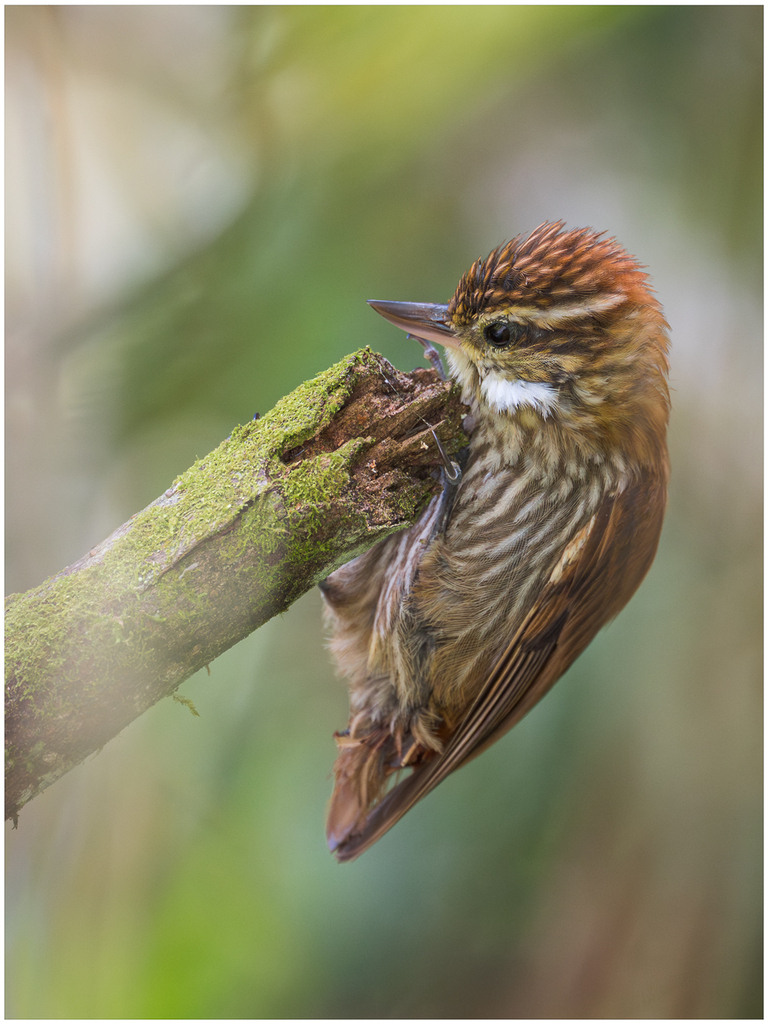
Streaked Xenops
Photo © Shiva Shenoy
Photo © Shiva Shenoy — CC BY 4.0 — Source: iNaturalist photo #608310442Identification
The Streaked Xenops is a diminutive passerine, measuring just 12–13 cm in length and weighing 10–15 g, making it easy to overlook in dense forest. Its most distinctive feature is a wedge-shaped, short, thick bill—an adaptation for probing into bark and wood. Look for a conspicuous buff supercilium and pure white malar stripe contrasting against a brownish face. The crown is dark brown with rusty streaks, while the back shows rufescent-brown plumage with faint paler streaks. The rump and upper tail coverts are plain chestnut-rufous, and the underparts feature characteristic broad buffy-white streaks with dark edges. The sexes are identical in plumage. Juveniles appear less distinctly marked, with duller streaking and a cloudy greyish throat.
Range & Habitat
The Streaked Xenops is found throughout the New World from Costa Rica and Trinidad south to Bolivia and Argentina, with 11 recognized subspecies distributed across this vast range. In montane regions—the Andes and Central American highlands—it inhabits evergreen and deciduous forests between 700 and 2,400 m elevation, though in Costa Rica it ranges from 1,200–2,500 m and in Colombia from 1,400–2,800 m. In lowland areas, it occupies diverse forest and woodland habitats ranging from semi-arid to humid environments, including primary and secondary tropical forests. The species favors forest interiors and edges, and is a year-round resident throughout its range.
Behaviour & Diet
The Streaked Xenops is an active forager that feeds almost exclusively on arthropods, including wood-boring beetle larvae and adult insects. Often seen singly or in pairs, it frequently joins mixed-species foraging flocks for added vigilance and foraging efficiency. The bird is a nimble climber, hitching along slender branches and sometimes using its stiff tail as a brace. It captures prey by gleaning from foliage, chiselling into bark, and flaking away rotten wood—techniques well-suited to its specialized bill structure. Remarkably, it has also been observed catching flying termites in mid-air.
Best Time & Places to See It
Breeding occurs from January to May in Costa Rica and February to May in Trinidad, making these months optimal for observing paired birds and breeding activity. The species nests in cavities—either natural holes, abandoned woodpecker holes, or self-excavated chambers positioned 1.5–9 m above ground, where it raises clutches of two or three eggs. Search for this bird in the forest understory and mid-canopy levels, particularly at forest edges and in secondary growth. Its preference for specific elevations in different regions—higher in mountains, lower in plains—means targeting the appropriate habitat type for your location.
Photography Tips
The Streaked Xenops' small size and cryptic behaviour require patience and a steady hand. Position yourself quietly near mixed-species feeding flocks, as the bird often joins these groups. Early morning light is essential to capture the subtle rufous and buff tones that distinguish this species. When the bird is foraging on branches and bark, shoot at eye level or slightly below to showcase its diagnostic white malar stripe and buff supercilium against the darker face. The bird's habit of using branches as perches offers opportunities for clean, uncluttered compositions. A telephoto lens (at least 400 mm) is advisable given its small stature and preference for interior forest habitat where it can be distant and partially obscured by foliage.
Araucárias National Park
Bahuaja Sonene National Park
Baru Volcano National Park
Brasília National Park
Braulio Carrillo National Park
Calilegua National Park
Campos Amazónicos National Park
Cantão State Park
Carlos Botelho State Park
Nothing matches these filters.
No community photos yet. Log in to add the first one.
No community observations of this species yet.