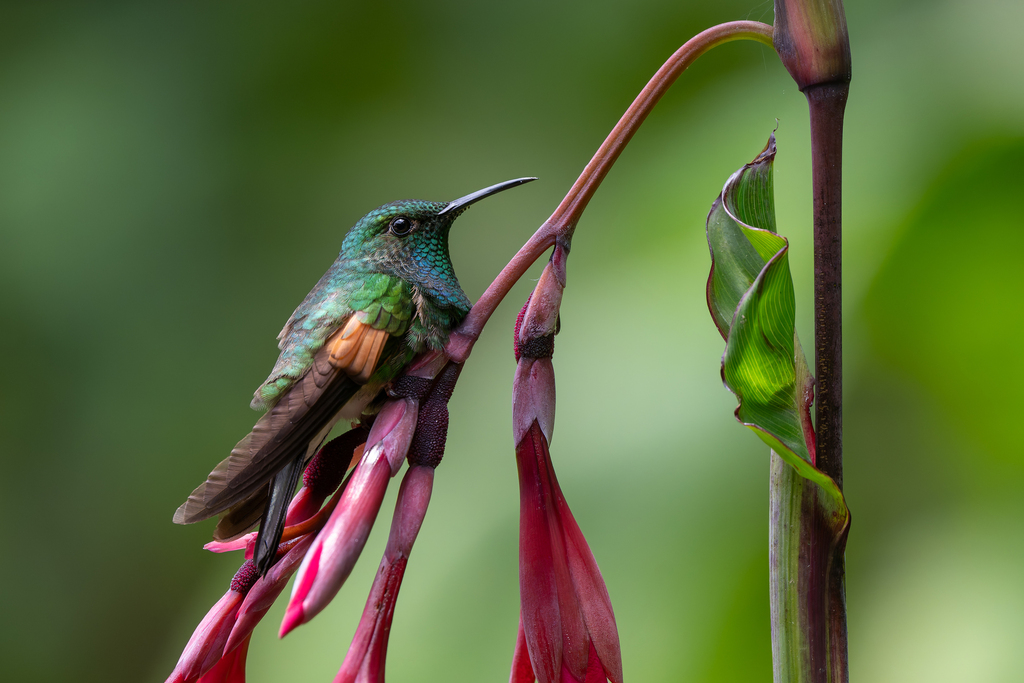
Stripe-tailed Hummingbird
Photo © Adam Jackson
Photo © Adam Jackson — CC0 1.0 — Source: iNaturalist photo #561144173Identification
The stripe-tailed hummingbird is a small species, measuring just 9 to 10.5 cm in length and weighing only 4–4.5 grams on average. Both sexes sport a distinctive straight black bill. Males of the nominate subspecies display bright metallic grass-green upperparts that become more bronzy on the uppertail coverts, with cinnamon-rufous secondaries visible as a patch on the folded wing. The species derives its English name from its striking tail pattern: the three inner pairs of tail feathers are dark bronze-green, while the outer two pairs feature black outer webs and white inner webs with black tips—a distinctive marking that aids identification in the field.
Females are somewhat different in appearance, with grass-green upperparts but brownish-gray underparts spotted with metallic green on the sides. Their tail resembles the male's pattern, though with additional dusky to black tips on the inner feathers. The two larger subspecies, E. e. nelsoni and E. e. egregia, show subtle variations: nelsoni males have more yellowish-green underparts and less sharply defined black tail tips, while egregia males have reduced black markings on the outermost tail feathers.
Range & Habitat
The stripe-tailed hummingbird is distributed from southeastern Mexico through Central America to Panama, with three recognized subspecies occupying different regions. The northernmost subspecies, E. e. nelsoni, inhabits the eastern Mexican states of Veracruz and Oaxaca. The nominate subspecies ranges from Chiapas through southern Belize, Honduras, El Salvador, and into central Nicaragua, while E. e. egregia occupies Costa Rica and western Panama on both Caribbean and Pacific slopes.
This species favors humid montane, semi-deciduous, and pine-oak forests, as well as plantations, preferring forest edges and interiors. It occurs across a wide elevational range, from near sea level to 1,800 meters in Mexico, 300 to 1,800 meters in Honduras, and 300 to 2,450 meters in Costa Rica, allowing it to exploit diverse forest habitats throughout its range.
Behaviour & Diet
The stripe-tailed hummingbird exhibits seasonal elevational movements, breeding in the higher portions of its range before descending to lower elevations after breeding concludes. When foraging for nectar, the species operates at all forest levels but most frequently in the canopy. Both sexes forage lower at forest edges and clearings, though only females regularly venture into the understory. Males are notably aggressive in defending flower patches, a common territorial behavior among hummingbirds.
The species feeds on a diverse array of flowering plants, showing particular preference for Inga trees, Acanthaceae and Rubiaceae shrubs, epiphytes, and flowers of Clusia, Besleria, and Salvia. Breeding occurs between April and August in Mexico and September to April in Costa Rica. The bird constructs a delicate cup nest from plant down decorated with lichens (especially red ones) on the exterior, typically positioning it 1 to 3 meters above the ground near a stream. Clutches consist of two eggs. The species produces a distinctive song of "1-3 squeaky, sometimes metallic notes, then a low, dry, insectlike trill, then 1-3 more squeaks," along with various calls including a liquid rattling trill, sharp piercing notes, and sharp buzzes.
Best Time & Places to See It
The stripe-tailed hummingbird is considered fairly common to common throughout most of its large range and is assessed as Least Concern by the IUCN. For the best viewing opportunities, visit montane forest regions during breeding season: April through August in Mexico and September through April in Costa Rica. Forest edges and clearings offer particularly good sighting chances, as the species forages lower in these open areas compared to dense forest interior.
While the species ranges from near sea level to considerable elevations, targeting mid-elevation forests between 300 and 1,800 meters will maximize encounter probability. Look for flowering plants, especially Inga trees and flowering shrubs, which attract feeding birds. The species' aggressive territorial behavior means that flowering patches are reliable locations for observation, particularly when males are defending nectar sources.
Photography Tips
The stripe-tailed hummingbird's small size and preference for canopy foraging present typical hummingbird photography challenges. Fast shutter speeds (at least 1/2000 second) are essential to freeze the bird's rapid wing beats and movement. The species' metallic plumage requires careful attention to lighting; side-lit or backlit angles will best reveal the iridescent green of the males' upperparts and the distinctive white and black tail pattern that gives the species its name.
Forest edges and clearings offer the most accessible shooting opportunities, as birds forage lower in these areas than in dense forest interior. Early morning light often provides the best conditions for capturing the metallic brilliance of male plumage. Patient observers who locate productive flowering plants can increase their chances of obtaining repeated photo opportunities as territorial males regularly return to defend their food sources.
Arenal Volcano National Park
Peñas Blancas, Costa Rica
+551 birds+21 mammals
Straddling the border between Alajuela and Guanacaste in northwestern Costa Rica, this national park rises dramatically around one of Central America's most active volcanic systems. The…
VIEW NATIONAL PARKChirripó National Park
Rivas, Costa Rica
+274 birds+6 mammals
Where the volcanic spine of Costa Rica's Central Cordillera reaches its apex, Chirripó National Park encompasses a landscape that shifts dramatically with elevation, from montane cloud…
VIEW NATIONAL PARKBraulio Carrillo National Park
Las Horquetas, Costa Rica
+547 birds+18 mammals
Where the Caribbean slope descends from the central volcanic cordillera toward the humid lowlands of Heredia, Braulio Carrillo National Park preserves one of Costa Rica's most…
VIEW NATIONAL PARKGuanacaste National Park
Santa Elena, Costa Rica
+461 birds+17 mammals
Where the Pacific slopes of northwestern Costa Rica rise toward the Continental Divide, dry tropical forest gives way to cloud-laden peaks and misty ridges—a landscape that…
VIEW NATIONAL PARKVolcán Poás National Park
Toro Amarillo, Costa Rica
+237 birds+4 mammals
Where volcanic slopes rise sharply from the Central Valley floor, Volcán Poás National Park protects one of Costa Rica's most active and accessible volcanic systems. The…
VIEW NATIONAL PARKBaru Volcano National Park
Cerro Punta, Panama
+402 birds+6 mammals
Where the land rises sharply toward the Caribbean's western spine, Baru Volcano National Park sprawls across roughly 220 square kilometres of southwestern Panama, anchored by the…
VIEW NATIONAL PARKGeneral de División Omar Torrijos Herrera National Park
La Pintada, Panama
+401 birds+2 mammals
Across the highlands of central Panama, where the continental divide funnels moisture-laden trade winds into steep river valleys, the terrain rises and falls in a landscape…
VIEW NATIONAL PARKParque Internacional la Amistad
Teribe, Panama
+325 birds+11 mammals
Where the continental divide rises between the Caribbean and Pacific watersheds, a wilderness of extraordinary biological richness unfolds across the Talamanca Range and into lowland rainforest—a…
VIEW NATIONAL PARKLagunas de Montebello National Park
Laguna de Montebello, Mexico
+360 birds+2 mammals
Where turquoise lagoons pierce the limestone plateau of southeastern Chiapas, the Lagunas de Montebello National Park unfolds across roughly 174 square kilometers of spectral water and…
VIEW NATIONAL PARKMontes Azules
Candelaria, Mexico
+395 birds+47 mammals
Where jungle-clad limestone plateaus plunge into canyon systems carved by the Usumacinta River, Mexico's most pristine rainforest reserve unfolds across the Lacandón region of Chiapas. Montes…
VIEW BIOSPHERE RESERVELos Quetzales National Park
Copey, Costa Rica
+232 birds+3 mammals
Cloud forest sweeps across the upper slopes of the Central Valley watershed, where elevation and persistent moisture forge an ecosystem unlike any other in Costa Rica.…
VIEW NATIONAL PARKRincón de la Vieja National Park
Liberia, Costa Rica
+451 birds+30 mammals
Where volcanic slopes rise abruptly from the Guanacaste lowlands, Rincón de la Vieja National Park sprawls across a landscape shaped by geothermal drama and seasonal extremes.…
VIEW NATIONAL PARKTapantí Macizo de la Muerte National Park
Orosi, Costa Rica
+503 birds+18 mammals
Where montane cloud forest rises steeply from the Orosi Valley, Tapantí Macizo de la Muerte National Park enfolds a landscape of perpetual moisture and emerald complexity.…
VIEW NATIONAL PARKLa Amistad International Park
Crorina, Costa Rica
+532 birds+20 mammals
Where the Caribbean slopes of Costa Rica's Talamanca Mountains rise steeply inland from Limón, the boundary between two nations dissolves into an unbroken expanse of rainforest.…
VIEW NATIONAL PARKVolcán Tenorio National Park
Guatuso, Costa Rica
+480 birds+12 mammals
Where volcanic slopes rise through Costa Rica's northwestern borderlands, Volcán Tenorio National Park sprawls across terrain shaped by ancient lava flows and mineral-rich springs. The park's…
VIEW NATIONAL PARKNo community photos yet. Log in to add the first one.
No community observations of this species yet.