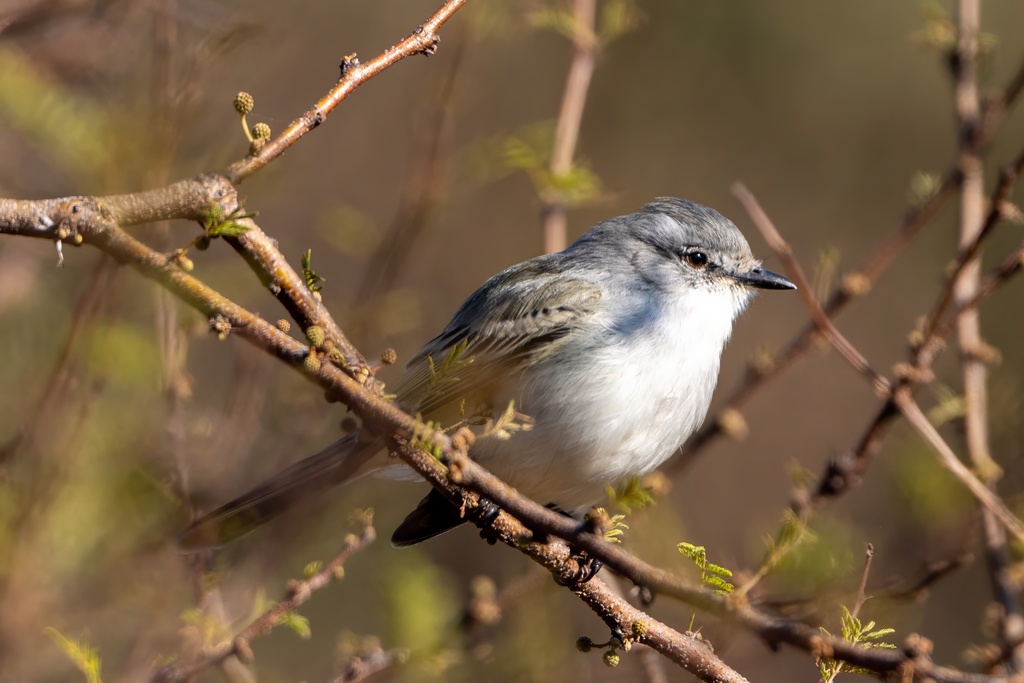
Suiriri Flycatcher
Photo © Gonzalo González Mora
Photo © Gonzalo González Mora — CC BY 4.0 — Source: iNaturalist photo #425731715Identification
The Suiriri Flycatcher is a small to medium-sized tyrant flycatcher, measuring 15 to 16 cm in length. It is a subtle, understated bird that rewards close observation. The nominate subspecies—the most southerly population—features a gray crown and nape, whitish face with a distinctive white spot behind the lores and a short white supercilium, gray upperparts, and whitish underparts with a slightly darker breast. The wings display darker gray flight feathers with paler edges and two visible bars on closed wings formed by grayish-white wing covert tips. Both males and females share identical plumage, and all subspecies possess a dark brown iris, stubby black bill, and black legs and feet.
Geographic variation exists among the three subspecies. Subspecies S. s. burmeisteri, found in northern regions, is noticeably larger and shows more olive tones on the back, a buffy-yellowish rump, more yellowish wing markings, and a pale yellow belly. Subspecies S. s. bahiae, restricted to northeastern Brazil, resembles burmeisteri but with a brownish rather than pale rump. These subtle plumage differences reflect populations adapted to different ecosystems across the species' vast South American range.
Range & Habitat
The Suiriri Flycatcher is distributed across much of central and eastern South America, occurring in Argentina, Bolivia, Brazil, Paraguay, Suriname, and Uruguay. The nominate subspecies inhabits the southern portions of this range, including eastern and southern Bolivia, most of Paraguay, northern and eastern Argentina south to Río Negro Province, adjacent southern Brazil, and western Uruguay. The burmeisteri subspecies is found in Suriname, northern Bolivia, northeastern Paraguay, and central-eastern Brazil, with scattered small populations in Amazonian regions. The bahiae subspecies is confined to northeastern Brazil from Paraíba to northeastern Bahia.
This species favors semi-open to open landscapes, including Gran Chaco dry forests, open woodlands, and dry cerrado savanna. The burmeisteri subspecies shows a preference for cerrado and campo ecosystems, including isolated pockets within the Amazon rainforest. In most of its range, the Suiriri Flycatcher is a year-round resident, though populations in eastern Bolivia are present only during the non-breeding season, indicating some seasonal movement in that region.
Behaviour & Diet
The Suiriri Flycatcher is an insectivore that supplements its diet with small fruits. It employs a variety of foraging techniques, though it predominantly gleans arthropods from leaves and branches while perched. Less frequently, it hover-gleans, sallies out to catch insects in flight, or drops to the ground to capture prey. This opportunistic approach to feeding allows it to thrive across different open habitats.
Breeding occurs from October to December in Argentina, though the breeding season in other parts of its range remains undocumented. The bird constructs a cup-shaped nest from wool, spider web, and lichen, typically placing it in a branch fork 3 to 6.5 meters above the ground. The normal clutch consists of three eggs. Vocalizations vary between subspecies: the nominate and bahiae subspecies produce a simple nasal "rowl" or "jyow" call, while the burmeisteri subspecies is notably more vocal, with pairs engaging in duet singing. Males deliver sneezy "pi-chew" sequences, while females sing higher-pitched squeaky notes that often decelerate toward the end.
Best Time & Places to See It
The Suiriri Flycatcher is considered uncommon to fairly common across its extensive range and occurs in numerous protected areas throughout South America. For travelers seeking this species, the dry cerrado and Gran Chaco habitats offer the best opportunities. The nominate subspecies' range in Paraguay, northern Argentina, and southern Brazil provides accessible options for birders exploring these regions. The bird's year-round residency in most areas means it can be encountered throughout the year, though breeding season (October to December in Argentina) may offer increased activity and vocalization.
The species occupies many both private and public protected areas across its range. Birders should focus on semi-open woodlands and cerrado savanna where the bird's preference for perching and gleaning makes it relatively visible compared to many other small flycatchers. Early morning hours typically offer the best viewing opportunities, when the bird is most active and vocal.
Photography Tips
Photographing the Suiriri Flycatcher requires patience and attention to subtle plumage details. The bird's relatively small size (15-16 cm) and preference for perching on exposed branches provide reasonable opportunities for photography compared to many other tyrant flycatchers. Use a telephoto lens of at least 400-500mm to capture frame-filling images while maintaining safe distance. The nominate subspecies' predominantly gray and white coloration photographs well in soft, diffuse light, where subtle variations in plumage tone become apparent.
Position yourself to observe the bird's gleaning behavior, which often occurs on outer branches and twigs where good light penetration and photographic angles are available. Capture the bird in profile to show its distinctive white supercilium and facial markings. If photographing burmeisteri, emphasize its buffy-yellowish rump and pale belly, which distinguish it from the nominate form. Early morning or late afternoon light will enhance the definition of wing bars and flight feather edgings. Be prepared for patient waiting, as the bird's deliberate foraging rhythm offers only occasional opportunities for sharp, well-composed shots.
Emas National Park
Brazil
+333 birds+23 mammals
Across the high plateaux of central Brazil, where the cerrado grasslands roll toward distant horizons under an immense sky, Emas National Park anchors one of South…
VIEW NATIONAL PARKSerra do Cipó National Park
Brazil
+379 birds+5 mammals
Where granite escarpments rise above the Atlantic Forest transition zone in southeastern Brazil, Serra do Cipó National Park unfolds across a landscape of dramatic ridges, cascading…
VIEW NATIONAL PARKSerra do Teixeira National Park
Brazil
+160 birds+5 mammals
Rugged plateaus and deep escarpments define this 3,112-square-kilometre sweep of the Brazilian Northeast, where the crystalline bedrock of the Borborema Plateau rises abruptly from the surrounding…
VIEW NATIONAL PARKChapada dos Guimarães National Park
Brazil
+450 birds+1 mammals
Where weathered sandstone plateaus rise above the cerrado grasslands of central Brazil, Chapada dos Guimarães National Park protects 624 square kilometres of ecological transition zone that…
VIEW NATIONAL PARKChapada dos Veadeiros National Park
Brazil
+324 birds+6 mammals
Where granite plateaus rise above the cerrado savanna in central Brazil, Chapada dos Veadeiros National Park unfolds across 6,665 square kilometres of some of the world's…
VIEW NATIONAL PARKPantanal Matogrossense National Park
Brazil
+322 birds+17 mammals
Where the flooded forests of central Brazil meet vast seasonally inundated grasslands, Pantanal Matogrossense National Park sprawls across nearly 2,900 square kilometers of one of the…
VIEW NATIONAL PARKChapada Diamantina National Park
Brazil
+346 birds+5 mammals
Where granite peaks and sandstone cliffs rise abruptly from the Brazilian interior, Chapada Diamantina National Park sprawls across 4,215 square kilometers of some of Brazil's most…
VIEW NATIONAL PARKBrasília National Park
Plano Piloto, Brazil
+338 birds+15 mammals
Cerrado grassland and scattered woodland sweep across the central Brazilian plateau where this national park sprawls across more than a thousand square kilometres of the Federal…
VIEW NATIONAL PARKEl Palmar National Park
Distrito Sexto, Argentina
+244 birds+14 mammals
Across the Paraná River floodplain in northeastern Argentina, palms rise from wetland and grassland in a landscape shaped by water and time. El Palmar National Park…
VIEW NATIONAL PARKRío Pilcomayo National Park
Argentina
+271 birds+13 mammals
Where the Río Pilcomayo cuts through northeastern Argentina's subtropical lowlands, a sprawling mosaic of wetlands, grasslands, and seasonally flooded forests creates one of South America's most…
VIEW NATIONAL PARKLos Cardones National Park
Argentina
+193 birds+6 mammals
Where the Andes descend into northwestern Argentina, Los Cardones National Park sprawls across nearly 1,200 square kilometres of one of South America's most distinctive high-altitude desert…
VIEW NATIONAL PARKEl Rey National Park
Municipio de Las Lajitas, Argentina
+317 birds+4 mammals
Where the eastern slopes of the Andes descend into northwestern Argentina's subtropical transition zone, El Rey National Park unfolds across 841 square kilometers of dramatically varied…
VIEW NATIONAL PARKCalilegua National Park
Municipio de Calilegua, Argentina
+288 birds+8 mammals
Where the eastern Andean slopes plunge into northwestern Argentina's humid subtropics, nearly 2,645 square kilometers of steep terrain and luxuriant forest compose one of South America's…
VIEW NATIONAL PARKSierra de las Quijadas National Park
Argentina
+168 birds+5 mammals
Sandstone cliffs and deeply incised canyons define this 1,137-square-kilometre expanse in San Luis Province, where the dry Chacoan landscape of central Argentina reveals an unexpected ecological…
VIEW NATIONAL PARKParque Provincial Pampa del Indio
Laguna Limpia, Argentina
+231 birds+4 mammals
Across the flat horizons of Chaco Province, where the Paraná River system spills into vast wetlands and grasslands, Parque Provincial Pampa del Indio protects one of…
VIEW NATURE RESERVEChaco National Park
Municipio de Presidencia de la Plaza, Argentina
+258 birds+7 mammals
Across the humid subtropical lowlands of northeastern Argentina, where the Paraná River basin feeds vast seasonal wetlands and gallery forests, Chaco National Park protects one of…
VIEW NATIONAL PARKNo community photos yet. Log in to add the first one.
No community observations of this species yet.