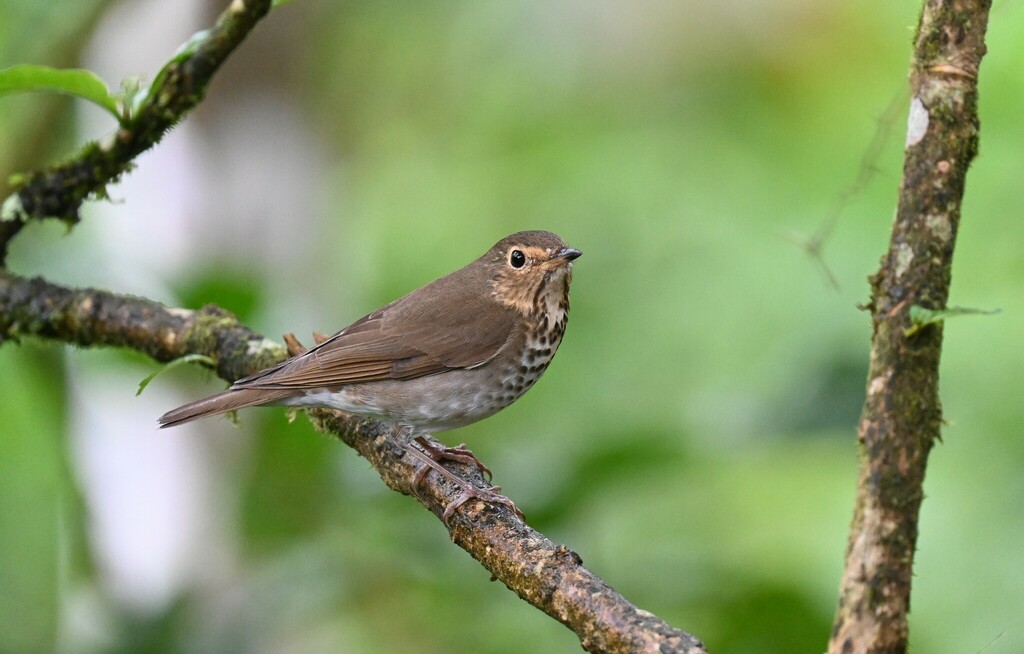
Swainson’s Thrush
Photo © Chrissy McClarren and Andy Reago
Photo © Chrissy McClarren and Andy Reago — CC0 1.0 — Source: iNaturalist photo #259541210Identification
Swainson's thrush is a medium-sized thrush measuring 16–20 cm in length with an average wingspan of 30 cm. Adults display brown upperparts with white underparts, lighter brown spotting on the breast, and brown flanking. A distinctive light brown eye ring and pink legs are visible at close range. Eastern birds show more olive-brown tones, while western birds are noticeably more reddish-brown. All birds exhibit the characteristic white-dark-white underwing pattern typical of the genus Catharus. The species is most readily identified by its beautiful, ascending flute-like song—a hurried series of tones that spirals upward.
Range & Habitat
Swainson's thrush breeds across coniferous forests with dense undergrowth throughout Canada, Alaska, and the northern United States, as well as in deciduous wooded areas along the Pacific coast of North America. Two genetically distinct populations follow different migratory routes: coastal birds travel down the Pacific coast to winter from Mexico to Costa Rica, while continental birds migrate eastward across North America before heading south to winter from Panama to Bolivia. The species is an extremely rare vagrant to western Europe and northeast Asia.
The breeding habitat consists primarily of dense, mature forest with substantial understory cover. In winter quarters, Swainson's thrush tends to avoid areas of human construction and activity, preferring undisturbed woodland.
Behaviour & Diet
Swainson's thrush forages both on the forest floor and in trees, feeding primarily on insects, fruits, and berries. Research in the White Mountains of New Hampshire revealed that their diet varies by elevation—at higher elevations, detritivores such as woodlice and ghost spiders become more prominent, though these prey items are more nutrient-poor than lowland invertebrates. The species constructs a cup nest placed on a horizontal tree branch.
Indigenous peoples of the Pacific Northwest, including the Saanich, Tlingit, Haida, and Kwakwaka'wakw, have long associated this bird's song with the ripening of salmonberries, embedding the species deeply in regional cultural traditions.
Best Time & Places to See It
Swainson's thrush can be found during breeding season in coniferous and mixed forests across northern and western North America. The species' beautiful ascending song makes it relatively easy to locate in suitable habitat during the breeding season, though the bird itself may remain concealed in dense undergrowth. Migration periods offer opportunities to encounter the species in a wider range of locations as populations move between breeding and wintering grounds.
Photography Tips
The subdued brown and white plumage of Swainson's thrush demands careful exposure metering to preserve detail in both highlights and shadows. Patience is essential, as the bird often forages in dense undergrowth where sightlines are limited. Early morning light and the bird's tendency to perch openly while singing offer the best opportunities for photography. A telephoto lens (400–600 mm) is recommended for capturing details of the eye ring, spotting pattern, and pink legs from a respectful distance without disturbing the bird.
Tombstone Territorial Park
Acadia National Park
Alaska Maritime National Wildlife Refuge
Algonquin Provincial Park
Alligator River National Wildlife Refuge
Amacayacu National Park
Antisana National Park
Arctic National Wildlife Refuge
Arenal Volcano National Park
Nothing matches these filters.
No community photos yet. Log in to add the first one.
No community observations of this species yet.