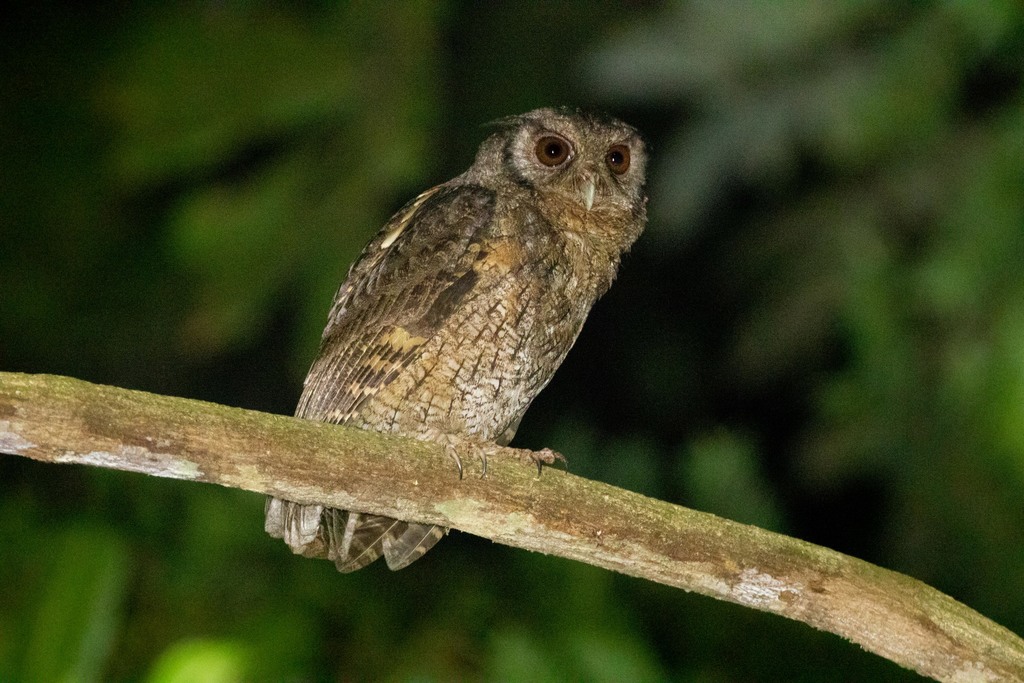
Tawny-bellied Screech Owl
Photo © Thibaud Aronson
Photo © Thibaud Aronson — CC BY-SA 4.0 — Source: iNaturalist photo #94233382Identification
The tawny-bellied screech owl is a small owl, measuring 19 to 24 cm in length and weighing between 114 and 155 grams depending on subspecies. The nominate subspecies displays a dark buff facial disc rimmed with a thin darker border, dark buff brows, and distinctive longish broad "ear" tufts. Its crown and upperparts are dark gray-brown with black and buff spots and vermiculations, while the tail features alternating brown and light buff bars. The breast is dark brown with small buff spots, and the remaining underparts are buff with black streaks and faint white bars on the belly. The subspecies M. w. usta is noticeably more rufous overall with broader streaks on the underparts and warm brown eyes, and it also occurs in brown and buff color morphs.
Range & Habitat
The tawny-bellied screech owl is found across much of northern South America and the Amazon basin, occurring in Bolivia, Brazil, Colombia, Ecuador, French Guiana, Guyana, Peru, Suriname, and Venezuela. The nominate subspecies inhabits areas north of the Amazon River, ranging from eastern Colombia eastward through Venezuela and the Guianas and south through Ecuador into northeastern Peru and Amazonian Brazil. The subspecies M. w. usta occupies territory south of the Amazon in eastern Peru, northern Bolivia, and southern Amazonian Brazil to northern Mato Grosso.
This species prefers the interior of lowland rainforest, particularly old growth and mature secondary forest, typically favoring undergrowth to the mid-story below 30 meters in height. While it is seldom found above elevations of 600 to 700 meters, M. w. usta shows greater adaptability and can also be found in altered forest along waterways and near human settlements.
Behaviour & Diet
The tawny-bellied screech owl is nocturnal and forages at lower levels of the forest. Little is known about its feeding habits, but it is believed to feed mostly on insects, possibly supplemented with small vertebrates. Breeding biology remains poorly documented, though nests have been found in holes within dead palms; one nest contained a very young chick while another held two eggs, with at least one nest documented in September.
The vocalization of the nominate subspecies is distinctive: its primary song is a long series of rapid notes that accelerates and increases in volume before fading into a low trill, while its secondary song consists of a brief series of short "wu" notes. M. w. usta produces similar vocalizations but at a slower tempo, with a secondary song believed to be a fast series of "bu" notes that slow to a "bouncing" rhythm.
Best Time & Places to See It
The tawny-bellied screech owl appears to be fairly common and widespread throughout its range, though it remains poorly known. Travellers seeking this species should focus on mature and old-growth lowland rainforest habitats in the Amazon basin. The bird's preference for undergrowth and mid-story levels means that nocturnal visits to suitable forest locations offer the best chance of encounter. The subspecies M. w. usta's greater tolerance of altered forest and proximity to human settlements may make it slightly more accessible to travellers in parts of Peru, Bolivia, and Brazil south of the Amazon River.
Photography Tips
Photographing this small, nocturnal owl presents significant challenges. Night-time photography will be essential, requiring high-ISO capability and either artificial lighting or infrared equipment. The species' preference for the lower and middle forest levels, rather than exposed perches, means patience and knowledge of its calls will improve your chances of locating individuals. Learning to recognize the distinctive vocalizations of the nominate subspecies and M. w. usta will help you pinpoint birds by sound. Always photograph responsibly in rainforest habitats, maintaining distance to avoid disturbing this poorly-studied species, and be prepared for the dense, humid forest environment in which it lives.
Yasuní National Park
Aguarico, Ecuador
+601 birds+43 mammals
Where the western Amazon basin converges with Ecuador's Orellana Province, lowland rainforest reaches toward the horizon in an unbroken canopy of staggering botanical density. Yasuní National…
VIEW NATIONAL PARKNatural Sierra de Chiribiquete National Park
Solano, Colombia
+359 birds+27 mammals
Massive table-top mountains rise abruptly from the lowland rainforest of southeastern Colombia, their sheer sandstone cliffs and isolated summits creating some of the most dramatic topography…
VIEW NATIONAL PARKNatural la Paya National Park
Puerto Leguízamo, Colombia
+262 birds+4 mammals
Where the Amazon's western reaches fold into the Andes foothills, La Paya National Park sprawls across more than 8,500 square kilometers of pristine Amazonian rainforest in…
VIEW NATIONAL PARKNatural Sierra de la Macarena National Park
Vista Hermosa, Colombia
+566 birds+15 mammals
Across nearly 20,000 square kilometres of Colombia's Meta Department, the terrain rises from lowland savanna into Andean foothills through a mosaic of gallery forests, palm-fringed wetlands,…
VIEW NATIONAL PARKAmacayacu National Park
Leticia, Colombia
+567 birds+25 mammals
Where the Rio Amazonas curves through the tri-border region where Colombia, Peru, and Brazil converge, Amacayacu National Park sprawls across more than 5,250 square kilometres of…
VIEW NATIONAL PARKViruá National Park
Brazil
+389 birds+6 mammals
Across the northern frontier of Roraima, where the forest canopy rises from ancient Amazonian lowlands, Viruá National Park protects nearly 3,700 square kilometres of terra firme…
VIEW NATIONAL PARKSerra do Pardo National Park
Brazil
+153 birds
Vast upland forests and weathered plateaus define this 7,129-square-kilometre protected expanse in the heart of Pará's remote interior, where ancient bedrock and swollen rivers have carved…
VIEW NATIONAL PARKChapada dos Guimarães National Park
Brazil
+450 birds+1 mammals
Where weathered sandstone plateaus rise above the cerrado grasslands of central Brazil, Chapada dos Guimarães National Park protects 624 square kilometres of ecological transition zone that…
VIEW NATIONAL PARKAmazônia National Park
Brazil
+439 birds+6 mammals
Where the Rio Amazonas and its tributaries weave through the heart of Pará state, a vast tapestry of rainforest stretches across 23,611 square kilometers of unbroken…
VIEW NATIONAL PARKJaú National Park
Brazil
+354 birds+3 mammals
Vast floodplain forests and blackwater rivers define this remote corner of western Amazonas, where the Rio Negro and its tributaries have carved an intricate mosaic of…
VIEW NATIONAL PARKPacaás Novos National Park
Brazil
+279 birds+1 mammals
Across the border between Rondônia and Amazonas, vast tracts of humid tropical forest rise and fall in gentle undulations, carved by clear-flowing rivers that feed into…
VIEW NATIONAL PARKAnavilhanas National Park
Brazil
+468 birds+8 mammals
Across the Rio Negro in central Amazonas, an archipelago of over a thousand islands rises from the world's largest rainforest river system, creating a labyrinth of…
VIEW NATIONAL PARKCampos Amazónicos National Park
Amazonas, Brazil
+434 birds+7 mammals
Sprawling across the southwestern Amazon basin in Amazonas state, this 27,263-square-kilometre national park encompasses some of the region's most pristine lowland rainforest, where terra firme forest…
VIEW NATIONAL PARKOtishi National Park
Río Tambo, Peru
+108 birds
Where the Andes descend toward the Amazon basin, vast cloud forests cloak the ridges and valleys of Peru's Río Tambo watershed, and this is where Otishi…
VIEW NATIONAL PARKYanachaga–chemillén National Park
Palcazu, Peru
+639 birds+6 mammals
Where the eastern slopes of Peru's central cordillera plunge into cloud forest, Yanachaga–Chemillén National Park protects nearly three thousand square kilometres of montane wilderness that few…
VIEW NATIONAL PARKManu National Park
Manu, Peru
+892 birds+26 mammals
Across the eastern slopes of the Peruvian Andes, tropical rainforest descends into the Amazon basin with a complexity that few terrestrial ecosystems match. Manu National Park…
VIEW NATIONAL PARKBahuaja Sonene National Park
San Pedro de Putina Punco, Peru
+602 birds+8 mammals
Where the Madre de Dios and Heath rivers converge in southeastern Peru rises one of South America's most biodiverse wilderness regions: a vast protected realm of…
VIEW NATIONAL PARKNo community photos yet. Log in to add the first one.
No community observations of this species yet.