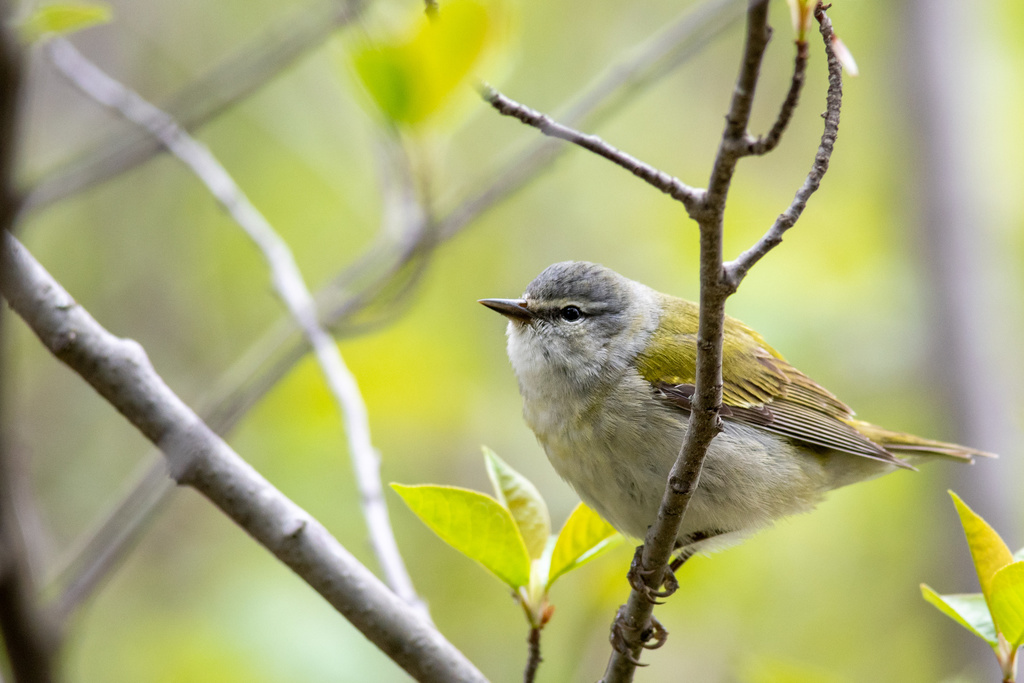
Tennessee Warbler
Photo © Thompson Hyggen
Photo © Thompson Hyggen — CC0 1.0 — Source: iNaturalist photo #198793535Identification
The Tennessee Warbler is a small songbird measuring 11.5 cm long with a wingspan of 19.69 cm and weighing roughly 10 g. It is characterized by long wings, a short tail, and a thin, pointed bill. The breeding male displays an olive back, shoulders, rump and vent, with slate gray on the neck, crown and eyeline, and gray-white underparts. The female is much duller, tinged with yellow and olive throughout, especially below. In winter and fall, adult males become more greenish-olive above and yellowish below, with a distinctive yellow supraocular line visible on the face. Both sexes retain white undertail coverts year-round. Juveniles and first-year birds resemble females. The species can be confused with female Black-throated Blue Warblers (which have darker cheeks and white wing spots), Red-eyed Vireos (larger, slower-moving, nearly constant singers), and Orange-crowned Warblers (lacking white eyebrows, grayer-brown above, with yellow undertail coverts).
Range & Habitat
The Tennessee Warbler breeds across northeastern and northern midwestern United States and much of Canada, from the Adirondack Mountains in New York through northern New England and west across Canada, with additional breeding populations in northeast Minnesota and Michigan's Upper Peninsula. It is highly migratory, wintering in southern Central America, the Caribbean, and northern South America (Colombia and Venezuela), with occasional vagrants reaching Ecuador. The species is a very rare vagrant to western Europe. The bird favors coniferous forests, mixed conifer-deciduous forests, early successional woodlands, and boreal bogs for breeding.
Behaviour & Diet
Tennessee Warblers feed primarily on insects, with a marked preference for spruce budworm; their populations fluctuate in relation to budworm abundance. They also consume flower nectar, fruit, and seeds. Like most warblers, they are nervous and quick foragers, creeping along branches at all forest levels. Solitary during nesting season, they form mixed flocks after breeding. Females construct cup-shaped nests of dried grasses and moss, lined with finer materials and hair, placing them on the ground, in moss above bogs, or in shrub bases. Clutches typically consist of 4–7 white eggs with brown splotches.
Best Time & Places to See It
During spring and fall migration, Tennessee Warblers can be very common in the eastern United States, making migration periods the best opportunity for observation. They are vagrants to the western United States, particularly along the Pacific coast. Winter sightings in their Central and South American range require travel to tropical regions, while breeding season observations are possible across northeastern North America and Canadian boreal forests.
Photography Tips
Capture the subtle plumage differences between breeding and non-breeding males, as well as the duller female plumage. Focus on the distinctive yellow supraocular line visible in winter and fall birds. The bird's active foraging behavior and nervousness require quick reflexes and patient positioning along branches at various forest levels. Backlighting can emphasize the olive and gray tones of breeding plumage, while overcast conditions help reveal the yellow tints in winter birds. Early morning during migration periods offers the best activity levels and lighting.
Tombstone Territorial Park
Acadia National Park
Alaska Maritime National Wildlife Refuge
Algonquin Provincial Park
Alligator River National Wildlife Refuge
Arenal Volcano National Park
Arrecifes de Cozumel National Park
Badlands National Park
Banff National Park
Nothing matches these filters.
No community photos yet. Log in to add the first one.
No community observations of this species yet.