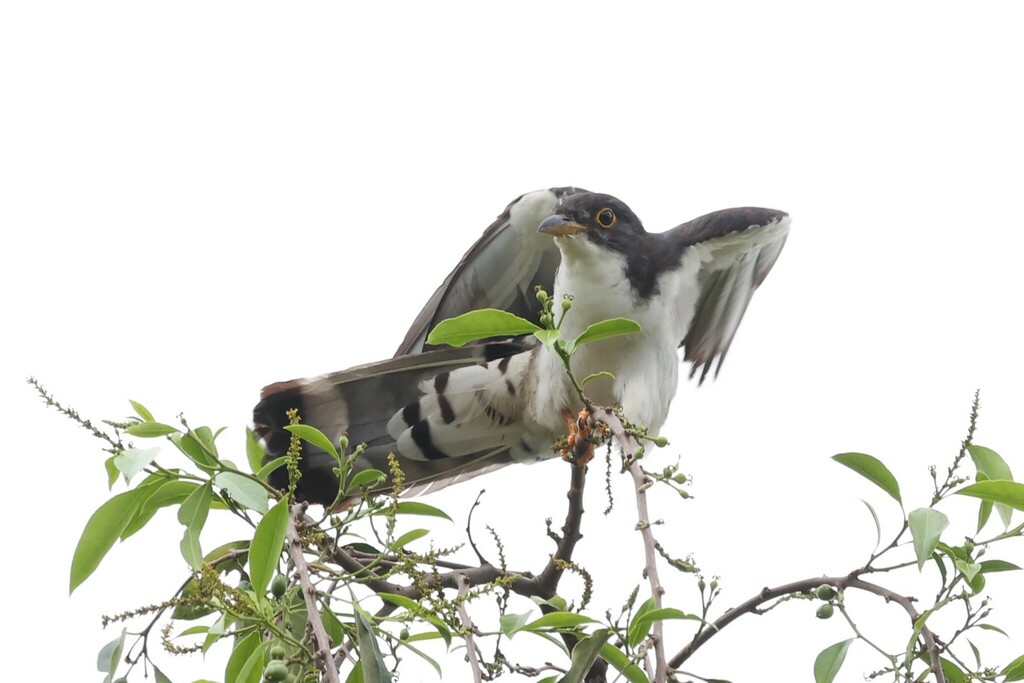
Thick-billed Cuckoo
Photo © Tommy Andriollo
Photo © Tommy Andriollo — CC BY 4.0 — Source: iNaturalist #141457331The thick-billed cuckoo (Pachycoccyx audeberti) is a species of cuckoo in the family Cuculidae. It is monotypic within the genus Pachycoccyx. It can easily be distinguished from other brood parasitic cuckoo species by its very thick bill, which is shaped in a rather hawk-like fashion. == Taxonomy == In a molecular genetic study by Sorenson and Payne (2005), the thick-billed cuckoo appeared to be most closely related to the koels, consisting of the dwarf koel (Microdynamis parva) and the true koels (Eudynamys), although the evidence was not very strong and further research was required. == Range and habitat == The thick-billed cuckoo is found in humid to subhumid woodlands and gallery forests from Guinea in the northwest to Mozambique in the southeast, though it is absent from large areas of the Congo Basin. It formerly occurred in the rainforests of northeastern Madagascar, but has not been reported from that island since 1922. In its southernmost regions the thick-billed cuckoo is partially migratory, spending the southern dry season in East Africa. == Habits == It is a typical cuckoo in terms of behaviour, feeding on hairy caterpillars, but also having a strong preference for grasshoppers and praying mantises. == Breeding ==…
Mapungubwe National Park
Musina Local Municipality, South Africa
+358 birds+29 mammals
Where the Limpopo River cuts through sandstone ridges at the convergence of South Africa, Botswana, and Zimbabwe, Mapungubwe National Park preserves a landscape of profound ecological…
VIEW NATIONAL PARKMurchison Falls National Park
Uganda
+608 birds+33 mammals
Where the Victoria Nile compresses through a narrow gorge and explodes across a 45-meter precipice, the landscape speaks in thunder. Murchison Falls National Park sprawls across…
VIEW NATIONAL PARKLake Mburo National Park
Uganda
+505 birds+24 mammals
Rolling acacia woodland and scattered lakes define this intimate savanna preserve in southwestern Uganda, where the rift valley's geological drama shapes every water source and grassland.…
VIEW NATIONAL PARKQueen Elizabeth National Park
Uganda
+672 birds+30 mammals
Across the southwestern escarpment of Uganda, where the Western Rift Valley descends through ancient volcanic terrain, Queen Elizabeth National Park sprawls across more than 8,300 square…
VIEW NATIONAL PARKKruger National Park
Ba-Phalaborwa Local Municipality, South Africa
+540 birds+91 mammals
Across the low-lying savanna of northeastern South Africa unfolds one of Africa's largest and most ecologically intact protected areas, where acacia woodlands merge into mopane scrub…
VIEW NATIONAL PARKZiwa Rhino and Wildlife Ranch
Nakasongola, Uganda
+359 birds+11 mammals
Where papyrus wetlands merge into sprawling savanna, Uganda's central landscape opens into one of East Africa's most vital rhino recovery zones. Ziwa Rhino and Wildlife Ranch…
VIEW WILDLIFE SANCTUARYNairobi National Park
Nairobi, Kenya
+515 birds+35 mammals
Just minutes from Kenya's capital, where the Nairobi River winds through acacia woodland and open grassland, lies one of Africa's most paradoxical wildlife sanctuaries. The park's…
VIEW NATIONAL PARKLake Nakuru National Park
Nakuru West, Kenya
+494 birds+32 mammals
Alkaline waters ringed by acacia woodland and grassland create one of East Africa's most distinctive wetland ecosystems, where the interplay of geology and climate sustains a…
VIEW NATIONAL PARKMeru National Park
Igembe Central, Kenya
+408 birds+38 mammals
Granite outcrops and acacia woodland rise across the northern reaches of Meru, where semi-arid savanna transitions into drier scrubland under the fierce equatorial sun. The park's…
VIEW NATIONAL PARKArabuko Sokoke Forest Reserve
Kilifi, Kenya
+383 birds+29 mammals
Coastal forest rises from the Indian Ocean plains of Kilifi County, where sandy soils and seasonal rainfall have sculpted a woodland ecosystem unlike anywhere else on…
VIEW NATURE RESERVENo community photos yet. Log in to add the first one.
No community observations of this species yet.