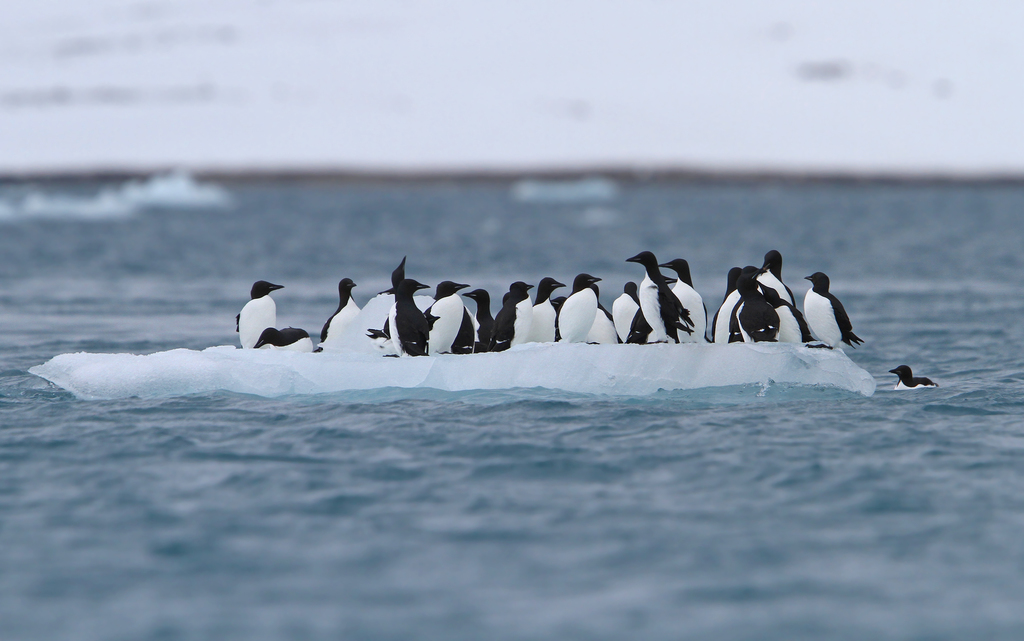
Thick-billed Murre
Photo © Christoph Moning
Photo © Christoph Moning — CC BY 4.0 — Source: iNaturalist photo #101335654Identification
The thick-billed murre is the largest living member of the auk family, measuring 40–48 cm in length with a wingspan of 64–81 cm. Adults are black on the head, neck, back and wings with contrasting white underparts. The most distinctive feature is the thick, short bill with a characteristic white gape stripe. In winter, the lower face becomes white. These birds look noticeably shorter and stockier in flight compared to their close relative, the common murre.
Key field marks for distinguishing thick-billed from common murres include the thicker, shorter bill, darker head and back, and the presence of either a white eye-stripe or white bill-stripe (but never both). First-year birds have smaller bills and less obvious markings, making head pattern the most reliable identification feature at that age.
Range & Habitat
This species is distributed across the polar and sub-polar regions of the Northern Hemisphere, with four recognized subspecies occupying different sectors. The Atlantic race inhabits coasts from northeast Canada through Greenland, Iceland, Scandinavia, and Svalbard; the Pacific race ranges from Alaska through the Aleutian Islands to Kamchatka and the Kuril Islands; while two additional subspecies occupy the Russian Arctic from the Taymyr Peninsula to the New Siberian Islands and Wrangel Island.
Thick-billed murres are pelagic birds spending their entire lives at sea in waters below 5°C, except during breeding season. They move south only in winter to maintain access to ice-free waters, ranging as far as the northernmost Atlantic and Pacific regions. They are rare vagrants to southern European countries and occasionally appear off the coasts of Britain, Ireland, and the Netherlands.
Behaviour & Diet
These auks form some of the most spectacular breeding colonies in the Northern Hemisphere, sometimes exceeding a million birds crowded onto narrow cliff ledges and steep rocky faces. Remarkably, they maintain the smallest territory of any bird species, requiring less than one square foot per individual. Despite these cramped conditions, thick-billed murres remain one of the most abundant marine birds in the Northern Hemisphere.
Breeding pairs lay a single egg annually on bare rock without constructing a nest. Both parents share incubation duties and chick-rearing responsibilities. Due to the enormous energy demands of flight, adults can only deliver one food item to their chick at a time. Chicks remain in the colony for 18 to 25 days before fledging. These birds produce harsh cackling calls at breeding colonies but remain silent at sea.
Best Time & Places to See It
The breeding season is the best time to encounter thick-billed murres, when they congregate in vast, accessible colonies on coastal cliffs. Locations with major breeding populations include Greenland, Iceland, Svalbard, and various Arctic coastal regions. For Pacific populations, the Aleutian Islands and Alaskan coasts offer excellent viewing opportunities during the breeding season when birds are concentrated and vocal.
Winter observations are challenging as birds disperse into open sea far from shore, though they remain in northernmost ice-free waters. Historically, winter movements brought flocks to the Great Lakes and St. Lawrence River region of North America, though such irruptions have not occurred since 1952.
Photography Tips
Breeding colonies offer unparalleled photographic opportunities with massive concentrations of birds in dramatic cliff-side settings. Use fast shutter speeds to capture the dynamic activity—take-offs, landings, and communal displays. The contrast between black upperparts and white underparts provides striking compositional opportunities, particularly when photographing birds against sea or rocky backgrounds.
Position yourself to backlight the white underparts while maintaining detail in the black plumage. Capture the distinctive white gape stripe and bill profile as diagnostic field marks. Early breeding season provides the best light and most active behavior, with birds performing communal displays to synchronize breeding cycles. Wide-angle lenses help convey the scale and density of these extraordinary colonies.
Arctic Ecology and Ecosystem Conservation Tour
Cape Breton Highlands National Park
Cape Breton Highlands National Park, Canada
+215 birds+18 mammals
Where the Atlantic coast of Nova Scotia rises in weathered cliffs and glacially carved valleys, Cape Breton Highlands National Park spans a landscape where boreal and…
VIEW NATIONAL PARKSouth Spitsbergen National Park
Norway
+41 birds+15 mammals
Glaciers and tundra meet in Norway's high Arctic, where South Spitsbergen National Park sprawls across the southernmost reaches of the Svalbard archipelago. Here, massive valley glaciers…
VIEW NATIONAL PARKNorthwest Spitsbergen National Park
Norway
+58 birds+17 mammals
Where the High Arctic converges with the Norwegian mainland, Northwest Spitsbergen National Park sprawls across one of Earth's most extreme and pristine wildernesses. Crowned by jagged…
VIEW NATIONAL PARKNorthern Isfjorden National Park
Norway
+40 birds+12 mammals
Where the Arctic fjord system cuts deep into Svalbard's northwestern coast, Northern Isfjorden National Park protects a landscape of stark geological drama—towering cliff faces, tidewater glaciers,…
VIEW NATIONAL PARKSirmilik National Park
Qikiqtaaluk Region, Canada
+58 birds+4 mammals
Where the Canadian Arctic archipelago fractures into a labyrinth of islands, Sirmilik National Park protects one of the High North's most pristine marine and terrestrial ecosystems.…
VIEW NATIONAL PARKL’Île-Bonaventure-Et-Du-Rocher-Percé National Park
Le Rocher-Percé, Canada
+214 birds+3 mammals
A dramatic thrust of russet sandstone pierces the Gulf of Saint Lawrence, its weathered arch framing a seascape where cool Atlantic currents sweep past cliffs alive…
VIEW NATIONAL PARKKenai Fjords National Park
Kenai Peninsula Borough, United States
+164 birds+19 mammals
Granite peaks and tidewater glaciers dominate Alaska's Kenai Peninsula, where nearly 7,900 square kilometers of pristine coastal wilderness descend from the Harding Icefield toward the Gulf…
VIEW NATIONAL PARKGlacier Bay National Park
Unorganized Borough, United States
+221 birds+15 mammals
Tidewater glaciers calving into fjords of impossible blue, where temperate rainforest rises steeply from the water's edge and alpine peaks pierce the clouds—this is the ecological…
VIEW NATIONAL PARKGros Morne National Park
Canada
+180 birds+19 mammals
Where glacier-carved fjords pierce the interior of Newfoundland, Gros Morne National Park unfolds across nearly four thousand square kilometres of some of Canada's most dramatic coastal…
VIEW NATIONAL PARKForillon National Park
Gaspé, Canada
+258 birds+16 mammals
Where the Gaspésie Peninsula juts into the Gulf of Saint Lawrence, granite cliffs and coastal headlands frame one of eastern Canada's most dramatic marine-terrestrial boundaries. Forillon…
VIEW NATIONAL PARKSassen-Bünsow Land National Park
Soere, Norway
+30 birds+10 mammals
Where Arctic tundra sprawls across glaciated plateaus in the remote Svalbard archipelago, a realm of raw geological drama unfolds. Sassen-Bünsow Land National Park encompasses a landscape…
VIEW NATIONAL PARKForlandet National Park
Vera, Norway
+38 birds+12 mammals
Windswept Arctic tundra meets jagged coastal cliffs where the Barents Sea crashes against Norway's northernmost wilderness. This sliver of protected terrain on the Nordkapp Peninsula comprises…
VIEW NATIONAL PARKSt. Paul Island
Saint Paul, United States
+255 birds+8 mammals
Windswept tundra rolls across this remote Pribilof island, where volcanic basalt cliffs plunge into the Bering Sea and fog rolls in thick enough to erase the…
VIEW PROTECTED LANDSCAPEWrangel Island Nature Reserve
Wrangel Island, Russia
+25 birds+11 mammals
Where the Chukchi Sea fractures Arctic ice beneath an unforgiving sky, a lonely island holds one of Earth's most pristine ecosystems. Wrangel Island spans tundra so…
VIEW NATURE RESERVEDisko Bay
Kitsissuarsuit, Greenland
+46 birds+9 mammals
Where Arctic fjords carve deep into Greenland's western coast, Disko Bay creates a protected landscape of extraordinary ecological complexity. The waters here merge temperate Atlantic currents…
VIEW PROTECTED LANDSCAPEScoresby Sund
Vandreblok, Greenland
+43 birds+9 mammals
Where granite peaks pierce an Arctic sky and the world's largest fjord system carves deep into northeastern Greenland, a primordial landscape unfolds in shades of ice-blue…
VIEW PROTECTED LANDSCAPENuuk Fjord System
Nuuk, Greenland
+54 birds+3 mammals
Where granite peaks plunge directly into the Arctic Ocean, a labyrinth of deep fjords carves through Greenland's southwestern coast, their waters eternally shadowed by towering rock…
VIEW PROTECTED LANDSCAPERussian Arctic National Park
Russia
+23 birds+3 mammals
Across the stark tundra of Russia's northwestern Arctic, where permafrost defines the land and sunlight dictates the rhythm of life, lies a landscape sculpted by ice…
VIEW NATIONAL PARKAcadia National Park
Bar Harbor, United States
+291 birds+27 mammals
Where the Maine coast rises in granite cliffs and spruce-clad headlands, Acadia National Park unfolds across Mount Desert Island and its surrounding waters, a landscape carved…
VIEW NATIONAL PARKKodiak National Wildlife Refuge
United States
+221 birds+22 mammals
Where temperate rainforest meets subarctic coast, Kodiak National Wildlife Refuge sprawls across Alaska's largest island, a sanctuary defined by steep valleys carved by tidewater glaciers and…
VIEW WILDLIFE SANCTUARYAlaska Maritime National Wildlife Refuge
Alaska, United States
+391 birds+58 mammals
Where the North Pacific collides with Alaska's rugged coastline, a sprawling archipelago of islands, rocky outcrops, and coastal headlands forms one of North America's most remote…
VIEW WILDLIFE SANCTUARYIzembek National Wildlife Refuge
Cold Bay, United States
+138 birds+9 mammals
Where the Aleutian archipelago reaches westward into the Bering Sea, subarctic tundra and shallow coastal waters converge to create one of Alaska's most ecologically vital wildlife…
VIEW WILDLIFE SANCTUARYBecharof National Wildlife Refuge
United States
+146 birds+2 mammals
Across southwestern Alaska's windswept lowlands, where the Bristol Bay watershed spills into vast tidal flats and sedge marshes, lies one of North America's most pristine subarctic…
VIEW WILDLIFE SANCTUARYChincoteague National Wildlife Refuge
Chincoteague, United States
+362 birds+16 mammals
Across the barrier islands and salt marshes of Virginia's Eastern Shore, where Atlantic tides sculpt an intricate mosaic of sandy spits and tidal flats, lies one…
VIEW WILDLIFE SANCTUARYPea Island National Wildlife Refuge
Dare County, United States
+356 birds+15 mammals
Where the Outer Banks taper toward the Atlantic, a sliver of barrier island creates a microcosm of coastal ecology. Pea Island National Wildlife Sanctuary spans over…
VIEW WILDLIFE SANCTUARYHolkham National Nature Reserve
North Norfolk, United Kingdom
+235 birds+11 mammals
Where Norfolk's coastal flatlands meet the North Sea, Holkham National Nature Reserve unfolds across nearly 4,000 hectares of some of England's most dynamic and least predictable…
VIEW NATURE RESERVENo community photos yet. Log in to add the first one.
No community observations of this species yet.