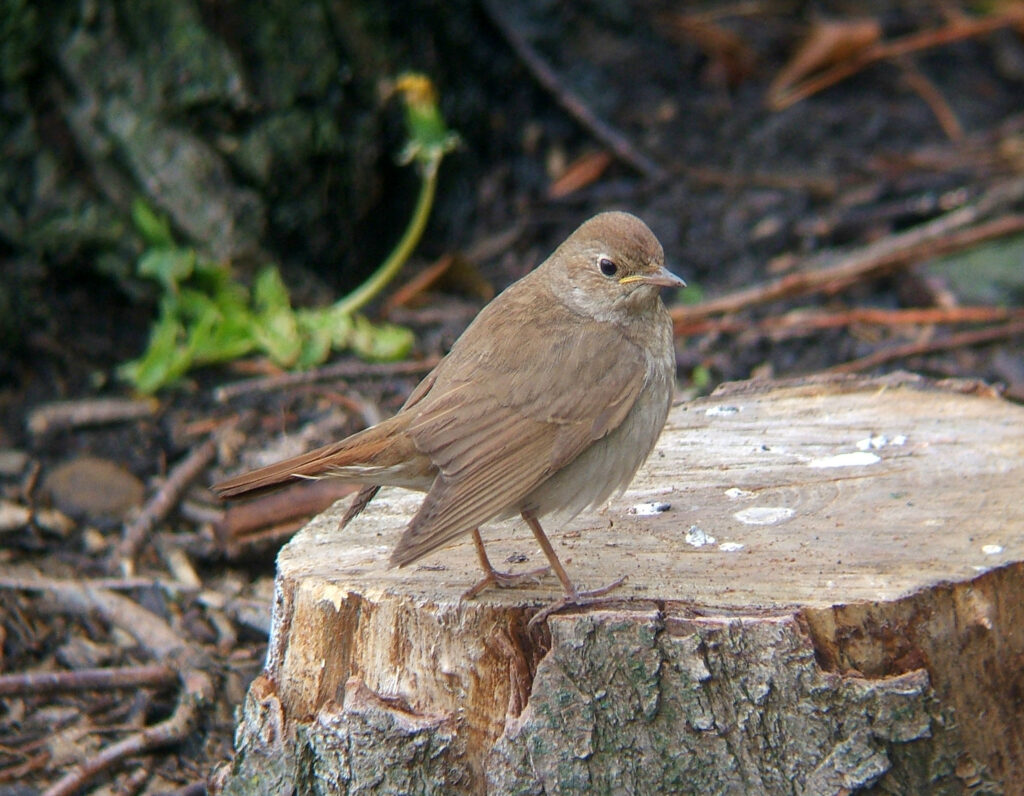
Thrush Nightingale
Photo © MPF
Photo © MPF — CC BY-SA 4.0 — Source: Wikimedia CommonsIdentification
The Thrush Nightingale is a small passerine bird, roughly the size of a European robin, measuring about 16 centimetres in length with a wingspan of approximately 18 centimetres. Both sexes are similar in appearance, displaying plain greyish-brown upper parts with a slight olive tinge that is notably deeper and less rufous than its close relative, the Common Nightingale. The underparts are white and greyish-brown, giving a cloudy appearance. Key distinguishing features include the lack of obvious rufous tail side patches present in the Common Nightingale, dark rufous-brown tail feathers, and mottled pale breast feathers with brown central bands. The lores and ear-coverts are brownish-black, while the beak, legs, and irises are dark brown. Juveniles are darker and more mottled than adults.
Range & Habitat
This migratory species breeds across eastern Europe and western temperate Asia, with its northern range extending through Denmark, southern Finland, Norway, Sweden, the Baltic States, and into Russia and Kazakhstan. Its southern breeding limit spans from Austria and the Czech Republic through Romania, Bulgaria, southern Russia, and Ukraine. The Thrush Nightingale overwinters in Africa south of the Sahara. During breeding season, it inhabits damp deciduous woodland with alder and birch, favouring thick undergrowth with brambles, dense shrubs, and tangled vegetation in swampy places near water. In winter quarters, it prefers dense patches of thorn bush in valley bottoms near watercourses and thick woodland edge vegetation.
Behaviour & Diet
This insectivore feeds primarily on the ground, consuming earthworms, spiders, and various insects including beetle adults and larvae, small moths, ants, and flies. In autumn, it supplements its diet with berries from currants and elders. Before migrating across the Sahara, Thrush Nightingales build up substantial fat reserves, a process stimulated by magnetic cues. The species is notably vocal, with males producing loud songs featuring whistles, trills, clicks, and a distinctive flute-like 'pioo' call with pure bell-like tones, occasionally interrupted by rasping sounds. The song is somewhat more solemn than that of the Common Nightingale and may be sung even in winter quarters. The call-note 'whit' is higher-pitched and more abrupt than that of its congener.
Best Time & Places to See It
During breeding season from spring through summer, Thrush Nightingales can be found in eastern European and western Asian forests, particularly in damp woodland with dense undergrowth near water. The species is an occasional visitor to the British Isles. The best approach for observing this secretive species involves visiting suitable breeding habitats in Scandinavia, the Baltic region, or eastern Europe during the breeding season, where males are most vocal. Listen for their distinctive song in early mornings and evenings in dense woodland with thick bramble and shrub cover.
Photography Tips
Photographing Thrush Nightingales presents significant challenges owing to their preference for dense undergrowth and secretive behaviour. Early morning visits to damp deciduous woodlands with thick vegetation offer the best opportunities. The species often remains concealed within brambles and dense shrubs, so patience and careful approach are essential. When visible, focus on capturing the subtle plumage details: the greyer tones of the underparts, the mottled breast pattern, and the lack of rufous tail patches that distinguish it from the Common Nightingale. A longer lens (400mm or greater) combined with a high shutter speed will help overcome the challenges posed by low-light woodland conditions and the bird's tendency to move through dense cover.
Abijata-Shalla Lakes National Park
Aggtelek National Park
Amboseli National Park
Arabuko Sokoke Forest Reserve
Arusha National Park
Awash National Park
Białowieża National Park
Biebrza National Park
Bieszczady National Park
Nothing matches these filters.
No community photos yet. Log in to add the first one.
No community observations of this species yet.