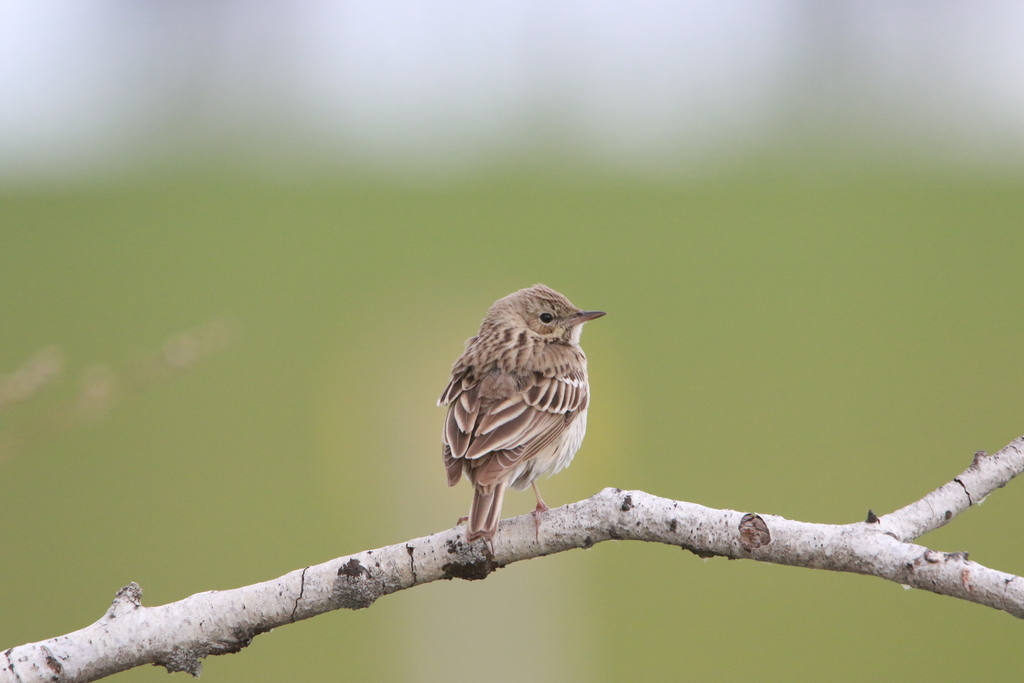
Tree Pipit
Photo © Нурхайдарова Татьяна
Photo © Нурхайдарова Татьяна — CC BY 4.0 — Source: iNaturalist photo #75346826Identification
The tree pipit is a small, rather understated passerine that can easily be confused with its close relative, the meadow pipit. Both species share a similar colour palette of brown streaking above and black markings on white underparts with a buff breast. However, the tree pipit can be distinguished by its noticeably heavier bill and the greater contrast between its buff breast and pure white belly. True to its name, tree pipits are more inclined to perch in trees than their meadow pipit cousins, a helpful behavioural clue for field identification.
Perhaps the most reliable way to identify a tree pipit is by its distinctive call and song. The call is a strong "spek"—considerably louder and more forceful than the weak call of the meadow pipit. The song flight is utterly unmistakable: the bird rises a short distance from a tree, then parachutes downward on stiff, spread wings while singing, with the song becoming increasingly drawn out as it descends.
Range & Habitat
Tree pipits breed throughout most of Europe and across the Palearctic as far east as the East Siberian Mountains. Two subspecies are recognised: the widespread A. t. trivialis, which breeds from Europe through southwest Siberia, north Iran, Turkey, east Kazakhstan, southcentral Siberia, Mongolia and northwest China; and the more localised A. t. haringtoni, which breeds in the northwest Himalayas. As long-distance migrants, tree pipits vacate their breeding grounds entirely, wintering in sub-Saharan Africa and southern Asia.
Tree pipits favour open woodland and scrub habitats, particularly lowland heath and coppiced woodland. They are most common in open woodland bordering moorland or in open-structured oak woodland that has been actively managed to create a gappy structure. They prefer medium-sized trees with relatively low canopies and an understory of low-growing scrub and brambles (less than 2 metres high), combined with a mosaic of grass and bracken. Light to moderate grazing is preferred; heavily grazed short turf is avoided.
Behaviour & Diet
Tree pipits are insectivorous, foraging primarily on the ground for invertebrates and insects, though they will supplement their diet with seeds and other plant material. During the breeding season, which runs from early May through August, pairs raise two broods. The female constructs the nest on the ground amongst grass or heather tussocks and incubates the clutch of 4–6 eggs for 12–14 days. Both parents feed the chicks, which fledge after a similar period of 12–14 days. Like many ground-nesting birds, tree pipit nests are occasionally parasitised by the common cuckoo.
Best Time & Places to See It
Tree pipits arrive in breeding territories such as the United Kingdom from mid-April onwards, following their long migration from sub-Saharan Africa. The prime breeding season runs from May through August, after which they depart between August and mid-September to return to African wintering grounds. To find tree pipits, seek out the open woodland and moorland-edge habitats they favour, particularly areas of oak woodland with active management creating a varied structure. Listen for their distinctive strong "spek" call and watch for their characteristic song-flight display rising from the trees.
Photography Tips
Photographing tree pipits can be rewarding but requires patience. Their preference for perching in trees gives you better opportunities than with ground-hugging meadow pipits, but their small size and subtle plumage demand good light and a steady hand or support. The bird's distinctive song-flight display offers a dramatic photographic opportunity: position yourself where you can observe trees used as launching points and be ready to capture the bird mid-parachute descent on stiff wings. Early morning in May and June, when territorial males are most vocal and active, offers the best chances. Focus on the head and breast to capture the diagnostic buff-and-white contrast and heavier bill that distinguish it from the meadow pipit.
Bwindi Impenetrable National Park
Kanha Tiger Reserve
Murchison Falls National Park
Queen Elizabeth National Park
Aberdare National Park
Abijata-Shalla Lakes National Park
Abruzzo, Lazio and Molise National Park
Aggtelek National Park
Alpilles Regional Nature Park
Nothing matches these filters.
No community photos yet. Log in to add the first one.
No community observations of this species yet.