Identification
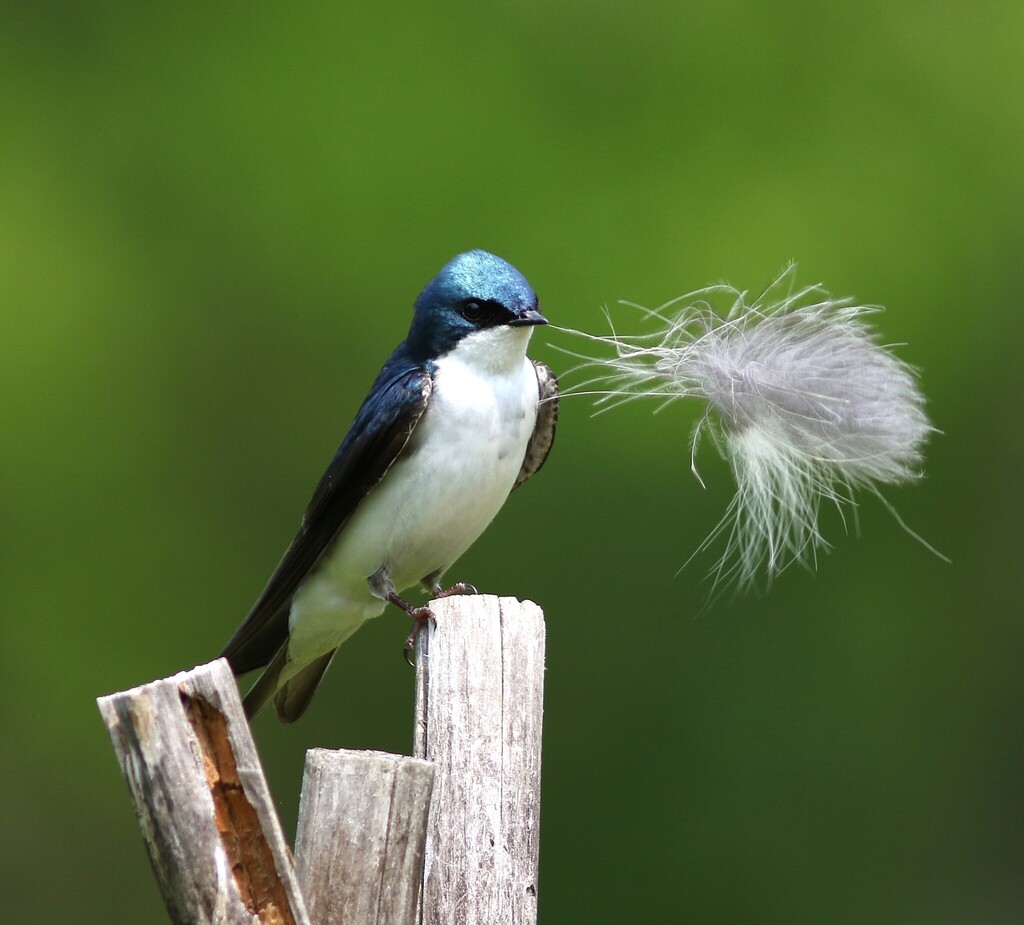
The Tree Swallow is a small, compact songbird measuring 12–14 cm in length with a wingspan of 30–35 cm. Males are unmistakable, displaying glossy blue-green upperparts contrasted sharply with pure white underparts and a white cheek patch. The wings and tail are blackish. Females are noticeably duller, often showing brownish tones on the head and upperparts, though some blue feathers may be present. First-year females are predominantly brown above with gray-brown-washed breasts. The bill is black, eyes dark brown, and legs pale brown.
Range & Habitat
The Tree Swallow breeds throughout the United States and Canada, nesting in both natural and artificial cavities, either in isolated pairs or loose groups. It is highly migratory, wintering along southern US coasts, the Gulf Coast, through Panama, and along the northwestern coast of South America, with populations also occurring in the West Indies. The species favors open areas near water where it can forage aerially for insects.
Behaviour & Diet
An aerial insectivore, the Tree Swallow forages both singly and in flocks, capturing insects mid-flight as its primary food, supplemented with mollusks, spiders, and fruit. Breeding occurs from early May through July, with clutches of two to eight pure white eggs (typically four to seven) incubated by the female for approximately 14–15 days. Chicks fledge 18–22 days after hatching and are fed by both parents. The species is generally socially monogamous, though about 8% of males are polygynous. Both adults and nestlings feed primarily on insects.
Best Time & Places to See It
Tree Swallows are most readily observed during breeding season (May–July) in their breeding range across North America, particularly near open water, marshes, and areas with suitable cavity nest sites. During migration and winter months, look for them along coastal areas, particularly the Gulf Coast, where they congregate in larger numbers. Scanning open skies over water bodies is the most effective viewing strategy.
Photography Tips
Capture the male's iridescent plumage in good lighting to showcase the glossy blue-green upperparts. Photograph birds in flight to emphasize their aerial agility, or focus on perched individuals against clear backgrounds to highlight the striking white underparts and facial pattern. Early morning light often brings out the metallic sheen of breeding males. Patience near nest boxes or cavity sites can yield behavioral images of courtship and feeding.
Tombstone Territorial Park
Acadia National Park
Alaska Maritime National Wildlife Refuge
Algonquin Provincial Park
Alligator River National Wildlife Refuge
Arches National Park
Arctic National Wildlife Refuge
Arenal Volcano National Park
Badlands National Park
Nothing matches these filters.
No community photos yet. Log in to add the first one.
No community observations of this species yet.