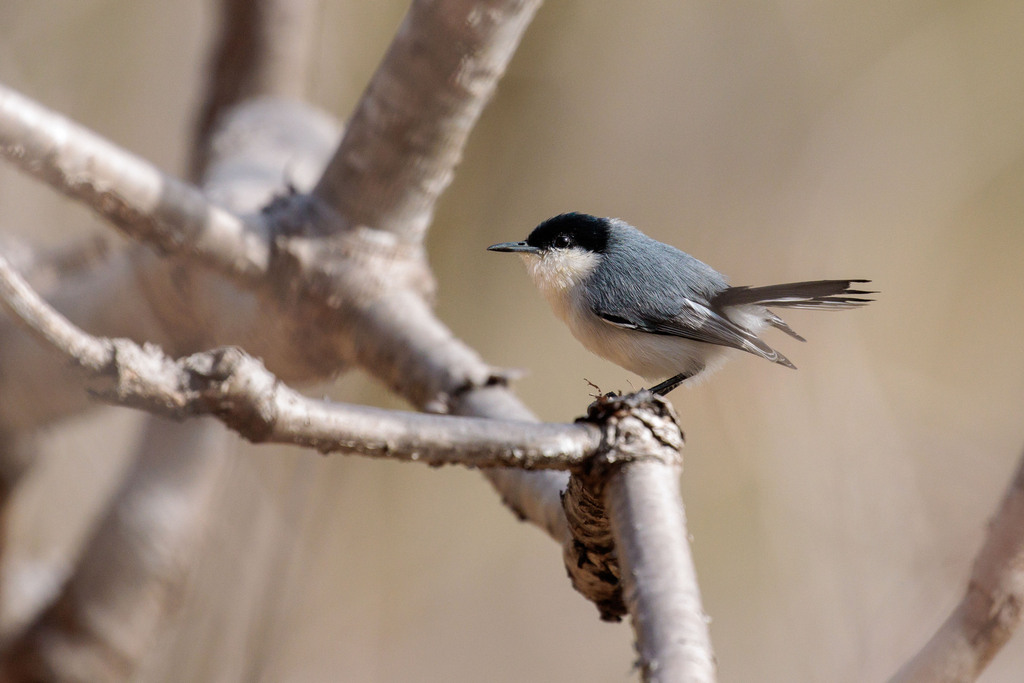
Tropical Gnatcatcher
Photo © Thomaz de Carvalho Callado
Photo © Thomaz de Carvalho Callado — CC BY 4.0 — Source: iNaturalist photo #566477422Identification
The tropical gnatcatcher is a diminutive songbird, measuring just 10–12 cm and weighing 6–8 g. Like all gnatcatchers, it displays the family's characteristic features: a slender, pointed bill, grey upperparts, whitish underparts, and a notably long tail that is frequently cocked. The tail's central feathers are black while the outer feathers are white, creating a striking two-toned appearance—predominantly black from above, white from below. A white wing patch formed by broad edging on the tertial feathers adds further distinction.
Sexual dimorphism is evident in the nominate subspecies. Males sport a contrasting black cap extending just below the eye, while females lack this marking and instead display a grey cap matching their back; some females show an irregular black patch behind the eye. The species' vocalizations include a thin, buzzy call and a trilled song, though voice structure and tone vary considerably across its range.
Range & Habitat
This resident species occupies a large portion of northern South America, with two main population groups. The nominate group ranges from northeastern Brazil's Caatinga region westward through the Amazon Basin to the Guianas, northern Venezuela, and northern Colombia, including the Magdalena and Cauca valleys. A second group extends from northwestern Peru through the Chocó and Central America to southern Mexico.
Tropical gnatcatchers inhabit diverse wooded environments, from arid scrublands such as the Caatinga to humid forests throughout the Amazon. They are primarily lowland birds, typically below 1,000 m altitude. In dense humid forest they favour canopy height, but move to lower levels in more open habitats. The species appears rather local in Amazonian várzea forests and other relatively open woodlands.
Behaviour & Diet
An active insectivore, the tropical gnatcatcher gleans spiders, spider eggs, beetles, caterpillars, and other small arthropods from outer twigs and foliage. It typically forages alone or in pairs but readily joins mixed-species feeding flocks alongside tanagers, New World warblers, and honeycreepers. The species is notably curious and shows little fear of humans, a trait that paradoxically renders it vulnerable to both aerial and ground predators.
Nesting involves construction of a small cup-shaped nest resembling a hummingbird's, built from vegetable fibres 2–8.5 m high on tree branches. Females lay two or three white eggs spotted with brown during May and June. Despite defensive efforts, nests are frequently raided by various predators including small omnivorous mammals such as common marmosets, particularly during dry seasons when fruit scarcity drives increased nest predation.
Best Time & Places to See It
This species is common and widespread throughout most of its range, making it a reliable sighting for travellers exploring northern South American habitats. Look for it in appropriate woodland and scrubland during the dry season months, when the birds are more active and visible. The breeding season of May–June offers opportunities to observe territorial and nesting behaviour, though birds remain relatively approachable year-round.
The species thrives in várzea forests and semi-open woodland habitats across the Amazon, the Guianas, Venezuela, and Colombia. Its lack of fear toward humans and constant activity make it a rewarding subject even in inhabited or disturbed areas where forest remains. Mixed-species flocks provide excellent opportunities for observation and photography.
Photography Tips
The tropical gnatcatcher's diminutive size and frequent tail-cocking habit demand a steady hand and adequate focal length—at least 400–500 mm is recommended. The bird's constant, rapid movement through foliage requires continuous autofocus and fast shutter speeds (1/1000 s or faster). Early morning light is ideal for capturing the subtle grey and white plumage details and the striking tail pattern.
Position yourself quietly near mixed-species feeding flocks to increase encounter probability. The species' lack of wariness permits closer approach than many forest birds, but patience and stillness yield the best results. Backlighting can effectively highlight the white outer tail feathers and wing patches, adding visual impact to images. Avoid sudden movements, as this may trigger the bird's vulnerable defensive response that makes it prone to predation.
Yasuní National Park
Aguarico, Ecuador
+601 birds+43 mammals
Where the western Amazon basin converges with Ecuador's Orellana Province, lowland rainforest reaches toward the horizon in an unbroken canopy of staggering botanical density. Yasuní National…
VIEW NATIONAL PARKNatural Farallones de Cali National Park
Buenaventura, Colombia
+733 birds+27 mammals
Where the Pacific coastal plain meets the western slopes of the Andes, Farallones de Cali National Park sprawls across nearly 3,500 square kilometers of dramatic topography…
VIEW NATIONAL PARKMorrocoy National Park
Municipio Silva
+290 birds
Where the Caribbean coast of northwestern Venezuela meets protected coastal waters, a mosaic of mangrove forests, sandy beaches, and coral reef systems defines Morrocoy National Park.…
VIEW NATIONAL PARKNatural Bahía Portete Kaurrele National Park
Colombia
+80 birds
Where the Caribbean coast of La Guajira rises to meet arid scrubland and seasonal wetlands, Natural Bahía Portete Kaurrele National Park spans 251 square kilometres of…
VIEW NATIONAL PARKNatural Sierra de la Macarena National Park
Vista Hermosa, Colombia
+566 birds+15 mammals
Across nearly 20,000 square kilometres of Colombia's Meta Department, the terrain rises from lowland savanna into Andean foothills through a mosaic of gallery forests, palm-fringed wetlands,…
VIEW NATIONAL PARKViruá National Park
Brazil
+389 birds+6 mammals
Across the northern frontier of Roraima, where the forest canopy rises from ancient Amazonian lowlands, Viruá National Park protects nearly 3,700 square kilometres of terra firme…
VIEW NATIONAL PARKSerra do Teixeira National Park
Brazil
+160 birds+5 mammals
Rugged plateaus and deep escarpments define this 3,112-square-kilometre sweep of the Brazilian Northeast, where the crystalline bedrock of the Borborema Plateau rises abruptly from the surrounding…
VIEW NATIONAL PARKSerra da Capivara National Park
Brazil
+156 birds+6 mammals
Across the semi-arid plateaus and deeply incised canyons of northeastern Brazil, where Piauí's ancient sandstone formations rise and fall in weathered waves, Serra da Capivara National…
VIEW NATIONAL PARKSete Cidades National Park
Brazil
+125 birds+1 mammals
Sete Cidades sprawls across 113 square kilometres of northeastern Brazil's interior plateau, where weathered sandstone formations rise dramatically from the cerrado landscape. The park's geology tells…
VIEW NATIONAL PARKCatimbau National Park
Brazil
+118 birds+6 mammals
Where sandstone plateaus rise from the semi-arid scrublands of northeastern Brazil, Catimbau National Park unfolds across more than 1,000 square kilometres of geological drama and surprising…
VIEW NATIONAL PARKJaú National Park
Brazil
+354 birds+3 mammals
Vast floodplain forests and blackwater rivers define this remote corner of western Amazonas, where the Rio Negro and its tributaries have carved an intricate mosaic of…
VIEW NATIONAL PARKAnavilhanas National Park
Brazil
+468 birds+8 mammals
Across the Rio Negro in central Amazonas, an archipelago of over a thousand islands rises from the world's largest rainforest river system, creating a labyrinth of…
VIEW NATIONAL PARKSierra del Divisor National Park
Alto Tapiche, Peru
+298 birds+2 mammals
Where the western Amazon meets the Andes foothills, nearly 41,000 square kilometres of pristine rainforest rise across Peru's Alto Tapiche region in a landscape of extraordinary…
VIEW NATIONAL PARKNo community photos yet. Log in to add the first one.
No community observations of this species yet.