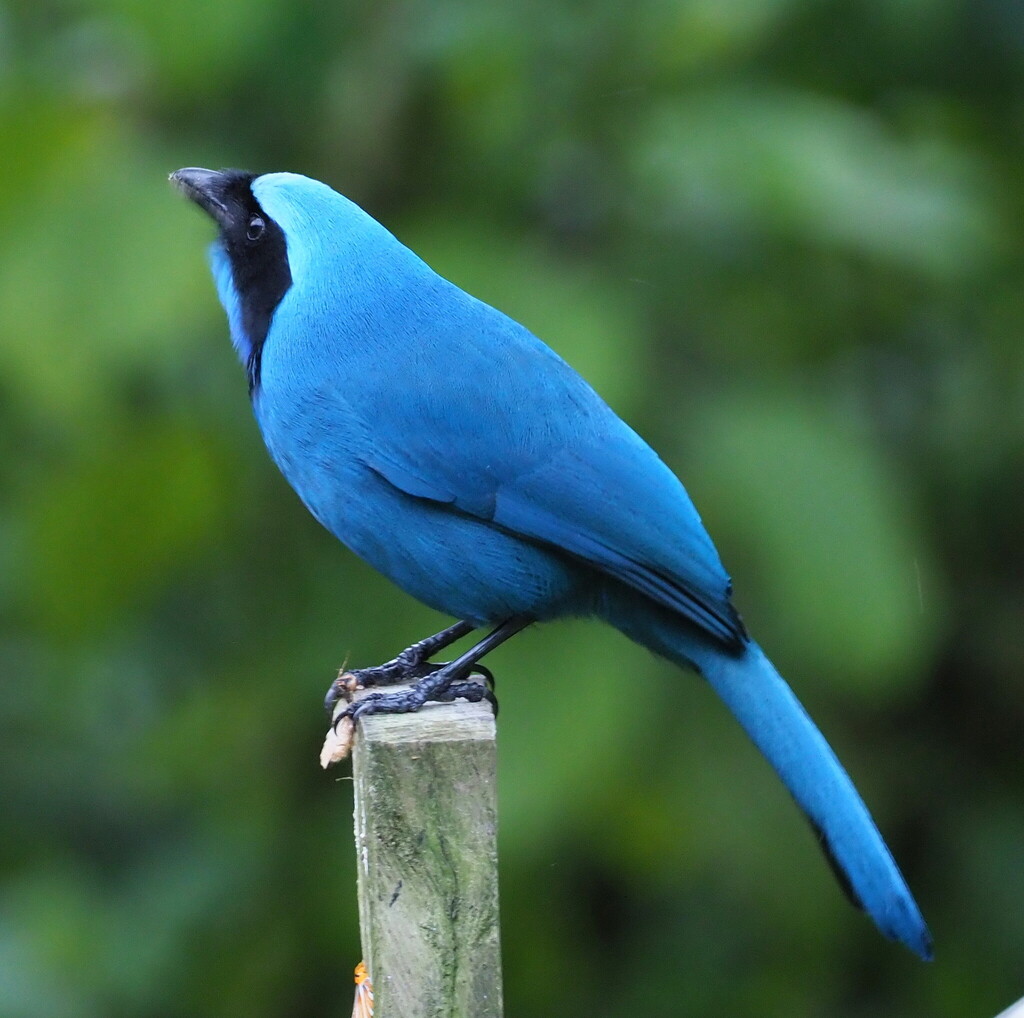
Turquoise Jay
Photo © Rosario Douglas
Photo © Rosario Douglas — CC BY 4.0 — Source: iNaturalist #296123679The turquoise jay (Cyanolyca turcosa) is a species of bird in the family Corvidae. The turquoise jay is a vibrant blue jay with a black face mask and collar. It is found exclusively in South America throughout southern Colombia, Ecuador, and northern Peru. The turquoise jay prefers a humid habitat of montane evergreen forest and elfin forest with both primary and secondary growth. This bird is omnivorous and is known to eat insects, berries, eggs, and young birds of other species. Turquoise jays are nonmigratory and tend to travel in mixed flocks. == Taxonomy == === Order and family === The order Passeriformes, commonly referred to as "perching birds", is the largest and most diverse order of birds. These birds are found worldwide, excluding Antarctica, but have their highest concentration in the tropics. Their sizes range from just a few grams to over a kilogram in weight, and they are generally colorful songbirds. The family Corvidae is in the order Passeriformes and includes the jays, magpies, and crows. Most of the birds are strongly built, are stout-billed, and are some of the largest birds in Passeriformes. In most cases there exists no sexual dimorphism. Corvids have loud, harsh voices and…
Sangay National Park
Cebadas, Ecuador
+320 birds+10 mammals
High in Ecuador's Andean spine, where the Western Cordillera rises to touch perpetual snow, a landscape of volcanic drama and ecological intensity unfolds across Sangay National…
VIEW NATIONAL PARKRío Negro-Sopladora National Park
Chontal, Ecuador
+84 birds
Where the eastern cordillera of Ecuador descends toward the Amazon basin, the Río Negro-Sopladora National Park sprawls across 615 square kilometers of montane forest and riverine…
VIEW NATIONAL PARKPodocarpus National Park
Zamora, Ecuador
+496 birds+6 mammals
Where the Andes descend toward the Amazon basin, Podocarpus National Park sprawls across nearly 2,800 square kilometres of the most biodiverse terrain in Ecuador's southern highlands.…
VIEW NATIONAL PARKYacuri National Park
Las Juntas, Ecuador
+166 birds+1 mammals
Where the eastern slopes of the Andes descend into Ecuador's southern frontier, Yacuri National Park unfolds across nearly 1,300 square kilometers of montane cloud forest and…
VIEW NATIONAL PARKSumaco Napo-Galeras National Park
Loreto, Ecuador
+563 birds+4 mammals
Where Ecuador's Amazon transitions into cloud forest, a massive shield volcano rises from the emerald lowlands of Orellana Province, anchoring one of the continent's most biodiverse…
VIEW NATIONAL PARKAntisana National Park
Quijos, Ecuador
+432 birds+21 mammals
Where the eastern Andean slopes descend into the Amazon basin, Antisana National Park sprawls across roughly 2,500 square kilometers of some of South America's most dramatic…
VIEW NATIONAL PARKCotopaxi National Park
Mulaló, Ecuador
+211 birds+6 mammals
High in Ecuador's volcanic corridor, where the páramo transitions into cloud forest along the slopes of Cotopaxi volcano, the national park unfolds across nearly 500 square…
VIEW NATIONAL PARKLlanganates National Park
Tena, Ecuador
+239 birds+8 mammals
Where the eastern slopes of the Andes plunge toward the Amazon basin, Llanganates National Park sprawls across nearly 3,500 square kilometers of montane wilderness, its terrain…
VIEW NATIONAL PARKCajas National Park
Cuenca, Ecuador
+190 birds+7 mammals
High in the Andes above Cuenca, where elevation ranges from 3,100 to 4,200 metres, the páramo landscape dominates—a windswept realm of cushion plants, alpine grasses, and…
VIEW NATIONAL PARKNo community photos yet. Log in to add the first one.
No community observations of this species yet.