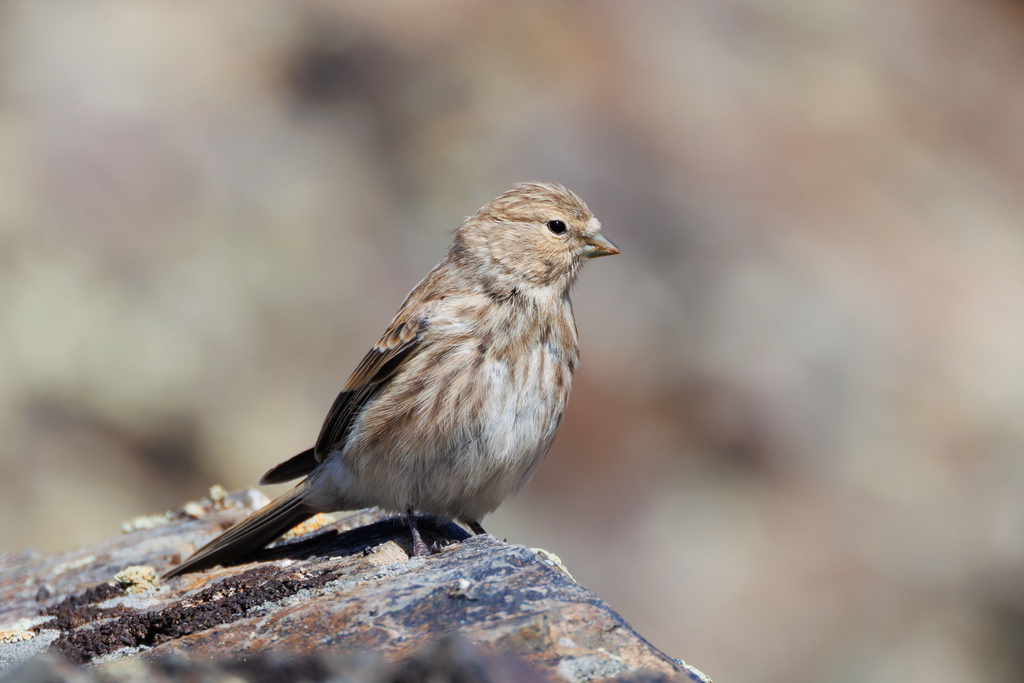
Twite
Photo © Михаил Голомысов
Photo © Михаил Голомысов — CC BY 4.0 — Source: iNaturalist photo #563305919Identification
The twite is a small finch, measuring 13 to 13.5 cm long, with a compact build similar to a linnet. It is predominantly brown, streaked with black on the upperparts. The most distinctive feature in breeding males is a pink rump, while females and immatures show a brown rump instead. The underparts are buff to whitish with brown streaking. The conical bill is particularly useful for identification: it appears yellow in winter and grey in summer. Twites lack the red head patch and breast markings characteristic of linnets and redpolls, making them readily distinguishable from these close relatives.
The bird's call is instantly recognizable—a very distinctive nasal "twaa-it" from which its common name derives. The song features fast trills and twitters. Subspecific variation occurs across the range, with British and Irish birds (L. f. pipilans) being the darkest due to their hyper-humid oceanic climate, while Asian subspecies inhabiting drier mountain regions are considerably paler.
Range & Habitat
The twite has a strongly disjunct distribution spanning northern Europe and the Palearctic across to Siberia, China, and the Asian mountains from eastern Turkey to Nepal, western China, and Mongolia. In Asia, the species breeds at extremely high altitudes, typically between 3,600 and 4,900 meters in alpine grasslands and low shrubland. By contrast, northwestern European populations breed in much cooler oceanic climates and occupy much lower elevations, including coastal areas down to sea level in northwestern Ireland, western and northern Scotland, and Norway. Here, they are strongly associated with traditional low-intensity farming on coastal machair grassland.
The twite is partially migratory. Many birds remain year-round in breeding areas, while others migrate southward or shift to coastal regions during winter. The species has experienced sharp population declines in parts of its range, notably in Ireland, making it increasingly important to monitor and protect remaining populations.
Behaviour & Diet
Twites are primarily granivorous, feeding mainly on small seeds, though they occasionally supplement their diet with insects. Outside the breeding season, they often form large flocks, sometimes mixing with other finch species, particularly on coasts and salt marshes where they congregate to exploit seasonal seed availability.
During breeding, females construct nests either on the ground or low in bushes, typically laying 3 to 6 eggs. The eggs are light or dark blue with variable dark purplish-brown speckling concentrated toward the broad end. Incubation lasts 12 to 13 days and is performed by the female alone. Young fledge at 11 to 12 days of age and continue to receive parental care for approximately two weeks after leaving the nest. Ringing studies in Britain reveal that twite populations show remarkable fidelity to specific non-breeding areas, with birds from different breeding regions moving to separate wintering grounds that do not overlap with continental populations.
Best Time & Places to See It
For European observers, the twite is best sought in its breeding grounds during late spring and summer in northern Scotland, northwest Ireland, and Scandinavia, where birds occupy coastal machair grasslands and low moorland. Winter offers alternative opportunities to find twites as they congregate on coasts and salt marshes, particularly along the Lancashire coast, the Hebrides, Flintshire in Wales, and southeastern coastal regions. Large flocks may gather during migration periods, offering excellent viewing opportunities for patient observers.
Asian travelers should target high-altitude mountain habitats from eastern Turkey through the Caucasus, Central Asian ranges, and Himalayan foothills during the breeding season. The extreme altitudes (3,600–4,900 m) of Asian populations mean that specialist mountain birding expeditions are typically required to encounter these more remote subspecies.
Photography Tips
The twite's small size and preference for open habitats on coasts and grasslands make it accessible to photographers willing to work from a distance. A telephoto lens (at least 400–600 mm) is essential given their tendency to flush easily. Winter flocks on salt marshes and coastal areas provide excellent opportunities for flock photography and behavioral documentation. The pale plumage of Asian subspecies contrasts well against darker mountain backgrounds, while the darker British birds require careful exposure metering to retain detail in brown tones.
Capture diagnostic features by focusing on the rump coloration (pink in males), the yellow winter bill, and the streaked underparts. Early morning light on coastal breeding grounds reveals plumage details beautifully. The bird's distinctive call can also be recorded, making audio documentation a worthwhile complement to photography work.
Altai Tavan Bogd National Park
Altun Mountain National Nature Reserve
Biebrza National Park
Caerlaverock National Nature Reserve
Cairngorms National Park
Connemara National Park
De Weerribben-Wieden National Park
Dovrefjell-Sunndalsfjella National Park
Drentsche Aa National Park
Nothing matches these filters.
No community photos yet. Log in to add the first one.
No community observations of this species yet.