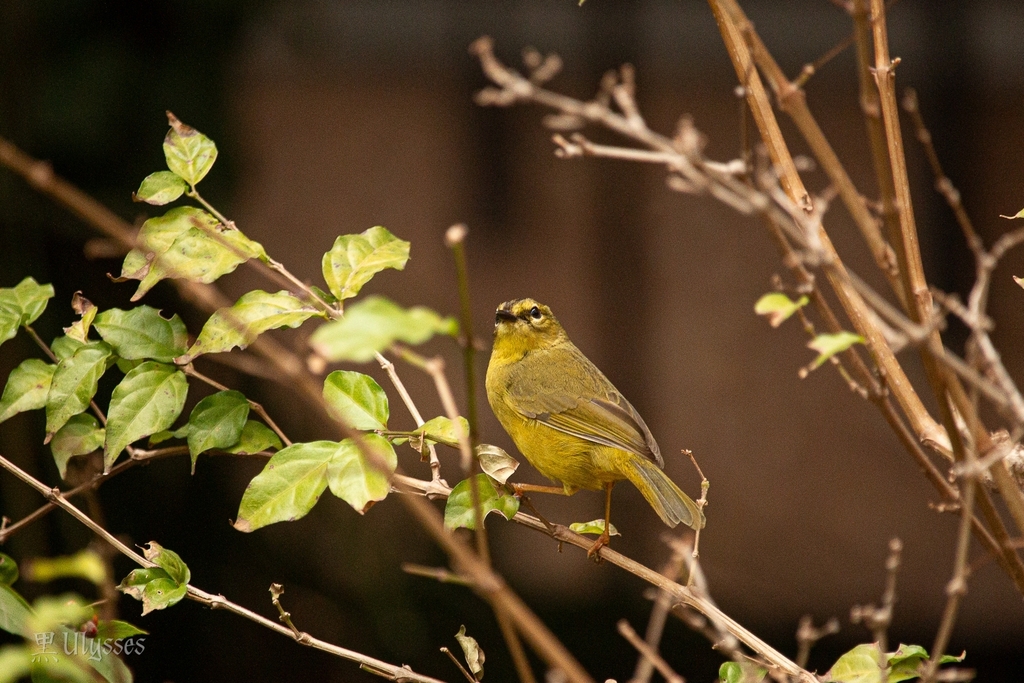
Two-banded Warbler
Photo © Gaspar
Photo © Gaspar — CC BY 4.0 — Source: iNaturalist photo #534833351Identification
The two-banded warbler is a small warbler, measuring 12.5 to 14 cm in length. Both sexes display identical plumage. The nominate subspecies M. b. bivittata features a distinctive black crown with an orange-rufous central stripe, dusky lores, and a yellow supercilium that forms a crescent above the eye, complemented by a buffy-white to yellow crescent below. The nape and upperparts are olive-green, while the throat and underparts are predominantly yellow with pale olive wash on the sides of the breast and flanks. The subspecies M. b. argentinae shows a mostly yellow central crown stripe with more olive feather tips and slightly paler upperparts, while M. b. roraimae lacks olive on the black crown feathers and has fainter eye crescents. All adults possess a dark brown iris, blackish-brown upper mandible, and brown lower mandible with pinkish base.
Range & Habitat
The two-banded warbler occupies a disjunct range across northern and central South America, including Venezuela, Guyana, Brazil, Peru, Bolivia, and Argentina. The subspecies M. b. roraimae inhabits tepuis in southeastern Venezuela and western Guyana at elevations between 700 and 1,800 meters, favoring humid primary and secondary forest interiors and edges. The nominate subspecies and M. b. argentinae range along the eastern Andean slopes from Peru through Bolivia to northern Argentina, inhabiting diverse forest types from 300 to 2,200 meters elevation. These latter subspecies prefer areas with dense understory vegetation, often associating with bamboo thickets.
Behaviour & Diet
This is a sedentary, year-round resident that does not migrate. The two-banded warbler forages primarily in the forest understory between 2 and 10 meters above ground, though it will occasionally ascend to the canopy. It gleams invertebrate prey from vegetation and branches, likely comprising the majority of its diet, though specific dietary details remain understudied. Pairs and family groups typically forage together and rarely join mixed-species feeding flocks.
Best Time & Places to See It
The best opportunities to observe this species vary by subspecies. For M. b. roraimae, seek this warbler on Venezuelan and Guyanese tepuis during the austral summer months when breeding activity peaks in February and March. In Peru and Bolivia, the nominate subspecies and M. b. argentinae are most active during their breeding season from September to December. Look for them in montane forests with dense understory and bamboo thickets at mid-elevations; early mornings offer the best chance of detecting their distinctive vocalizations and observing foraging activity.
Photography Tips
Photographing the two-banded warbler requires patience and knowledge of forest habitats. Focus on dense understory regions where the species typically forages between 2 and 10 meters elevation. The species' preference for thick vegetation demands positioning yourself where light penetrates the forest interior. Early morning light is crucial for capturing the subtle coloring of the crown stripe and eye markings. Listening for the distinctive songs—the accelerating series of notes in roraimae or the deep, rich warble of the nominate subspecies—will help you locate individuals. Since pairs and family groups forage together, finding one bird often leads to photographing multiple subjects in their natural understory habitat.
Monte Roraima National Park
Brazil
+226 birds+1 mammals
Where the tepuis rise from the Amazon basin like islands in a sea of forest, Monte Roraima National Park sprawls across 3,714 square kilometres of one…
VIEW NATIONAL PARKManu National Park
Manu, Peru
+892 birds+26 mammals
Across the eastern slopes of the Peruvian Andes, tropical rainforest descends into the Amazon basin with a complexity that few terrestrial ecosystems match. Manu National Park…
VIEW NATIONAL PARKBahuaja Sonene National Park
San Pedro de Putina Punco, Peru
+602 birds+8 mammals
Where the Madre de Dios and Heath rivers converge in southeastern Peru rises one of South America's most biodiverse wilderness regions: a vast protected realm of…
VIEW NATIONAL PARKEl Rey National Park
Municipio de Las Lajitas, Argentina
+317 birds+4 mammals
Where the eastern slopes of the Andes descend into northwestern Argentina's subtropical transition zone, El Rey National Park unfolds across 841 square kilometers of dramatically varied…
VIEW NATIONAL PARKCalilegua National Park
Municipio de Calilegua, Argentina
+288 birds+8 mammals
Where the eastern Andean slopes plunge into northwestern Argentina's humid subtropics, nearly 2,645 square kilometers of steep terrain and luxuriant forest compose one of South America's…
VIEW NATIONAL PARKBaritú National Park
Argentina
+81 birds+2 mammals
Where the eastern slopes of the Serranías del Hornocal descend into cloud forest and subtropical ravines, Baritú National Park protects one of northwestern Argentina's most biodiverse…
VIEW NATIONAL PARKNo community photos yet. Log in to add the first one.
No community observations of this species yet.