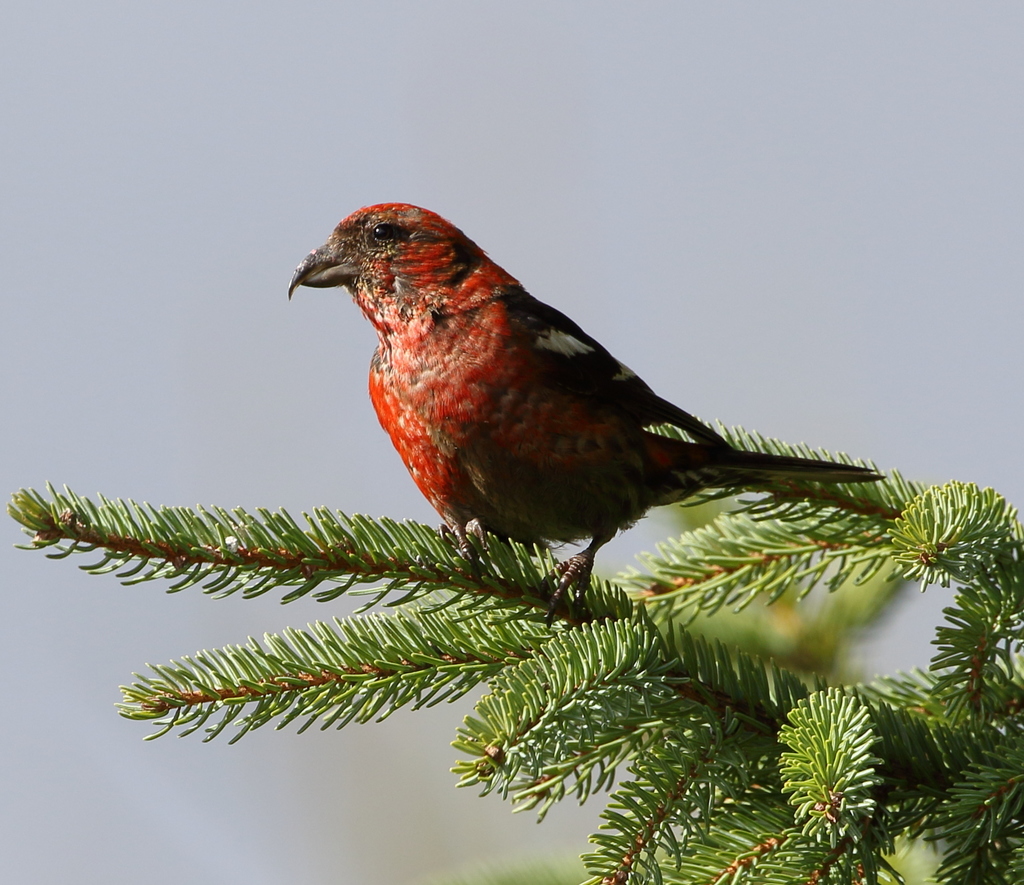
Two-barred Crossbill
Photo © David Bird
Photo © David Bird — CC0 1.0 — Source: iNaturalist photo #11206802Identification
The two-barred crossbill is a small finch measuring 14.5–17 cm in length, with a distinctive crossed bill and two prominent white wing-bars that make it relatively easy to identify. Males display bright raspberry-red plumage on the forehead, crown, nape and upper parts, with black or blackish-brown scapulars edged in pink. Females lack the pink coloring and instead show greenish-yellow head and upperparts. The white tips on the tertials and the characteristic white wing-bars distinguish this species from the similar red crossbill, which occasionally shows only weak wing-bars. The male two-barred crossbill is also noticeably brighter and pinker than other male crossbills, and its chip call is weaker and higher-pitched than that of the red crossbill.
Range & Habitat
This species breeds across the coniferous forests of Alaska, Canada, the northernmost United States, and throughout the Palearctic region extending into northeast Europe. Two subspecies are recognized: the nominate subspecies (L. l. leucoptera) in North America, and L. l. bifasciata found from northern Europe eastward through Siberia to northeast China. While primarily resident, two-barred crossbills will irregularly irrupt southward when food sources fail, with the American race showing more frequent wandering than the Eurosiberian subspecies. In winter, they often form mixed flocks with other crossbill species and are rare visitors to western Europe, typically arriving alongside red crossbill irruptions.
Behaviour & Diet
The two-barred crossbill is a specialist feeder on conifer cones, with its uniquely crossed bill perfectly adapted for extracting seeds. It shows a strong preference for larch species, particularly Siberian and Dahurian larch in Eurasia and Tamarack larch in North America. The diet is supplemented with rowan berries and, in North America, eastern hemlock and white spruce cones. During breeding season, females construct nests 2–20 meters above ground using conifer twigs, usually positioned against a conifer trunk. Clutches typically contain 3–4 eggs, incubated by the female for 14–15 days, with both parents feeding the chicks. Young fledge after 22–24 days but remain dependent on their parents for up to 6 weeks.
Best Time & Places to See It
Winter offers the best opportunities to observe two-barred crossbills, particularly during years when seed crop failures trigger southern irruptions. In North America, focus efforts on coniferous forests of Alaska and Canada, where the species is most predictable. Western Europe may receive occasional winter visitors during major irruption events. Scanning larch and spruce forests in the early morning when birds are most active feeding will maximize your chances. Outside of irruption years, the species remains resident in northern boreal forests, making it challenging to locate except within its core breeding range.
Photography Tips
The two-barred crossbill's small size and high elevation habitat present challenges, so use a telephoto lens of at least 500mm to capture detail. The birds' colorful plumage—particularly the striking white wing-bars and bright red males—photographs best in soft, diffused light. Aim to shoot early morning when birds are feeding actively in the canopy, moving slowly through coniferous forests to avoid flushing flocks. The distinctive crossed bill and white wing-bars are diagnostic features worth emphasizing in your images. Winter light can be harsh, so overcast conditions are ideal for revealing the subtle pink tones of the males and the warm yellow-green of females without blown highlights.
Tombstone Territorial Park
Acadia National Park
Alaska Maritime National Wildlife Refuge
Algonquin Provincial Park
Arctic National Wildlife Refuge
Banff National Park
Becharof National Wildlife Refuge
Bic National Park
Cape Breton Highlands National Park
Nothing matches these filters.
No community photos yet. Log in to add the first one.
No community observations of this species yet.