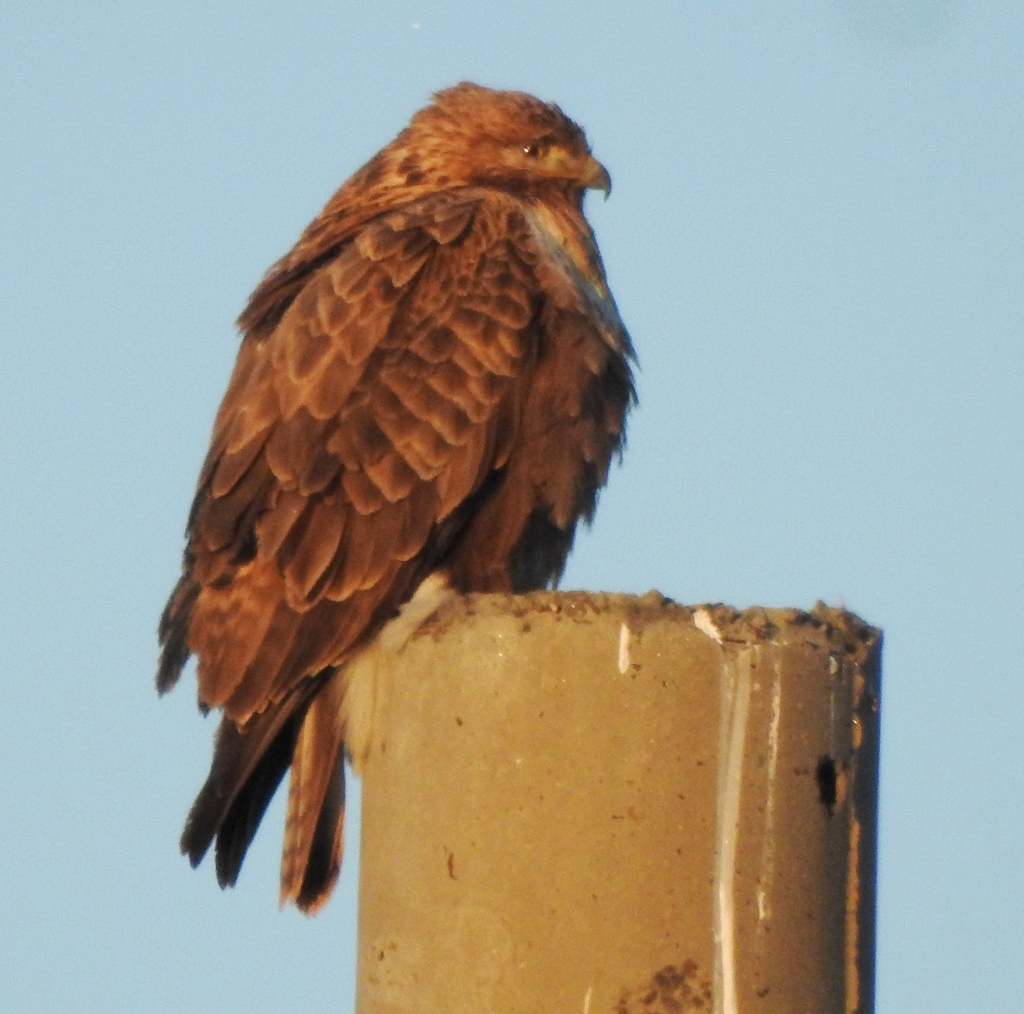
Upland Buzzard
Photo © Анна Васильченко
Photo © Анна Васильченко — CC BY 4.0 — Source: iNaturalist #105202119Identification
The upland buzzard is the largest member of the Buteo genus, with a total length of 57 to 72 cm and a wingspan of 143 to 161 cm. It is a conspicuously large and long-winged buzzard with a relatively long tail and fairly eagle-like proportions compared to related species. The bird occurs in both pale and dark morphs. Pale morph birds are generally beige and earthy dark brown, with a whitish chest contrasted by dark brown areas on the lower breast and abdomen, dark flanks and belly, and a greyish tail with dark bands. In flight, pale morphs show variable major coverts with a distinctive strong blackish patagium mark and whitish flight feathers with dark barring. Dark morph birds are almost entirely solid black-brown throughout. A characteristic feature is heavily feathered "trousers" covering at least three-quarters of the legs, rivalling the ferruginous hawk and rough-legged buzzards in insulation.
The upland buzzard is often confused with the similar long-legged buzzard, which overlaps in range and plumage. However, the upland species is slightly larger and lacks the warmer, rufous tones of the long-legged buzzard, typically showing more earthen brown coloration. The smaller Himalayan and eastern buzzards can be distinguished by their conspicuously smaller size and proportions, shorter wings and tails, and differently marked plumage with paler bellies and less strongly contrasting wing patterns. The upland buzzard's call is a prolonged nasal mewing similar to the common buzzard, though it vocalizes less frequently.
Range & Habitat
The upland buzzard inhabits mountainous grassy and rocky areas across Central Asia, northern South Asia, and East Asia, with its range extending from Kazakhstan to Korea. The central portion of its breeding range comprises much of Mongolia and China, particularly in western, northern, and northeastern areas of China. This little-known raptor has a large range and is generally uncommon throughout its distribution, though it is not thought to be rare or declining as a species.
The species is migratory but typically covers only short distances, apparently to avoid snow cover that may hamper prey capture. This short-distance migration strategy suggests movements within or between upland regions rather than long intercontinental journeys, keeping the bird in suitable habitat year-round.
Behaviour & Diet
The upland buzzard primarily subsists on small mammals, which form the bulk of its diet. However, this opportunistic predator does not shun alternate prey, including small to large birds and insects. This dietary flexibility allows the species to adapt to varying prey availability across its mountainous range.
Best Time & Places to See It
The upland buzzard's vast range across Central Asia, Mongolia, China, and East Asia offers multiple opportunities for observation, though the species is generally uncommon. The central breeding range in Mongolia and China, particularly in western, northern, and northeastern areas, represents the most likely regions to encounter this species. As a short-distance migrant, the buzzard's presence may vary seasonally depending on snow cover and prey availability.
Photography Tips
Photographing upland buzzards presents challenges due to their remote mountainous habitats and generally uncommon status. Look for birds perched on rocky outcrops or ridges in high-elevation terrain where they can scan for small mammals. The heavily feathered legs are a distinctive field mark worth capturing, as are the strongly contrasting wing patterns visible in flight, particularly the blackish patagium mark on pale morph birds. Be prepared for variable lighting conditions in mountainous regions and position yourself to capture the bird's large wingspan and eagle-like proportions. Dark morph individuals present particular challenges for identification and photography due to their uniform coloration.
Langtang National Park
Helambu, Nepal
+364 birds+14 mammals
Where the southern slopes of the Himalayan highlands descend toward the subtropical valleys of central Nepal, Langtang National Park sprawls across one of the subcontinent's most…
VIEW NATIONAL PARKSagarmatha National Park
Khumjung, Nepal
+219 birds+7 mammals
Soaring peaks and deep glacial valleys define this alpine wilderness in northeastern Nepal, where the terrain rises from forested foothills into a realm of high-altitude tundra…
VIEW NATIONAL PARKKhangchendzonga National Park
Sakkyong, India
+290 birds+1 mammals
Where the eastern Himalayas surge toward their crowning peaks, Khangchendzonga National Park embraces a landscape of almost overwhelming vertical drama. Rising from subtropical river valleys into…
VIEW NATIONAL PARKBaikal National Park
Ольхонский район, Russia
+184 birds+11 mammals
Where the world's deepest freshwater lake meets ancient Siberian taiga, Baikal National Park sprawls across 66,203 square kilometers of one of Earth's most singular ecosystems. The…
VIEW NATIONAL PARKGiant Panda National Park
Mianyang, China
+447 birds+47 mammals
Where the eastern slopes of China's Sichuan plateau descend into cloud-wrapped valleys, one of Asia's most biodiverse landscapes unfolds across more than 350,000 square kilometres. This…
VIEW NATIONAL PARKJiuzhai Valley
Jiuzhaigou County, China
+226 birds+7 mammals
Where crystalline alpine streams cascade through limestone gorges and karst terrain rises in dramatic vertical walls, Jiuzhai Valley unfolds across nearly 1,300 square kilometers of southwestern…
VIEW NATURAL MONUMENTHuanglong Scenic and Historic Interest Area
Ngawa Tibetan and Qiang Autonomous Prefecture, China
+194 birds+7 mammals
Across the high plateau of northwestern Sichuan, a geological wonder unfolds where limestone terraces and mineral-rich springs have sculpted one of China's most distinctive natural monuments.…
VIEW NATURAL MONUMENTHemis National Park
Raigahar Dhar, India
+131 birds+13 mammals
Where granite gorges cleave through the Himalayas at dizzying altitudes, a vast wilderness of alpine desert unfolds across the rain shadow of Ladakh. Hemis sprawls across…
VIEW NATIONAL PARKKhangai Nuruu National Park
Erdenetsogt, Mongolia
+136 birds+7 mammals
Where granite ridges pierce Mongolia's central steppe, alpine meadows give way to dense coniferous forests that climb toward windswept summits. Khangai Nuruu sweeps across 1.2 million…
VIEW NATIONAL PARKGorkhi-Terelj National Park
Ulaanbaatar, Mongolia
+137 birds+5 mammals
Where granite monoliths rise abruptly from rolling steppe grasslands, Gorkhi-Terelj National Park unfolds across the landscape north of Ulaanbaatar, a sanctuary where forest and alpine meadow…
VIEW NATIONAL PARKAltai Tavan Bogd National Park
Tsengel, Mongolia
+146 birds+3 mammals
Where the Altai Mountains rise in jagged defiance along Mongolia's western frontier, the terrain transforms into a realm of alpine tundra, rocky plateaus, and glacier-carved valleys…
VIEW NATIONAL PARKHustai National Park
Altanbulag, Mongolia
+198 birds+16 mammals
Where the steppe rolls endlessly beneath vast Mongolian skies, Hustai National Park preserves one of Central Asia's most dynamic grassland ecosystems. Rolling hills and open prairie…
VIEW NATIONAL PARKGobi Gurvan Saikhan National Park
Tsagaan Subarga Hural, Mongolia
+183 birds+23 mammals
Where rust-coloured badlands rise from the southern Gobi steppe, the terrain transforms into a landscape of geological drama that few visitors expect to find in Mongolia's…
VIEW NATIONAL PARKKhoridol Saridag National Park
Khatgal, Mongolia
+164 birds+6 mammals
Where granite peaks thrust skyward across Mongolia's remote southeastern reaches, a landscape of raw geological drama unfolds. Deep river gorges carved through ancient stone create a…
VIEW NATIONAL PARKSanjiangyuan National Park
Nagqu, China
+187 birds+25 mammals
Where the headwaters of three great Asian rivers emerge from a high alpine plateau, the landscape unfolds in tundra and dwarf shrubland—a world of austere beauty…
VIEW NATIONAL PARKNortheast China Tiger and Leopard National Park
Mu Dan Jiang Shi, China
+202 birds+19 mammals
Across the temperate forests of northeastern China, where winters grip the landscape in subzero silence and summers remain cool and brief, the Mudanjiang region supports a…
VIEW NATIONAL PARKWolong National Nature Reserve
Wenchuan County, China
+333 birds+17 mammals
Where the Qingyi River cuts through the eastern flanks of the Minshan Range, a temperate montane forest cloaks steep valleys in dense canopy that thins dramatically…
VIEW NATURE RESERVEYancheng National Nature Reserve
Yancheng, China
+208 birds+4 mammals
Where the East China Sea's tidal rhythms sculpt the Jiangsu coast, Yancheng National Nature Reserve sprawls across one of Asia's most dynamic wetland complexes. This vast…
VIEW NATURE RESERVEPoyang Lake National Nature Reserve
Shangrao, China
+270 birds+7 mammals
Where the Yangtze River's massive floodplain spreads across central China, Poyang Lake National Nature Reserve encompasses one of the continent's most dynamic and water-rich wetland systems.…
VIEW NATURE RESERVECaohai National Nature Reserve
Bijie, China
+93 birds
At roughly 1,900 metres elevation on Guizhou's high plateau, Caohai sprawls across a temperate landscape shaped by pronounced seasonal extremes. Winters here are dry and cool,…
VIEW NATURE RESERVEQiangtang National Nature Reserve
Ngari Prefecture, China
+34 birds+5 mammals
Across the high Tibetan plateau north of Nagqu sprawls one of Earth's most extreme alpine tundra ecosystems, where vast expanses of sparse grassland and barren terrain…
VIEW NATURE RESERVEQinghai Lake National Nature Reserve
Hainan Tibetan Autonomous Prefecture, China
+243 birds+11 mammals
At 3,200 metres above sea level on the Tibetan plateau, where winter temperatures plunge far below freezing and snow blankets the landscape for half the year,…
VIEW NATURE RESERVEBaima Snow Mountain National Nature Reserve
Diqing Tibetan Autonomous Prefecture, China
+204 birds+3 mammals
High-altitude ridges and steep-sided valleys define this reserve in northwestern Yunnan, where elevations surge from around 3,000 metres to peaks above 4,100 metres. The terrain supports…
VIEW NATURE RESERVENo community photos yet. Log in to add the first one.
No community observations of this species yet.