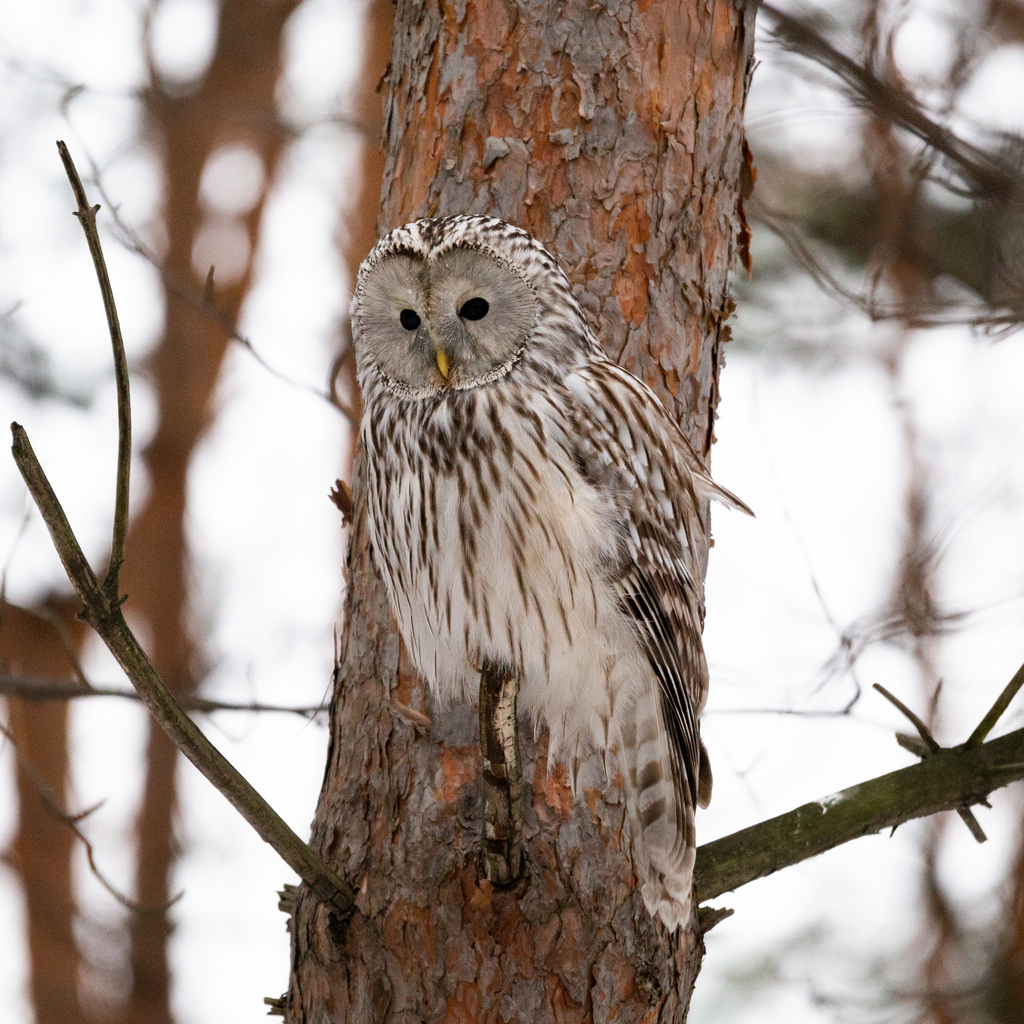
Ural Owl
Photo © Павел Кунгуров
Photo © Павел Кунгуров — CC BY 4.0 — Source: iNaturalist #146462951Identification
The Ural owl is a large nocturnal member of the true owl family (Strigidae) with a characteristic broad, rounded head and distinctly round facial disc. It is recognizable by its exceptionally long tail with a wedge-shaped tip—a feature unique among Strix species. Plumage is typically plain pale greyish-brown to whitish overall, with a darker grey-brown back and contrasting whitish markings. The underparts are pale cream-ochre to grey-brown with bold dark brown streaking but lacking crossbars. In flight, the Ural owl displays buffish-white underwings marked with heavy dark bars and a long white-tipped tail slung downwards, creating a buzzard-like silhouette with deeper, more relaxed wing beats. The eyes are notably dark brown, small, and closely set, giving a gentler expression than the great grey owl. The bill is yellowish with a dirty yellow cere, and tarsi, toes, and talons are greyish-yellow with darker tips.
Full-grown specimens range from 50 to 64 cm in length with wingspans from 110 to 134 cm, making them among the world's eight longest owl species. Females average larger than males. Males typically weigh 451–1,050 g, while females weigh 569–1,454 g. The Ural owl is approximately 25% smaller overall than the great grey owl, the largest Strix species.
Range & Habitat
The Ural owl has an extremely broad Palearctic distribution extending from Scandinavia and montane eastern Europe sporadically through central Europe, sweeping across Russia to Sakhalin and throughout Japan. The species encompasses up to 15 subspecies, though the actual number may be lower when accounting for clinal variations. This forest owl is typically associated with vast taiga forests across Eurosiberia but also inhabits mixed forests and temperate deciduous forests throughout its range.
Behaviour & Diet
The Ural owl is a dietary generalist like many Strix species but is usually locally reliant on small mammals, particularly small rodents such as voles. It is a vigorous territorial defender, maintaining the same territory historically for nesting. Natural nest sites include tree cavities, stumps, and abandoned nests of other bird species. In many parts of its range, the species has adapted to nest boxes provided by biologists and conservationists. Breeding success is often strongly correlated with prey population availability.
Best Time & Places to See It
The Ural owl's broad Palearctic range offers multiple opportunities for observation. Prime locations include the taiga forests of Scandinavia and Russia, montane regions of eastern Europe, and forests throughout Japan. The species' stability as a least concern species on the IUCN Red List, combined with successful reintroduction efforts in central Europe, makes these areas reliable for viewing. The owl's nocturnal habits mean observers should focus on dawn and dusk periods and listen for vocalizations to locate individuals.
Photography Tips
Photographing the Ural owl's distinctive long tail and round facial disc requires patient positioning, ideally from nest box areas where the species is well-established. The pale greyish-brown plumage demands careful exposure metering to avoid underexposure in low-light conditions. The bird's characteristic flight style, resembling a buzzard with relaxed wing beats, offers excellent opportunities for in-flight photography. The buffish-white underwings with dark trailing-edge barring provide striking contrast that photographs well. Focus on capturing the subtle streaking pattern of the underparts and the almond-shaped dark eyes, which are key identifying features. Listen for the distinctive male song—a deep rhythmic series of notes carrying up to 2 km—to help locate birds for photography.
Aggtelek National Park
Bieszczady National Park
Bükk National Park
Duna-Ipoly National Park
Färnebofjärden National Park
Isojärvi National Park
Karula National Park
Khangai Nuruu National Park
Kurjenrahka National Park
Nothing matches these filters.
No community photos yet. Log in to add the first one.
No community observations of this species yet.