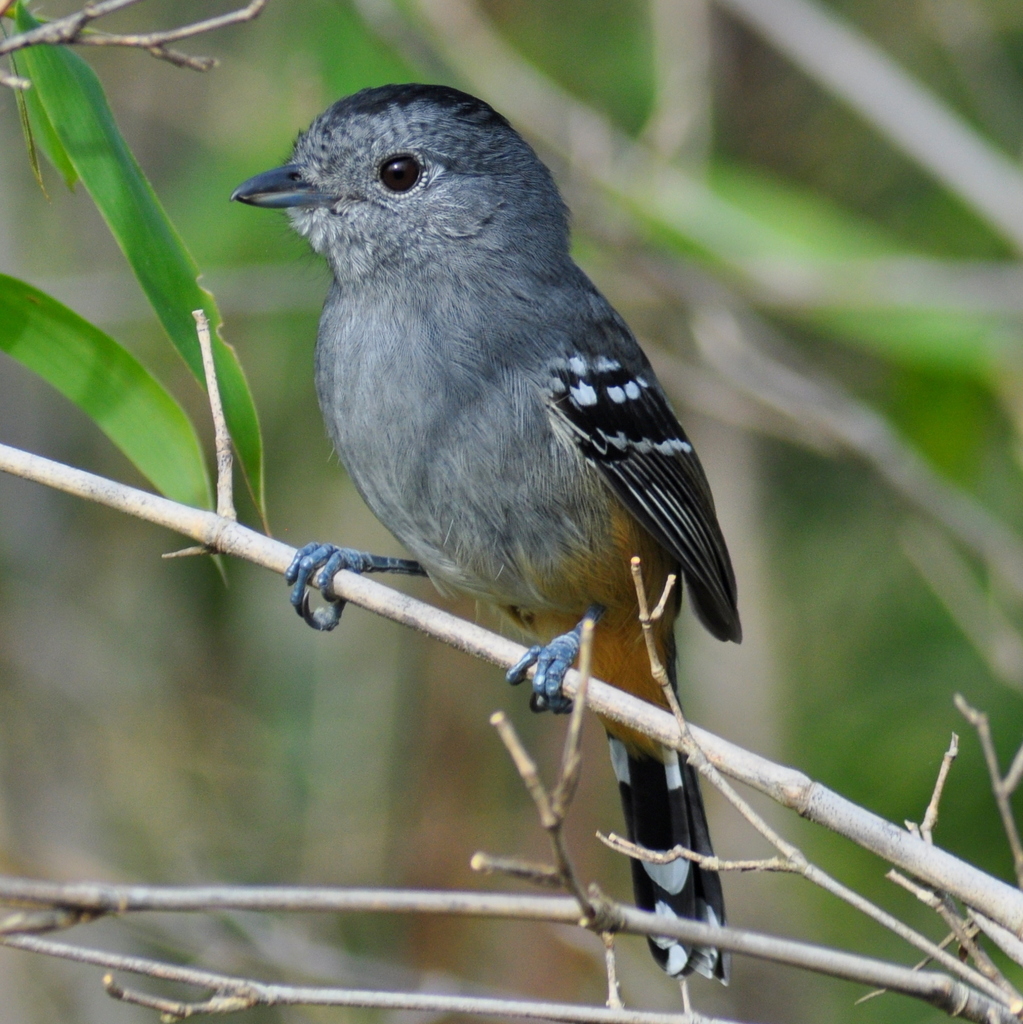
Variable Antshrike
Photo © vinicius_s_domingues
Photo © vinicius_s_domingues — CC BY 4.0 — Source: iNaturalist photo #244790819Identification
The variable antshrike is a small passerine, 14–16 cm long, and represents one of the most plumage-variable species within the antbird family. Members of genus Thamnophilus are characterized by stout, hooked bills reminiscent of true shrikes. The species exhibits marked sexual dimorphism and significant subspecific variation. Adult males of the nominate subspecies show a black crown and nape with gray face, dark gray upperparts marked by a white scapular patch, and blackish flight feathers with pale edges. The underparts are gray with faint scalloping. Females are notably different, displaying an olive-brown crown, mostly olive-brown upperparts with clay and yellow-brown tones, very dark wing coverts with white-tipped edges, and warm cinnamon-tawny underparts. Other subspecies range from predominantly black males (melanchrous, aspersiventer) to more rufous or ochraceous variants (cearensis, ochraceiventer), making field identification across the range challenging without subspecific knowledge.
Range & Habitat
The variable antshrike is found across much of central and southern South America, including Argentina, Bolivia, Brazil, Paraguay, Peru, and Uruguay. Its distribution is notably disjunct, with subspecies T. c. cearensis isolated in northeastern Brazil, while the remaining seven subspecies form a large contiguous range spanning from the Andean foothills of Peru southward through Bolivia and into the subtropical forests and woodlands of Paraguay, Argentina, and Brazil. Specific subspecies occupy distinct geographic regions: melanchrous inhabits the eastern Andean slopes in Peru; dinellii ranges across the Bolivian Andes into northwestern Argentina; gilvigaster is found in northeastern Argentina, southeastern Brazil, and Uruguay; while caerulescens occupies southeastern Paraguay and adjacent regions. The species prefers wooded and scrubby habitats within its broad range.
Behaviour & Diet
As a member of the antbird family, the variable antshrike is an insectivorous species that forages actively through vegetation. Like other antshrikes, it likely hunts for arthropods among foliage and branches, though detailed behavioral studies remain limited in the published literature. The species is notable for vocal variation across its range—different subspecies produce distinct calls and songs, with some variation appearing clinal rather than discrete. Molecular and acoustic research on Bolivian populations, which represent a meeting point for several subspecifically distinct populations, has confirmed gene flow between populations and suggests these vocal differences do not indicate separate species, despite historical speculation to the contrary.
Best Time & Places to See It
The variable antshrike can be encountered year-round throughout its range, though specific seasonal patterns of activity or movement are not well documented in available sources. Birders and nature travelers seeking this species should focus on appropriate habitat within the respective subspecies' ranges: the Andean foothills and cloud forests of Peru for melanchrous; the Chocó and montane regions of Bolivia for aspersiventer and dinellii; the subtropical forests and woodlands of Paraguay, Argentina, and southern Brazil for the lowland subspecies. The species' plumage variability means observers should be prepared to encounter birds that appear quite different from standard field guide illustrations, particularly when crossing subspecies boundaries in areas like Bolivia.
Photography Tips
Photographing the variable antshrike presents unique challenges due to its variable plumage and preference for dense woodland habitats. Use a telephoto lens (400–600 mm) to capture details from a distance, as the species may be wary. Early morning light often yields the best results for revealing plumage details, particularly the subtle white markings on wings and scapulars in males and the warm tones of female plumage. The significant sexual dimorphism makes it rewarding to document both sexes; patience and familiarity with local subspecies characteristics will help you anticipate and photograph diagnostic features. Take note of locality and subspecies when cataloging images, as this information greatly enhances the scientific and educational value of your photographs for regional bird documentation.
Tijuca National Park
Brazil
+317 birds+13 mammals
Where the Atlantic forest rises steeply from Rio de Janeiro's urban edge, Tijuca National Park encompasses a landscape of dramatic granite peaks, cascading waterfalls, and closed-canopy…
VIEW NATIONAL PARKSerra do Cipó National Park
Brazil
+379 birds+5 mammals
Where granite escarpments rise above the Atlantic Forest transition zone in southeastern Brazil, Serra do Cipó National Park unfolds across a landscape of dramatic ridges, cascading…
VIEW NATIONAL PARKItatiaia National Park
Brazil
+519 birds+12 mammals
Where granite peaks pierce the Atlantic rainforest canopy in southeastern Brazil, Itatiaia National Park rises as one of the country's oldest and most ecologically vital protected…
VIEW NATIONAL PARKPeixe National Park Lagoon
Brazil
+293 birds+4 mammals
Where the coastal plains of Rio Grande do Sul meet the Atlantic, Peixe National Park Lagoon sprawls across nearly 2,200 square kilometres of shallow waters, reed…
VIEW NATIONAL PARKUbajara National Park
Brazil
+122 birds+1 mammals
Granite peaks rise sharply from the humid tropical forests of northeastern Brazil, where Ubajara's 234 square kilometres straddle the transition between Atlantic rainforest and drier cerrado…
VIEW NATIONAL PARKSuperagui National Park
Brazil
+246 birds+2 mammals
Where the Atlantic rainforest meets the subtropical coast of Paraná, Superagui National Park sprawls across more than 1,000 square kilometres of one of Brazil's most biodiverse…
VIEW NATIONAL PARKSaint-Hilaire/Lange National Park
Brazil
+225 birds
Subtropical Atlantic forests rise and fall across the plateaus of inland Paraná, where Saint-Hilaire/Lange National Park protects nearly 578 square kilometres of Brazil's most biodiverse woodland…
VIEW NATIONAL PARKSerra do Itajaí National Park
Brazil
+227 birds+2 mammals
Where the Atlantic rainforest rises steeply from the coastal plains of Santa Catarina, Serra do Itajaí National Park spreads across 1,136 square kilometres of montane wilderness…
VIEW NATIONAL PARKSerra da Bocaina National Park
Brazil
+441 birds+5 mammals
Where the escarpment of the Serra da Bocaina rises sharply from the Atlantic coastal plain, tropical rainforest cloaks steep mountainsides that climb toward peaks exceeding 2,000…
VIEW NATIONAL PARKIguaçu National Park
Brazil
+387 birds+17 mammals
Where the Paraná Plateau plunges toward the Atlantic watershed, six thousand square kilometers of subtropical rainforest cling to steep gorges and river valleys in this corner…
VIEW NATIONAL PARKIlha Grande National Park
Brazil
+233 birds
Across the subtropical plateaus and Atlantic forest remnants of southern Brazil, a vast protected landscape spanning nearly 4,600 square kilometers safeguards one of the continent's most…
VIEW NATIONAL PARKSão Joaquim National Park
Brazil
+222 birds+9 mammals
Where the southern Brazilian highlands rise above the Atlantic Forest, São Joaquim National Park protects nearly 1,000 square kilometers of montane terrain that shifts between temperate…
VIEW NATIONAL PARKPau Brasil National Park
Brazil
+211 birds
Tropical Atlantic forest cloaks the rolling terrain of northeastern Bahia, where Pau Brasil National Park protects nearly 390 square kilometers of one of Brazil's most biodiverse…
VIEW NATIONAL PARKSerra dos Órgãos National Park
Brazil
+446 birds+13 mammals
Granite peaks thrust skyward through the Atlantic Forest canopy in the mountains immediately north of Rio de Janeiro, their bare rock faces rising above a landscape…
VIEW NATIONAL PARKChapada Diamantina National Park
Brazil
+346 birds+5 mammals
Where granite peaks and sandstone cliffs rise abruptly from the Brazilian interior, Chapada Diamantina National Park sprawls across 4,215 square kilometers of some of Brazil's most…
VIEW NATIONAL PARKSerra do Gandarela National Park
Brazil
+333 birds+3 mammals
Where granite massifs rise through Atlantic Forest in southeastern Brazil's highlands, Serra do Gandarela National Park protects nearly 1,000 square kilometres of montane terrain that few…
VIEW NATIONAL PARKCatimbau National Park
Brazil
+118 birds+6 mammals
Where sandstone plateaus rise from the semi-arid scrublands of northeastern Brazil, Catimbau National Park unfolds across more than 1,000 square kilometres of geological drama and surprising…
VIEW NATIONAL PARKBrasília National Park
Plano Piloto, Brazil
+338 birds+15 mammals
Cerrado grassland and scattered woodland sweep across the central Brazilian plateau where this national park sprawls across more than a thousand square kilometres of the Federal…
VIEW NATIONAL PARKAraucárias National Park
Brazil
+231 birds+3 mammals
Where the southern Brazilian highlands rise into cool temperate forest, Araucárias National Park protects one of the Atlantic Forest's most distinctive ecosystems across 506 square kilometres…
VIEW NATIONAL PARKSerra Geral National Park
Brazil
+211 birds+2 mammals
Where basalt cliffs and sandstone escarpments rise above the subtropical forests of southern Brazil, Serra Geral National Park preserves one of the Atlantic region's most dramatic…
VIEW NATIONAL PARKCampos Gerais National Park
Brazil
+143 birds
Where rolling plateaus rise above the Atlantic forest escarpment in Paraná's interior, Campos Gerais National Park unfolds across 539 square kilometers of highland grassland and forest…
VIEW NATIONAL PARKYanachaga–chemillén National Park
Palcazu, Peru
+639 birds+6 mammals
Where the eastern slopes of Peru's central cordillera plunge into cloud forest, Yanachaga–Chemillén National Park protects nearly three thousand square kilometres of montane wilderness that few…
VIEW NATIONAL PARKManu National Park
Manu, Peru
+892 birds+26 mammals
Across the eastern slopes of the Peruvian Andes, tropical rainforest descends into the Amazon basin with a complexity that few terrestrial ecosystems match. Manu National Park…
VIEW NATIONAL PARKTingo Maria National Park
Mariano Dámaso Beraún, Peru
+423 birds
Where the eastern slopes of the Peruvian Andes descend toward the Amazon basin, the landscape fractures into a maze of limestone ridges, humid gorges, and cloud-wrapped…
VIEW NATIONAL PARKCordillera Azul National Park
Pampa Hermosa, Peru
+322 birds+1 mammals
Where the eastern Andes descend into the western Amazon basin, Cordillera Azul National Park sprawls across nearly 38,000 square kilometres of some of Peru's most pristine…
VIEW NATIONAL PARKEl Palmar National Park
Distrito Sexto, Argentina
+244 birds+14 mammals
Across the Paraná River floodplain in northeastern Argentina, palms rise from wetland and grassland in a landscape shaped by water and time. El Palmar National Park…
VIEW NATIONAL PARKRío Pilcomayo National Park
Argentina
+271 birds+13 mammals
Where the Río Pilcomayo cuts through northeastern Argentina's subtropical lowlands, a sprawling mosaic of wetlands, grasslands, and seasonally flooded forests creates one of South America's most…
VIEW NATIONAL PARKIguazú National Park
Puerto Iguazú, Argentina
+346 birds+15 mammals
Where the Paraná Plateau plunges toward the Atlantic watershed, nearly 800 square kilometers of subtropical rainforest drape across Misiones Province in a landscape carved by millennia…
VIEW NATIONAL PARKEl Rey National Park
Municipio de Las Lajitas, Argentina
+317 birds+4 mammals
Where the eastern slopes of the Andes descend into northwestern Argentina's subtropical transition zone, El Rey National Park unfolds across 841 square kilometers of dramatically varied…
VIEW NATIONAL PARKCalilegua National Park
Municipio de Calilegua, Argentina
+288 birds+8 mammals
Where the eastern Andean slopes plunge into northwestern Argentina's humid subtropics, nearly 2,645 square kilometers of steep terrain and luxuriant forest compose one of South America's…
VIEW NATIONAL PARKBaritú National Park
Argentina
+81 birds+2 mammals
Where the eastern slopes of the Serranías del Hornocal descend into cloud forest and subtropical ravines, Baritú National Park protects one of northwestern Argentina's most biodiverse…
VIEW NATIONAL PARKParque Provincial Pampa del Indio
Laguna Limpia, Argentina
+231 birds+4 mammals
Across the flat horizons of Chaco Province, where the Paraná River system spills into vast wetlands and grasslands, Parque Provincial Pampa del Indio protects one of…
VIEW NATURE RESERVEChaco National Park
Municipio de Presidencia de la Plaza, Argentina
+258 birds+7 mammals
Across the humid subtropical lowlands of northeastern Argentina, where the Paraná River basin feeds vast seasonal wetlands and gallery forests, Chaco National Park protects one of…
VIEW NATIONAL PARKNo community photos yet. Log in to add the first one.
No community observations of this species yet.