Vega Gull
Photo © Marco Mussita
Photo © Marco Mussita — CC BY 4.0 — Source: iNaturalist #67377166Identification
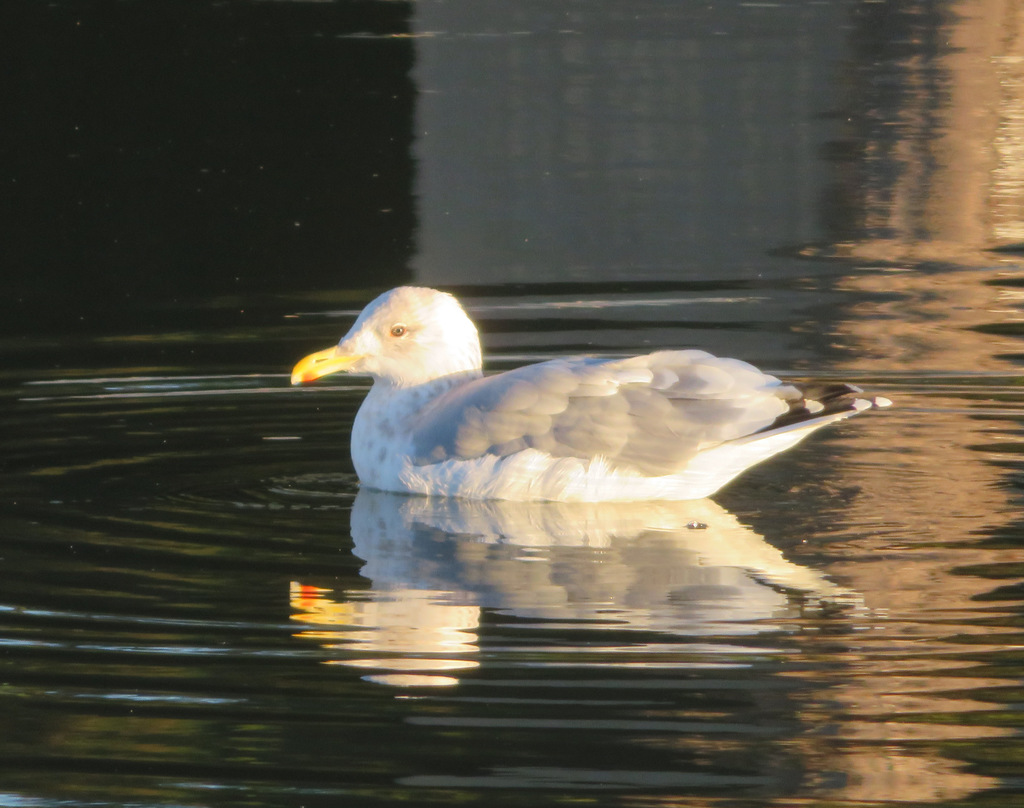
The Vega gull is a large gull belonging to the herring gull complex, though its exact taxonomic status remains debated among ornithologists. It closely resembles the herring gull but can be distinguished by its slightly darker grey upperparts. In winter plumage, the head becomes heavily streaked with brown, particularly on the back and sides of the neck, creating a distinctive collar marking. The legs are typically bright pink, while eye colour is variable but usually dark with a red orbital ring.
Ageing this species presents challenges for field birders. First- and second-winter birds display darker brown flecks and streaks across almost their entire body, with the crown notably darker than in the similar Mongolian gull. During this immature stage, the bill is dark grey to black, only gradually acquiring yellow colouration with a red spot as the bird matures. Adult Vega gulls in winter can be confused with the slaty-backed gull and western gull, though the Vega gull's grey is lighter than both of these species.
Range & Habitat
This species breeds in northeastern Siberia and undertakes a significant migration southward each winter. The wintering range extends across East Asia, including Japan, Korea, eastern China, and Taiwan, where they are typically found in harbours, on rocky shores, and at river mouths. Vega gulls are regularly recorded on St. Lawrence Island and near Nome, Alaska, with occasional sightings elsewhere in western Alaska.
Remarkably, this essentially Asian species has appeared sporadically in North America, with a few photo-documented records from Washington and California suggesting occasional vagrants reaching the Pacific coast. Populations breeding in the northwestern part of their range are notably paler above and are sometimes considered a separate subspecies, Birula's gull.
Behaviour & Diet
Like other large gulls, Vega gulls are opportunistic foragers well-adapted to coastal and maritime environments. Their presence in harbours, rocky shores, and river mouths during winter reflects their adaptability to varied feeding opportunities in these productive zones. As members of the herring gull complex, they are likely generalist feeders, though specific dietary details are not extensively documented in readily available sources.
Best Time & Places to See It
Winter is the prime season for observing Vega gulls, particularly in their East Asian range across Japan, Korea, eastern China, and Taiwan, where they concentrate in coastal harbours and at river mouths. For North American birders, St. Lawrence Island and Nome, Alaska offer the most reliable locations, particularly during migration periods. Patience and careful observation are required, as distinguishing Vega gulls from other large gulls demands close attention to plumage details and structural features.
Photography Tips
When photographing Vega gulls, pay particular attention to lighting on the head and neck to capture the diagnostic brown streaking visible in winter plumage. The bright pink legs and eye details with the red orbital ring provide useful field marks worth documenting. Photographing birds in different plumages—immatures with their darker bills and heavily streaked bodies versus adults with yellow bills and lighter heads—helps build a comprehensive reference collection for identification purposes.
St. Paul Island
Saint Paul, United States
+255 birds+8 mammals
Windswept tundra rolls across this remote Pribilof island, where volcanic basalt cliffs plunge into the Bering Sea and fog rolls in thick enough to erase the…
VIEW PROTECTED LANDSCAPEBaikal National Park
Ольхонский район, Russia
+184 birds+11 mammals
Where the world's deepest freshwater lake meets ancient Siberian taiga, Baikal National Park sprawls across 66,203 square kilometers of one of Earth's most singular ecosystems. The…
VIEW NATIONAL PARKNortheast China Tiger and Leopard National Park
Mu Dan Jiang Shi, China
+202 birds+19 mammals
Across the temperate forests of northeastern China, where winters grip the landscape in subzero silence and summers remain cool and brief, the Mudanjiang region supports a…
VIEW NATIONAL PARKYancheng National Nature Reserve
Yancheng, China
+208 birds+4 mammals
Where the East China Sea's tidal rhythms sculpt the Jiangsu coast, Yancheng National Nature Reserve sprawls across one of Asia's most dynamic wetland complexes. This vast…
VIEW NATURE RESERVEPoyang Lake National Nature Reserve
Shangrao, China
+270 birds+7 mammals
Where the Yangtze River's massive floodplain spreads across central China, Poyang Lake National Nature Reserve encompasses one of the continent's most dynamic and water-rich wetland systems.…
VIEW NATURE RESERVEAlaska Maritime National Wildlife Refuge
Alaska, United States
+391 birds+58 mammals
Where the North Pacific collides with Alaska's rugged coastline, a sprawling archipelago of islands, rocky outcrops, and coastal headlands forms one of North America's most remote…
VIEW WILDLIFE SANCTUARYYukon Delta National Wildlife Refuge
Bethel, United States
+156 birds+12 mammals
Across the Yukon Delta sprawls one of North America's most expansive coastal wetland sanctuaries, where the boreal subarctic climate strips down existence to essentials. This vast…
VIEW WILDLIFE SANCTUARYFarallon National Wildlife Refuge
San Francisco, United States
+384 birds+16 mammals
Windswept granite peaks rising abruptly from the Pacific, the Farallon Islands form a wildlife sanctuary of extraordinary seabird abundance and ecological significance just twenty-seven miles west…
VIEW WILDLIFE SANCTUARYNo community photos yet. Log in to add the first one.
No community observations of this species yet.