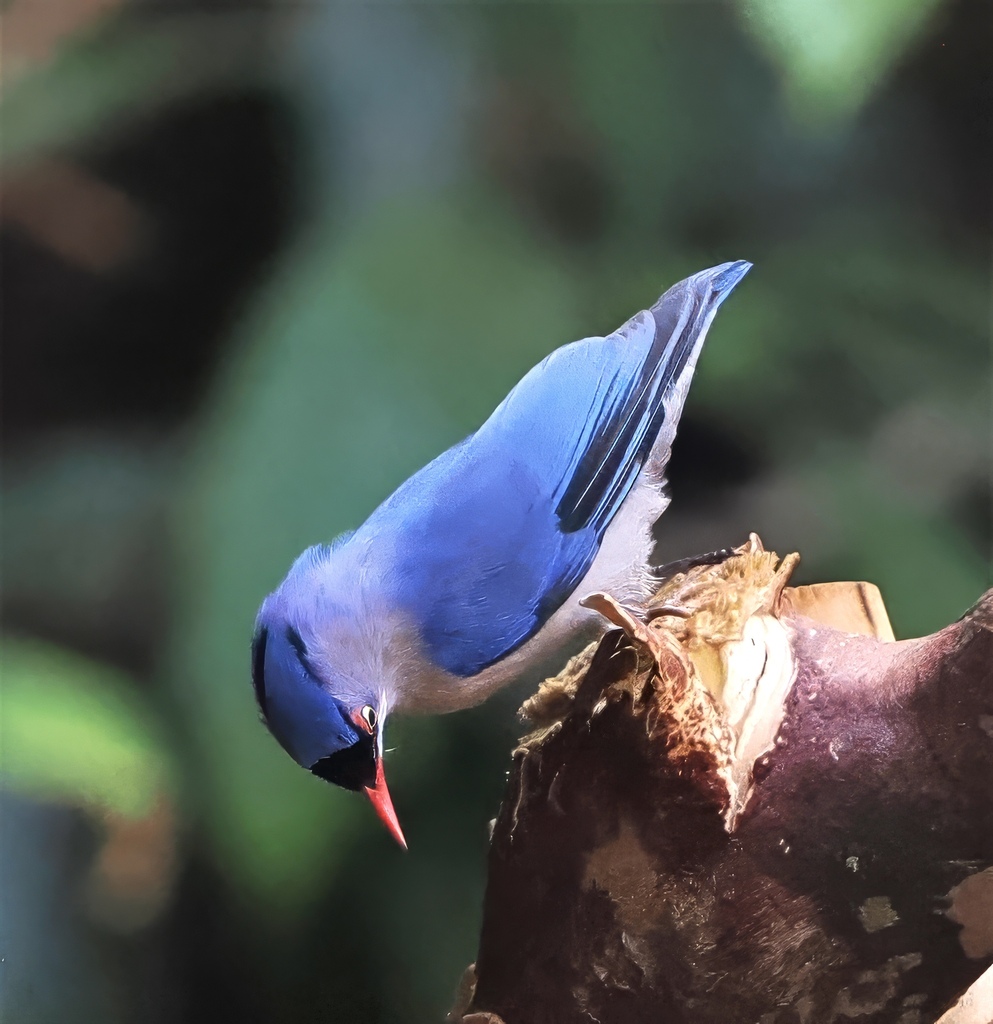
Velvet-fronted Nuthatch
Photo © desertnaturalist
Photo © desertnaturalist — CC BY 4.0 — Source: iNaturalist #291208241Identification
The velvet-fronted nuthatch is a small passerine, measuring just 12–13.5 cm long, with the compact frame and powerful bill typical of nuthatches. Its most striking features are its violet-blue upperparts contrasting with lavender cheeks and buffy-grey underparts, complemented by a distinctive whitish throat and bright yellow eyes. The bill is orange-red to bright red, and a prominent black patch adorns the forehead and lores—well-developed in adults but less pronounced in younger birds.
Sexual dimorphism is evident: adult males display a characteristic black superciliary stripe running above the eye and across the head toward the nape, while females lack this marking and show warmer underpart coloration. Juveniles are noticeably duller, lacking the bold black frontal band entirely. The bill darkens in young birds, and the undertail coverts display dark tips. Leg color varies between subspecies, ranging from yellowish to bright orange-red depending on geographic location.
Range & Habitat
The velvet-fronted nuthatch inhabits southern Asia from Nepal, India, and Sri Lanka eastward through Bangladesh, southwestern China, and Indonesia. Five accepted subspecies are distributed across this range, occupying diverse forest types from deciduous to evergreen woodland, and even secondary forest. The species adapts readily to human-modified landscapes, including shade trees in south Indian coffee plantations and mangrove forests such as those found in the Sunderbans.
These birds favor forests with good tree cover and show a preference for resident breeding in stable woodland habitats. They demonstrate ecological flexibility, making them relatively widespread throughout their range across multiple elevations and forest types.
Behaviour & Diet
Like all nuthatches, the velvet-fronted nuthatch possesses strongly curved claws that enable it to descend vertical tree trunks and move along the undersides of horizontal branches—a capability lacking in woodpeckers and other climbing birds. The bird moves jerkily up, down, and around tree trunks and branches in an active, restless manner, constantly gleaning insects and spiders from bark surfaces. It is an accomplished forager, often participating in mixed-species feeding flocks with other passerines, where its activity helps disturb prey that may be captured by other species, notably the racket-tailed drongo in Sri Lanka.
The velvet-fronted nuthatch is notably vocal, producing a rapid chipping call and a distinctive repeated "sit-sit-sit" note by which it is often located in the field. Adults undergo a complete postbreeding molt beginning at the end of June in northern India, replacing all plumage annually.
Best Time & Places to See It
The breeding season varies geographically: in northern India it occurs from April to June, while southern India and Sri Lanka see breeding from January to May. The species' year-round resident status means it can be encountered throughout the year in suitable habitat. Look for these birds in any forest with adequate tree cover across their range, from the Himalayan foothills to the humid forests of Indonesia.
The bird's noisy and active nature makes it relatively detectable despite its small size. Mixed feeding flocks present excellent opportunities for observation, particularly in early morning hours when foraging activity peaks.
Photography Tips
The velvet-fronted nuthatch's small size and active behavior demand a telephoto lens—at least 300mm or greater—to capture satisfying frame-filling images. The bird's violet-blue plumage and bright red bill are striking subjects, but require careful exposure metering to preserve detail in both highlights and shadows while maintaining color saturation. The contrasting black facial markings of males provide excellent compositional elements.
Position yourself near feeding flocks during early morning hours when light is favorable and activity is highest. The bird's jerky movements along tree trunks offer dynamic composition opportunities, though fast shutter speeds (1/1000s or faster) are essential to freeze motion. Males with their distinctive superciliary stripe present the most identifiable subjects for field guide photography.
Lunugamvehera National Park
Sri Lanka
+204 birds+14 mammals
Dry scrubland and shallow wetlands converge in Sri Lanka's southeastern lowlands, where Lunugamvehera National Park anchors one of the island's most ecologically vital landscapes. The park's…
VIEW NATIONAL PARKMaduru Oya National Park
Sri Lanka
+74 birds+1 mammals
Granite ridges rise abruptly from the humid lowlands of Sri Lanka's Uva Province, their weathered slopes clothed in dry monsoon forest and scattered woodland where deciduous…
VIEW NATIONAL PARKLangtang National Park
Helambu, Nepal
+364 birds+14 mammals
Where the southern slopes of the Himalayan highlands descend toward the subtropical valleys of central Nepal, Langtang National Park sprawls across one of the subcontinent's most…
VIEW NATIONAL PARKValmiki National Park
Ramnagar, India
+66 birds+6 mammals
Along Bihar's western frontier, where the Gandak River winds through subtropical forest and grassland, Valmiki National Park sprawls across terrain shaped by monsoon rains and seasonal…
VIEW NATIONAL PARKEravikulam National Park
Devikulam, India
+192 birds+7 mammals
High in the Western Ghats of Kerala, where monsoon mists cling to slopes that rise above 2,000 metres, Eravikulam National Park preserves one of South India's…
VIEW NATIONAL PARKKhao Yai National Park
Prachantakham District, Thailand
+377 birds+46 mammals
Evergreen dipterocarp forest blankets the rolling terrain of this national park in eastern Thailand, where limestone hills rise abruptly from the forest floor and seasonal streams…
VIEW NATIONAL PARKKhao Laem National Park
Sangkhla Buri District, Thailand
+197 birds
Where the Vajiralongkorn Reservoir sprawls across the forested valleys of Kanchanaburi's northern borderlands, Khao Laem National Park protects a landscape where limestone ridges rise dramatically from…
VIEW NATIONAL PARKKanha Tiger Reserve
Kanha Kisli F.V., India
+321 birds+23 mammals
Where sal forests give way to emerald meadows and crystalline streams carve through ancient valleys, one of India's finest wilderness reserves unfolds across the Maikal Range.…
VIEW NATIONAL PARKBandhavgarh National Park
Garhpuri, India
+285 birds+17 mammals
Where granite ridges rise dramatically above sal and bamboo forests, one of India's most pristine tiger reserves unfolds across the Vindhyan plateau. Ancient rock formations tower…
VIEW NATIONAL PARKKaziranga National Park
Kohora, India
+422 birds+26 mammals
Dawn breaks over the floodplains of the Brahmaputra, where tall grasslands stretch endlessly beneath monsoon-heavy skies. This sprawling wilderness of northeastern Assam is a mosaic of…
VIEW NATIONAL PARKPeriyar National Park
Mlappara, India
+232 birds+4 mammals
Dawn breaks over mist-shrouded ridges where the Western Ghats tumble toward Kerala's spice-scented lowlands. Here, ancient tropical forests envelope a glittering artificial lake, creating a mosaic…
VIEW NATIONAL PARKPampadum Shola National Park
Vattavada, India
+258 birds+14 mammals
Where misty shola forests cling to the high plateaus of the Nilgiri Mountains, ancient evergreen remnants create a world apart. This 2,316-hectare reserve protects one of…
VIEW NATIONAL PARKBandipur National Park
Hirehalli, India
+302 birds+19 mammals
Where the Western Ghats descend into the Deccan plateau, ancient deciduous forests blanket a landscape carved by the Nugu River. Bandipur unfolds across 880 square kilometres…
VIEW NATIONAL PARKNagarahole Tiger Reserve
Nalkeri Forest, India
+323 birds+23 mammals
Where granite escarpments rise above dense deciduous forests and the Kabini River carves through pristine wilderness, one of India's most biodiverse landscapes unfolds across the Western…
VIEW NATIONAL PARKBako National Park
Kuching, Malaysia
+210 birds+17 mammals
Weathered sandstone cliffs rise dramatically from the South China Sea, their ochre faces sculpted by millennia of wind and tide into a landscape of extraordinary geological…
VIEW NATIONAL PARKTaman Negara National Park
Kampong Samas, Malaysia
+393 birds+48 mammals
Where ancient rainforest meets limestone peaks, one of Southeast Asia's oldest protected wilderness preserves sprawls across 4,343 square kilometers of primordial landscape. Dipterocarp giants tower overhead,…
VIEW NATIONAL PARKPenang National Park
Balik Pulau, Malaysia
+107 birds+2 mammals
Granite peaks rise abruptly from the Andaman Sea where tropical rainforest clings to steep slopes in one of Malaysia's oldest protected landscapes. Mangrove forests fringe the…
VIEW NATIONAL PARKTaman Nasional Meru Betiri
Jember, Indonesia
+93 birds+1 mammals
Across East Java's southeastern coast, where the Indian Ocean meets a landscape of volcanic soils and monsoon-fed forests, sprawls a national park that epitomizes the ecological…
VIEW NATIONAL PARKGunung Ciremai National Park
Majalengka, Indonesia
+116 birds+1 mammals
Volcanic slopes rise sharply from West Java's interior, where Gunung Ciremai's 3,078-metre summit dominates a landscape carved by geological upheaval and shaped by equatorial monsoon rainfall.…
VIEW NATIONAL PARKWay Kambas National Park
Lampung Timur, Indonesia
+237 birds+20 mammals
Across the low swamplands of eastern Lampung, where freshwater wetlands merge into tidal mangrove forests along the Sunda Strait, sprawls one of Sumatra's most vital sanctuaries.…
VIEW NATIONAL PARKXishuangbanna National Nature Reserve
Xishuangbanna Dai Autonomous Prefecture, China
+173 birds+2 mammals
Where subtropical monsoon forests meet the margins of the Yunnan plateau, Xishuangbanna National Nature Reserve sprawls across a landscape of dramatic relief—deep river valleys carved by…
VIEW NATURE RESERVEGaoligong Mountain National Nature Reserve
Nujiang Lisu Autonomous Prefecture, China
+443 birds+13 mammals
VIEW NATURE RESERVENo community photos yet. Log in to add the first one.
No community observations of this species yet.