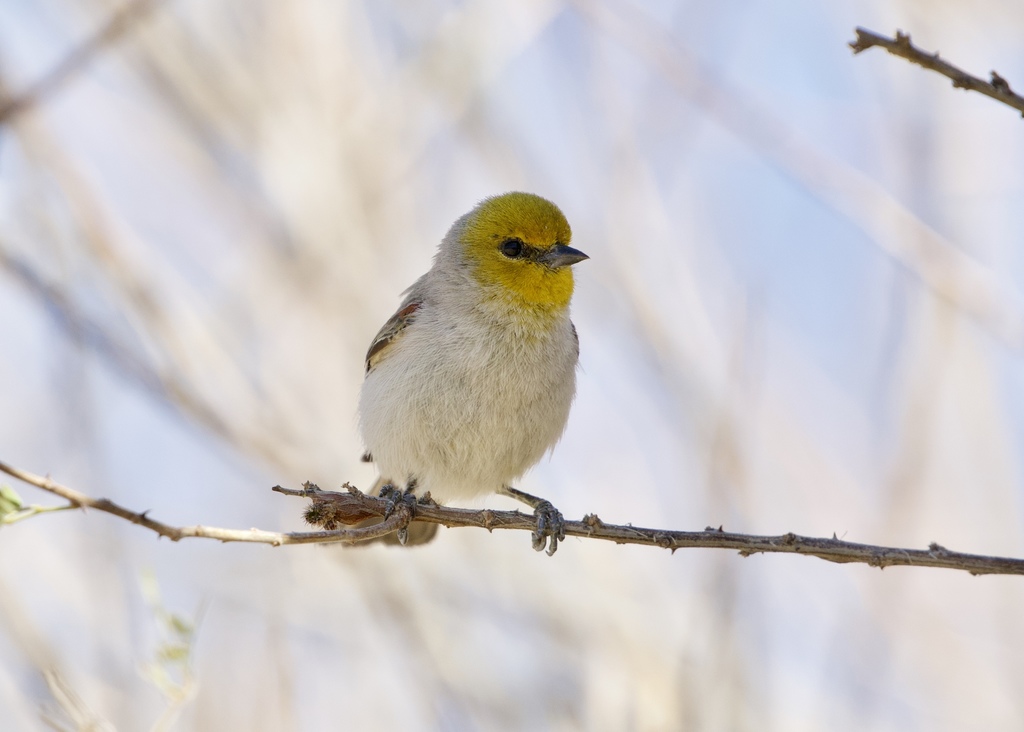
Verdin
Photo © RJ Baltierra
Photo © RJ Baltierra — CC BY 4.0 — Source: iNaturalist photo #151359816Identification
The verdin is a tiny bird, measuring just 4.5 inches (11 cm) in length, rivaling the American bushtit as one of North America's smallest passerines. Adults are unmistakable: gray overall with a bright yellow head and rufous shoulder patch (lesser coverts). Juveniles lack both the yellow head and rufous patch, appearing uniformly light gray. All verdins have a distinctive sharply pointed bill that is thick at the base and tapers to a fine tip—a feature that sets them apart from typical tits.
Range & Habitat
The verdin is found across the southwestern United States and Mexico, with two subspecies breeding north of the border: A. f. acaciarum in southern California, Nevada, and Utah, associated with the Sonoran Desert; and A. f. ornatus in New Mexico and Oklahoma, linked to the Chihuahuan Desert. Four to five additional subspecies are resident to Mexico year-round. These birds favor shrubby desert landscapes, nesting in thorny thickets with few trees and foraging in scrubland and scrappy outcrops. Their distinctive spherical nests—bulky masses of twigs and branches lined with grasses, feathers, and hair—are constructed in shrubs, with an entrance hole roughly one inch in diameter typically located near the nest's base.
Behaviour & Diet
Verdins are primarily insectivorous, continuously foraging among desert vegetation for tiny insects, larvae, and occasionally hard and soft mast from trees and shrubs. They may also visit hummingbird feeders for sugar water. During breeding season, verdins form monogamous pairs and defend territories as large as 20 acres. Both sexes build nests, incubate eggs, and care for young. Clutches typically contain 3–6 light green eggs with irregular dark red-brown spotting. After fledging, young remain with both parents until winter before dispersing short distances from their birthsite.
Best Time & Places to See It
Spring is prime time to find verdins, when males sing frequently and breeding activity intensifies. The Sonoran and Chihuahuan deserts of the southwestern United States and Mexico offer the best opportunities. Look in dense shrubby areas, thornscapes, and scrubland where these tiny birds forage actively and loudly. Their vocal nature helps locate them despite their small size.
Photography Tips
The verdin's diminutive size and active foraging behavior present both challenge and opportunity for photographers. Position yourself near productive shrubland during early morning when birds are most active. The contrasting yellow head and rufous shoulder patch of adults provide striking subjects, particularly in good desert light. Patient observation of roosting and nesting sites may yield intimate nest-entry shots. Expect fast, jerky movements; use a fast shutter speed and consider video-capable equipment. The species' loud vocalizations can help you locate individuals before framing your shot.
Big Bend National Park
Bitter Lake National Wildlife Refuge
Bosque del Apache National Wildlife Refuge
Cabeza Prieta National Wildlife Refuge
Carlsbad Caverns National Park
Cave Creek Canyon
Chiricahua Mountains
Death Valley National Park
El Vizcaíno
Nothing matches these filters.
No community photos yet. Log in to add the first one.
No community observations of this species yet.