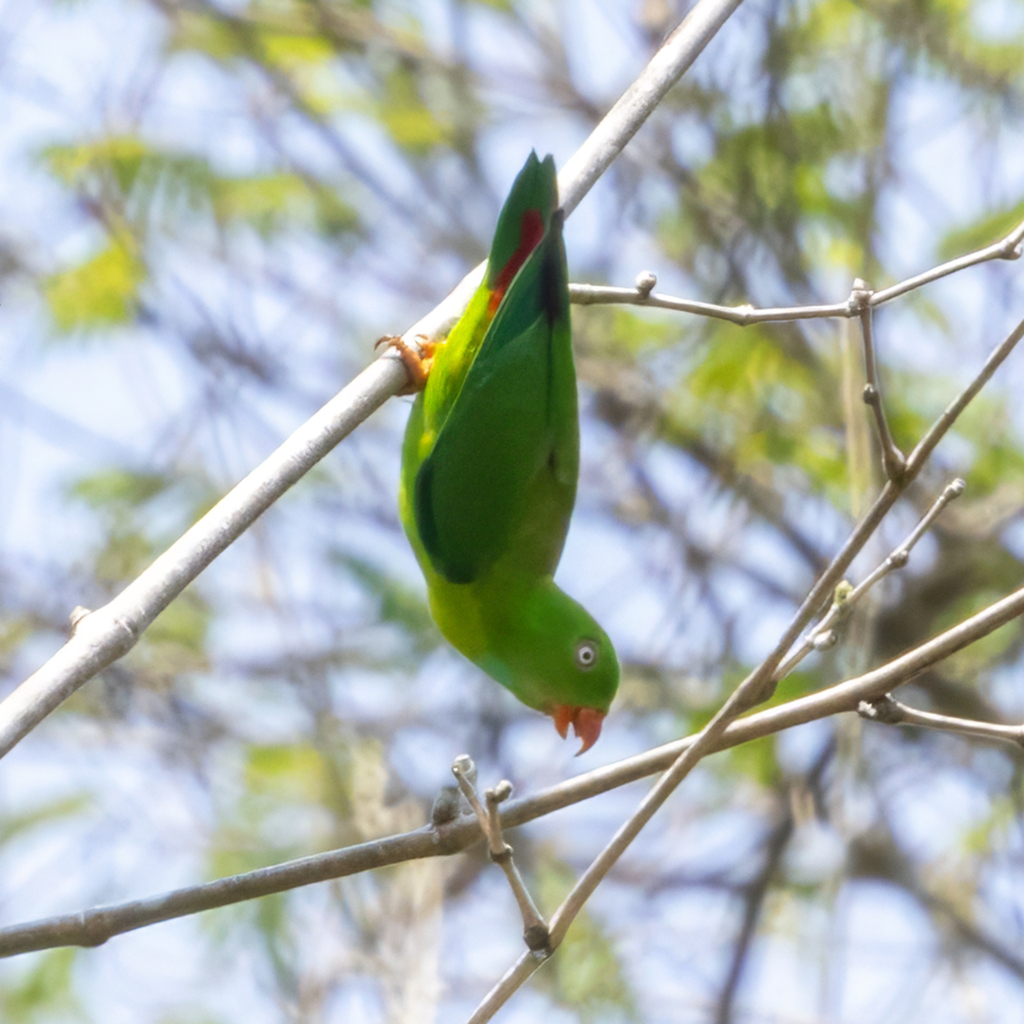
Vernal Hanging Parrot
Photo © Dan Vickers
Photo © Dan Vickers — CC BY 4.0 — Source: iNaturalist #345669165Identification
The vernal hanging parrot is a diminutive parrot, measuring only 14 cm in length with a characteristically short tail. Its plumage is predominantly green, providing excellent camouflage in its forested habitat. The adult male is unmistakable, displaying a striking red rump and red bill, along with a distinctive blue throat patch. Females lack the blue throat patch, instead showing a green patch in this area. Immature birds are duller overall, with a less vibrant rump and an absence of the throat patch entirely, making them potentially confusing to inexperienced birders.
Range & Habitat
This small parrot is a resident breeder throughout the Indian subcontinent and parts of Southeast Asia. It favours dry jungle and cultivated areas, making it a relatively accessible species for those visiting appropriate regions. The bird is notably absent from Sri Lanka, where it is replaced by the very similar endemic Sri Lanka hanging parrot.
Vernal hanging parrots undergo local movements throughout the year, driven primarily by the availability of their preferred food sources. They show a particular affinity for banyan trees, which provide abundant fruit, and plantain trees, which offer nectar-rich flowers.
Behaviour & Diet
This species sustains itself on a diet of fruit, seeds, buds, and blossoms, making it dependent on flowering and fruiting cycles across its range. Their close association with banyan and plantain trees reflects this dietary specialization. In flight, vernal hanging parrots are notably swift and direct, though their presence is often announced by their raucous, chattering calls before they are seen.
Unlike some of their hanging parrot relatives, vernal hanging parrots are less gregarious and typically occur in small groups outside the breeding season. During breeding, they nest in tree cavities, which they line with leaf fragments. Clutches usually comprise three eggs, occasionally up to four. The eggs are pure white, and the female alone incubates them for approximately 20 days. Chicks fledge around 33 days after hatching, a relatively rapid development for such a small species.
Best Time & Places to See It
Vernal hanging parrots are best located in areas with fruiting banyan trees or flowering plantains, as these sites concentrate the birds' feeding activity. The unpredictable nature of their local movements means that timing visits to coincide with peak fruiting or flowering periods will increase your chances of encounters. Early morning, when parrots are most active, offers the best opportunities for observation.
Photography Tips
The small size and predominantly green coloration of vernal hanging parrots present a genuine photographic challenge. Their swift, direct flight and preference for canopy feeding mean that patience and preparation are essential. Position yourself near productive food sources—particularly fruiting banyans—during peak activity hours at dawn. Use a fast shutter speed to freeze their rapid movements, and employ a telephoto lens to avoid disturbing the birds. Males are far more photogenic than females and juveniles, offering the best opportunity to capture the striking red rump and blue throat patch that define the species.
Eravikulam National Park
Devikulam, India
+192 birds+7 mammals
High in the Western Ghats of Kerala, where monsoon mists cling to slopes that rise above 2,000 metres, Eravikulam National Park preserves one of South India's…
VIEW NATIONAL PARKHat Noppharat Thara-Mu Ko Phi Phi National Park
Ao Nang, Thailand
+253 birds+9 mammals
Where limestone karsts rise dramatically from turquoise waters, Hat Noppharat Thara-Mu Ko Phi Phi National Park unfolds across a mosaic of beach, mangrove forest, and island…
VIEW NATIONAL PARKKhao Laem Ya-Mu Ko Samet National Park
Mueang Rayong District, Thailand
+159 birds+3 mammals
Where limestone hills meet the Gulf of Thailand, Khao Laem Ya–Mu Ko Samet National Park stitches together a mosaic of terrestrial and marine worlds that few…
VIEW NATIONAL PARKKhao Laem National Park
Sangkhla Buri District, Thailand
+197 birds
Where the Vajiralongkorn Reservoir sprawls across the forested valleys of Kanchanaburi's northern borderlands, Khao Laem National Park protects a landscape where limestone ridges rise dramatically from…
VIEW NATIONAL PARKKaziranga National Park
Kohora, India
+422 birds+26 mammals
Dawn breaks over the floodplains of the Brahmaputra, where tall grasslands stretch endlessly beneath monsoon-heavy skies. This sprawling wilderness of northeastern Assam is a mosaic of…
VIEW NATIONAL PARKPeriyar National Park
Mlappara, India
+232 birds+4 mammals
Dawn breaks over mist-shrouded ridges where the Western Ghats tumble toward Kerala's spice-scented lowlands. Here, ancient tropical forests envelope a glittering artificial lake, creating a mosaic…
VIEW NATIONAL PARKPampadum Shola National Park
Vattavada, India
+258 birds+14 mammals
Where misty shola forests cling to the high plateaus of the Nilgiri Mountains, ancient evergreen remnants create a world apart. This 2,316-hectare reserve protects one of…
VIEW NATIONAL PARKBandipur National Park
Hirehalli, India
+302 birds+19 mammals
Where the Western Ghats descend into the Deccan plateau, ancient deciduous forests blanket a landscape carved by the Nugu River. Bandipur unfolds across 880 square kilometres…
VIEW NATIONAL PARKNagarahole Tiger Reserve
Nalkeri Forest, India
+323 birds+23 mammals
Where granite escarpments rise above dense deciduous forests and the Kabini River carves through pristine wilderness, one of India's most biodiverse landscapes unfolds across the Western…
VIEW NATIONAL PARKNo community photos yet. Log in to add the first one.
No community observations of this species yet.