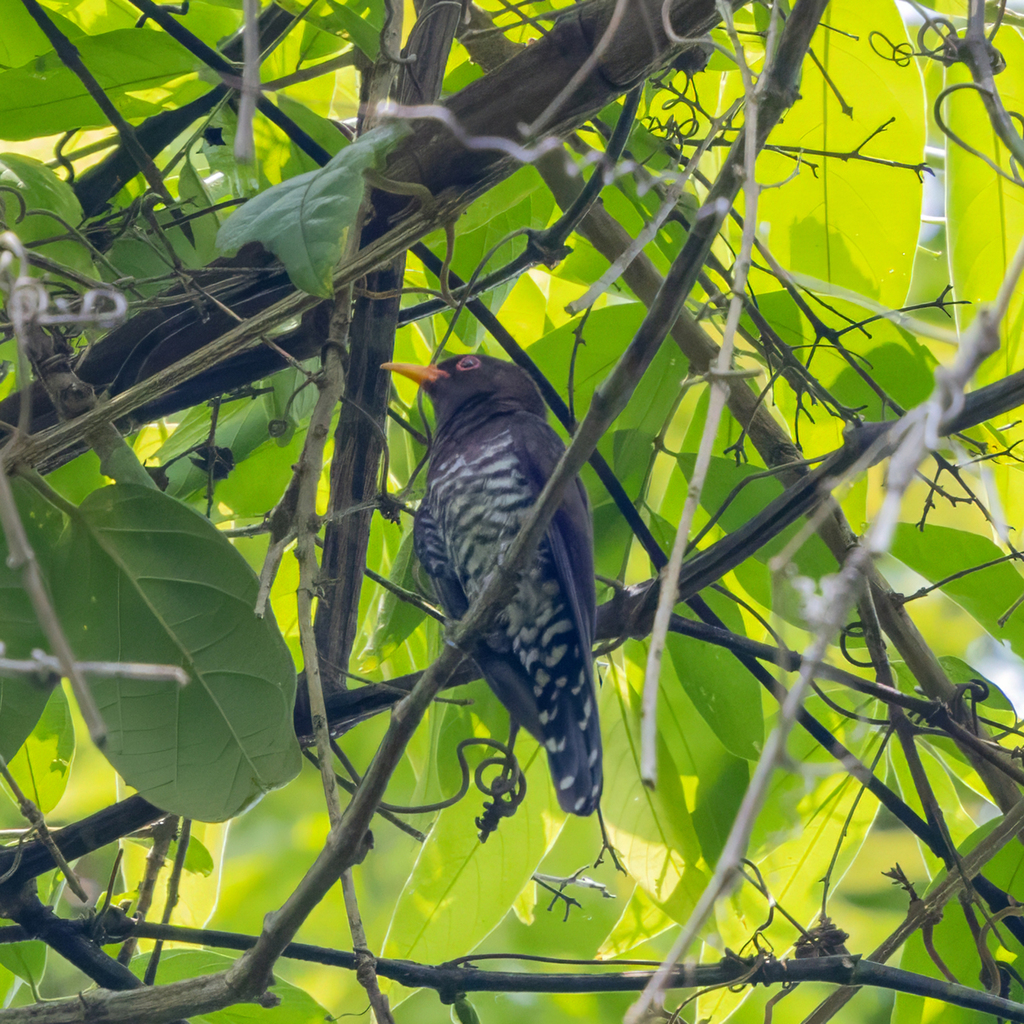
Violet Cuckoo
Photo © Dan Vickers
Photo © Dan Vickers — CC BY 4.0 — Source: iNaturalist #344909554Identification
The violet cuckoo is a strikingly iridescent species with marked sexual dimorphism. Males are instantly recognizable by their glossy violet head and upper parts, with the most spectacular feature being a brightly iridescent violet chin and upper breast. They sport a blackish tail with white tip and barred outer feathers, a white belly marked with broad black, green, or violet bars, and a distinctive red eye-ring. Females are far more subdued, displaying mottled greenish-bronze upper parts with a dark brown crown, white eye markings, and a whitish breast barred with bronze-green. Juveniles are characterized by barred rufous and greenish-bronze upper parts, a bright rufous crown, and brown-barred white underparts.
Range & Habitat
This species ranges from north-eastern India through Southeast Asia, the Greater Sundas, Palawan, and the Philippines. Northern populations, including those in Assam and Bangladesh, are migratory, while southern populations are resident year-round. The violet cuckoo inhabits subtropical and tropical moist lowland forests and mangrove forests, but is also readily seen in gardens, orchards, and rubber plantations. It occurs from lowlands up to 1,500 metres, though primarily below 700 metres. Though reported as uncommon throughout its range, its wide distribution means it is not currently considered threatened by the IUCN, though habitat loss poses localized concerns.
Behaviour & Diet
Violet cuckoos are primarily insectivorous but also consume fruit. They have been observed shaking hairy caterpillars to extract the stomach contents before eating. They typically forage by creeping methodically along branches but are equally adept at catching insects in flight. Like all cuckoos, they are obligate brood parasites, laying eggs in the nests of other birds. Males are vocal and active during breeding season to attract mates, while females become secretive as they search for suitable host nests. Recorded hosts include sunbirds and spiderhunters—particularly species of the genus Arachnothera. Though host species often recognize and chase adult cuckoos, they fail to identify cuckoo eggs as foreign. Cuckoo chicks typically outsize host chicks, and while many cuckoo species eject host chicks, this behavior has not yet been documented in the violet cuckoo.
Best Time & Places to See It
The breeding season offers the best opportunity to locate violet cuckoos, when males are most vocal and active. Northern populations in Assam, Bangladesh, and surrounding regions should be targeted during their resident season, while southern populations can be sought year-round. Scan lowland forests, mangrove stands, gardens, and cultivated areas up to 700 metres elevation. The species remains uncommon, making patience and careful listening essential. Early morning hours, when males vocalize most actively, improve your chances of detection.
Photography Tips
The violet cuckoo's iridescence requires careful handling of light. Males' glossy violet plumage is best photographed in soft, directional morning or late afternoon light that reveals the iridescent sheen without creating harsh shadows. Use a fast shutter speed when attempting in-flight shots, as they are active foragers. The white eye-ring and red orbital skin of males are diagnostic features worth capturing. Females and juveniles are cryptic; photograph them against neutral backgrounds to highlight their subtle bronze and rufous patterning. Given the species' preference for foraging high on branches, a telephoto lens (at least 300mm) is essential. Position yourself beneath suspected host plants and remain patient, as encounters are typically brief.
Bako National Park
Gunung Mulu National Park
Hat Noppharat Thara-Mu Ko Phi Phi National Park
Kaeng Krachan National Park
Kaziranga National Park
Khao Laem National Park
Khao Yai National Park
Kuching Wetlands National Park
Nong Bong Khai Non-Hunting Area
Nothing matches these filters.
No community photos yet. Log in to add the first one.
No community observations of this species yet.