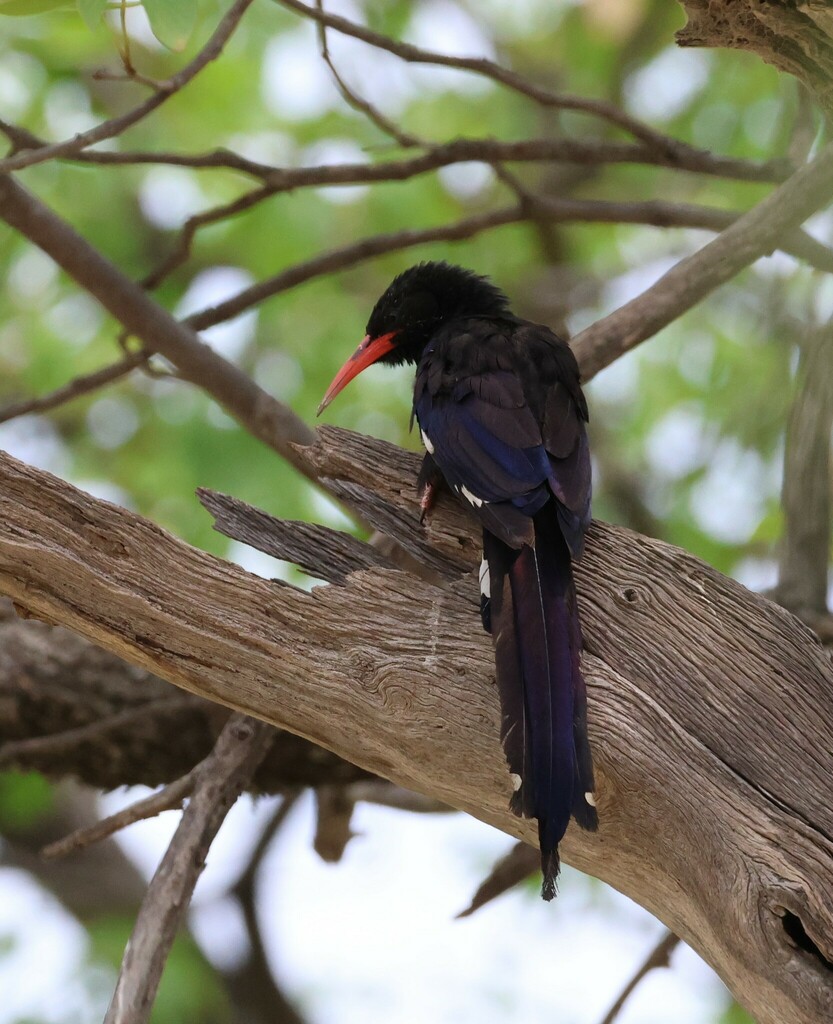
Violet Wood Hoopoe
Photo © scaup
Photo © scaup — CC BY 4.0 — Source: iNaturalist #198667944Identification
The violet wood hoopoe is a striking bird that bears some resemblance to the black-billed wood hoopoe but is distinguished by several key features. Most notably, it possesses a red beak, which contrasts sharply with the black bill of its relative. The throat is a distinctive green colour, while the mantle feathers display an attractive combination of coppery and violet tones that give the species its common name. These iridescent plumage features make it an eye-catching sight when observed in good light.
Range & Habitat
The violet wood hoopoe is found across four African countries: Angola, Kenya, Namibia, and Tanzania. Two subspecies are recognised, with P. d. damarensis occurring in Angola and Namibia, while P. d. granti is found in central and southeastern Kenya. The large geographical separation between these two populations has led some ornithologists to argue that they should be considered separate species entirely.
Behaviour & Diet
The violet wood hoopoe is notably more terrestrial in its foraging behaviour compared to its close relative, the green wood hoopoe, which tends to forage in a more arboreal manner. This difference in feeding ecology was one of the key arguments for recognising the violet wood hoopoe as a distinct species rather than a subspecies of the green wood hoopoe. The species was formerly considered conspecific with the green wood hoopoe before being elevated to full species status based on behavioural and morphological differences.
Best Time & Places to See It
For travellers and birdwatchers seeking to observe violet wood hoopoes, the species is distributed across Angola, Namibia, Kenya, and Tanzania. The best locations will depend on which subspecies you wish to encounter. Those exploring southern Africa should focus on Angola and Namibia for P. d. damarensis, while visitors to Kenya will have the opportunity to see P. d. granti in the central and southeastern regions of the country. Specific seasonal variations in visibility are not detailed in available sources, so local guides familiar with recent sightings in your chosen region would be invaluable.
Photography Tips
The violet wood hoopoe's distinctive red beak, green throat, and iridescent coppery-violet mantle feathers offer excellent photographic subjects, particularly when the bird is observed in bright, natural light that showcases the metallic tones of the plumage. Since the species forages more on the ground and lower levels compared to the green wood hoopoe, photographers may find it more accessible for close-range shots. Patience and a good understanding of the bird's terrestrial foraging behaviour will help in positioning yourself effectively for capturing images of this beautiful species in its natural habitat.
Tsavo East National Park
Athi ward, Kenya
+468 birds+50 mammals
Across the semi-arid lowlands of southeastern Kenya, where acacia woodland fragments into scrubland and the landscape rolls toward the Indian Ocean horizon, lies one of Africa's…
VIEW NATIONAL PARKTsavo West National Park
Mwatate, Kenya
+513 birds+49 mammals
Where volcanic ridges and weathered lava flows meet the semi-arid lowlands of south-central Kenya, Tsavo West National Park unfolds across a landscape sculpted by fire and…
VIEW NATIONAL PARKNamib-Naukluft National Park
Namibia
+217 birds+33 mammals
Across nearly 94,000 square kilometers of southwestern Namibia, a landscape of extremes unfolds where towering sand dunes meet rugged mountain ranges, and ancient riverbeds carve through…
VIEW NATIONAL PARKEtosha National Park
Namibia
+356 birds+58 mammals
Across northern Namibia's stark semi-arid plateau, a vast shallow depression transforms seasonally into one of Africa's most dramatic wildlife theaters. Etosha National Park, encompassing more than…
VIEW NATIONAL PARKWaterberg Plateau National Park
Okambukonde, Namibia
+198 birds+27 mammals
Where ancient sandstone cliffs rise 200 metres above the surrounding bushveld, a fortress of geology creates one of southern Africa's most compelling ecosystems. The plateau's steep…
VIEW NATIONAL PARKNairobi National Park
Nairobi, Kenya
+515 birds+35 mammals
Just minutes from Kenya's capital, where the Nairobi River winds through acacia woodland and open grassland, lies one of Africa's most paradoxical wildlife sanctuaries. The park's…
VIEW NATIONAL PARKLake Nakuru National Park
Nakuru West, Kenya
+494 birds+32 mammals
Alkaline waters ringed by acacia woodland and grassland create one of East Africa's most distinctive wetland ecosystems, where the interplay of geology and climate sustains a…
VIEW NATIONAL PARKMeru National Park
Igembe Central, Kenya
+408 birds+38 mammals
Granite outcrops and acacia woodland rise across the northern reaches of Meru, where semi-arid savanna transitions into drier scrubland under the fierce equatorial sun. The park's…
VIEW NATIONAL PARKSamburu National Reserve
Samburu, Kenya
+430 birds+42 mammals
Across the arid plains of northern Kenya, where scattered acacia woodland gives way to rocky outcrops and dry riverbeds, Samburu National Park unfolds as one of…
VIEW NATURE RESERVENo community photos yet. Log in to add the first one.
No community observations of this species yet.