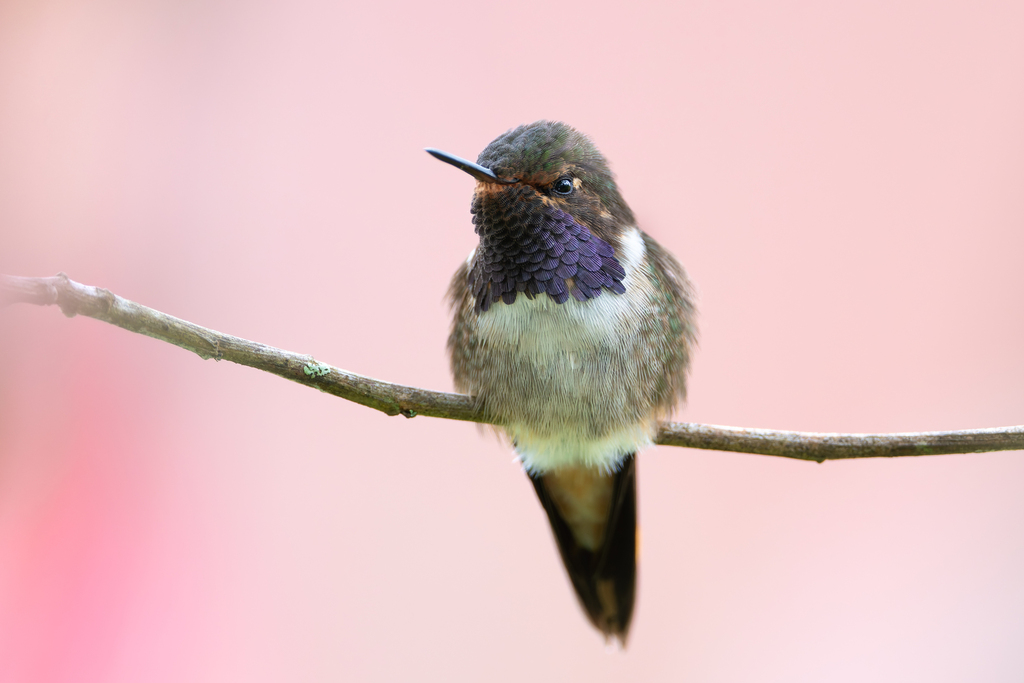
Volcano Hummingbird
Photo © Adam Jackson
Photo © Adam Jackson — CC0 1.0 — Source: iNaturalist photo #424635187Identification
The volcano hummingbird is a tiny species, measuring just 7.5 to 8 centimetres long and weighing approximately 2.5 grams in males and 2.8 grams in females. All birds share a distinctive short, straight black bill and a small white spot behind the eye. The nominate subspecies shows bronze-green upperparts with a striking mauve-purple gorget in males and mostly white underparts washed with buffy-cinnamon on the breast sides. Females are bronze-green above with green central tail feathers and rufous-based outer feathers marked with black bands and buffy-white tips; their throat is whitish with dusky bronze speckles. The other two subspecies differ subtly: S. f. torridus is whiter below with a purplish-gray male gorget, while S. f. simoni is buffier below with more black on the tail and a rose-red male gorget.
Range & Habitat
This species is endemic to the high mountains of Costa Rica and western Panama, with each of its three subspecies occupying specific volcanic regions. The nominate subspecies inhabits Volcanos Irazú and Turrialba in central Costa Rica; S. f. torridus is found on the Cordillera de Talamanca in southern Costa Rica and Volcán Barú in Panama; and S. f. simoni occupies Volcanos Poás and Barva in central Costa Rica. The volcano hummingbird favours semi-open to open habitats on high mountain slopes, including páramo grasslands, second growth on landslide scars, scrubby pastures, and elfin forest edges. It is typically found between 2,000 and 3,500 metres elevation, though it occasionally descends to 1,800 metres and seasonally to 1,350 metres.
Behaviour & Diet
These hummingbirds breed at higher elevations from August or September through February, with some individuals descending to lower elevations after breeding and occasionally moving between adjacent mountains, allowing subspecies to intermix. Males defend small territories and perform distinctive dive displays for females, while females less frequently defend flower clusters. The birds forage for nectar at a wide variety of small flowers on shrubs, vines, herbs, and trees, and also feed at larger flowers that bees or flowerpiercers have punctured. They supplement their diet with small arthropods captured in flight or gleaned from foliage and spider webs, particularly by females.
Best Time & Places to See It
The breeding season from August to February offers the best opportunity to observe volcano hummingbirds, when males are most active with their territorial displays. Visitors should target the high-elevation volcanic regions where each subspecies occurs: Volcanos Irazú and Turrialba for the nominate form, the Cordillera de Talamanca and Volcán Barú for S. f. torridus, and Volcanos Poás and Barva for S. f. simoni. Semi-open habitats and forest edges at 2,000 to 3,500 metres are most productive. All three subspecies benefit from protected areas throughout their range.
Photography Tips
Photographing this diminutive species requires patience and fast shutter speeds; aim for at least 1/2000th of a second to freeze the rapid wing beats. Position yourself near flowering shrubs and vines where birds forage, particularly in early morning when light is favourable and activity peaks. Watch for males performing dive displays—the sound produced by their tail feathers during these dives will alert you to their presence. The striking gorget colours in males are best captured with side or angled lighting that brings out the iridescence. Remember that this species appears on Costa Rica's 20,000 colones currency note, a testament to its cultural significance and photogenic appeal.
Chirripó National Park
Rivas, Costa Rica
+274 birds+6 mammals
Where the volcanic spine of Costa Rica's Central Cordillera reaches its apex, Chirripó National Park encompasses a landscape that shifts dramatically with elevation, from montane cloud…
VIEW NATIONAL PARKBraulio Carrillo National Park
Las Horquetas, Costa Rica
+547 birds+18 mammals
Where the Caribbean slope descends from the central volcanic cordillera toward the humid lowlands of Heredia, Braulio Carrillo National Park preserves one of Costa Rica's most…
VIEW NATIONAL PARKVolcán Poás National Park
Toro Amarillo, Costa Rica
+237 birds+4 mammals
Where volcanic slopes rise sharply from the Central Valley floor, Volcán Poás National Park protects one of Costa Rica's most active and accessible volcanic systems. The…
VIEW NATIONAL PARKBaru Volcano National Park
Cerro Punta, Panama
+402 birds+6 mammals
Where the land rises sharply toward the Caribbean's western spine, Baru Volcano National Park sprawls across roughly 220 square kilometres of southwestern Panama, anchored by the…
VIEW NATIONAL PARKParque Internacional la Amistad
Teribe, Panama
+325 birds+11 mammals
Where the continental divide rises between the Caribbean and Pacific watersheds, a wilderness of extraordinary biological richness unfolds across the Talamanca Range and into lowland rainforest—a…
VIEW NATIONAL PARKLos Quetzales National Park
Copey, Costa Rica
+232 birds+3 mammals
Cloud forest sweeps across the upper slopes of the Central Valley watershed, where elevation and persistent moisture forge an ecosystem unlike any other in Costa Rica.…
VIEW NATIONAL PARKTapantí Macizo de la Muerte National Park
Orosi, Costa Rica
+503 birds+18 mammals
Where montane cloud forest rises steeply from the Orosi Valley, Tapantí Macizo de la Muerte National Park enfolds a landscape of perpetual moisture and emerald complexity.…
VIEW NATIONAL PARKLa Amistad International Park
Crorina, Costa Rica
+532 birds+20 mammals
Where the Caribbean slopes of Costa Rica's Talamanca Mountains rise steeply inland from Limón, the boundary between two nations dissolves into an unbroken expanse of rainforest.…
VIEW NATIONAL PARKNo community photos yet. Log in to add the first one.
No community observations of this species yet.