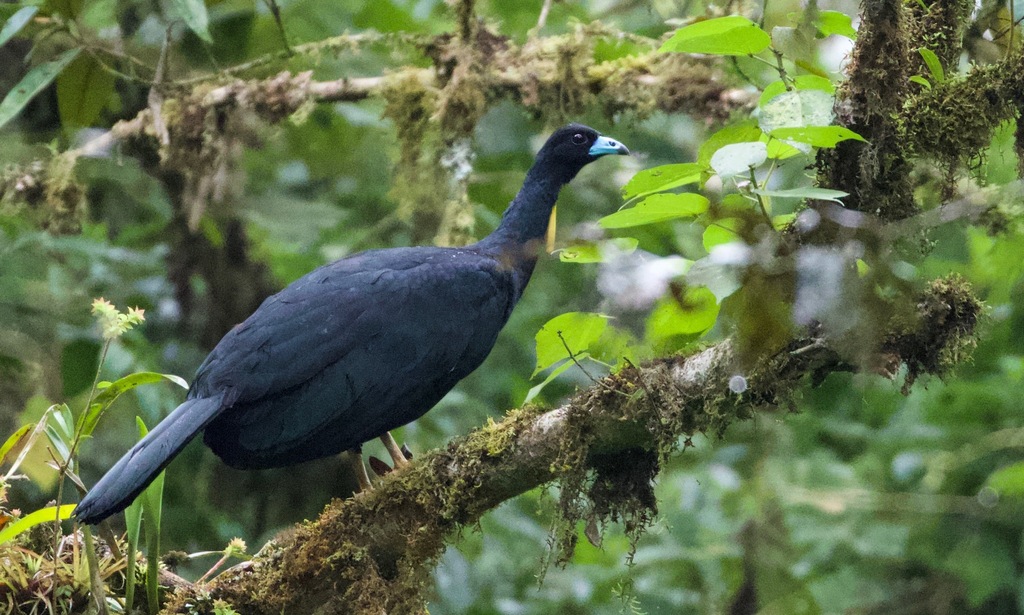
Wattled Guan
Photo © RJ Baltierra
Photo © RJ Baltierra — CC BY 4.0 — Source: iNaturalist photo #264014457Identification
The wattled guan is a fairly large, striking bird that is unmistakable once observed. It measures about 75 centimetres in length and weighs between 1,200 and 1,550 grams, with a notably long tail. The plumage is entirely black, providing a dramatic backdrop for its most distinctive feature: an elongated red-and-yellow fleshy wattle that dangles prominently from its throat. The bird has a blue-based, black-tipped beak and flesh-coloured feet, completing its rather austere but elegant appearance.
Range & Habitat
The wattled guan is endemic to the foothills of the Andes in South America, with its range extending from northwestern Venezuela through Colombia, Ecuador and Bolivia to southern Peru. Historically found on the western slopes of the Andes, it is believed no longer to occur there. Today it is rare in Venezuela but slightly more common in Colombia, with most populations found on the eastern Andean slopes.
The species inhabits wet mountain forest and woodland verges, and also occurs in secondary forest across its range. It is altitudinally distributed between 500 and 2,500 metres, making it a bird of montane and foothill regions rather than lowland areas.
Behaviour & Diet
The wattled guan is a fairly shy species that presents a challenge to birdwatchers and wildlife observers. It is mostly seen when it perches on the outer edge of the canopy, typically at some distance from the observer, making prolonged viewing difficult. Like many tropical forest birds, it is heard far more often than it is seen, with its calls drawing attention in the forested landscape.
Best Time & Places to See It
Those seeking the wattled guan should focus on the Andean foothills of northwestern South America, particularly in Colombia where the species is more regularly encountered than in Venezuela. The bird's preference for the outer canopy edge and its shy demeanour mean that patience and good optics are essential. Early morning hours often provide the best opportunity to locate birds through their vocalizations before attempting to spot them visually in the canopy.
Photography Tips
Photographing the wattled guan requires patience, as the bird typically remains at a distance on the canopy perimeter. A telephoto lens is essential to capture acceptable frame-filling images. Since the species is heard more often than seen, listening carefully and moving slowly through suitable montane forest habitat may increase chances of locating individuals. Early morning light in mountain forest can be challenging; a camera capable of performing well at higher ISO settings will improve success rates in the dappled forest environment where these birds typically perch.
Podocarpus National Park
Zamora, Ecuador
+496 birds+6 mammals
Where the Andes descend toward the Amazon basin, Podocarpus National Park sprawls across nearly 2,800 square kilometres of the most biodiverse terrain in Ecuador's southern highlands.…
VIEW NATIONAL PARKSumaco Napo-Galeras National Park
Loreto, Ecuador
+563 birds+4 mammals
Where Ecuador's Amazon transitions into cloud forest, a massive shield volcano rises from the emerald lowlands of Orellana Province, anchoring one of the continent's most biodiverse…
VIEW NATIONAL PARKAntisana National Park
Quijos, Ecuador
+432 birds+21 mammals
Where the eastern Andean slopes descend into the Amazon basin, Antisana National Park sprawls across roughly 2,500 square kilometers of some of South America's most dramatic…
VIEW NATIONAL PARKLlanganates National Park
Tena, Ecuador
+239 birds+8 mammals
Where the eastern slopes of the Andes plunge toward the Amazon basin, Llanganates National Park sprawls across nearly 3,500 square kilometers of montane wilderness, its terrain…
VIEW NATIONAL PARKNatural Serranía de los Churumbelos National Park
Santa Rosa, Colombia
+70 birds+2 mammals
Where the western cordillera of Colombia rises toward the Pacific watershed, the Serranía de los Churumbelos unfolds across more than 3,200 square kilometers of some of…
VIEW NATIONAL PARKNatural Serranía de los Yariguíes National Park
El Carmen de Chucurí, Colombia
+320 birds+3 mammals
Where the northern cordilleras of Colombia rise toward cloud forest, the Serranía de los Yariguíes unfolds across nearly 1,820 square kilometers of some of the most…
VIEW NATIONAL PARKNatural el Cocuy National Park
Güicán, Colombia
+313 birds+3 mammals
Where the Andes rise to their highest peaks in Colombia's eastern cordillera, El Cocuy National Park sprawls across more than 6,600 square kilometers of some of…
VIEW NATIONAL PARKGuácharos Cave National Natural Park
Acevedo, Colombia
+359 birds
High in the Andean foothills of southern Huila, where mist-laden slopes rise above 1,600 metres, lies a landscape carved by underground rivers and crowned by karst…
VIEW NATIONAL PARKEl Tamá National Park
Toledo, Colombia
+435 birds
Where the Andes descend toward the Caribbean coastal lowlands of northern Colombia, El Tamá National Park sprawls across nearly 3,800 square kilometres of montane forest, cloud…
VIEW NATIONAL PARKNatural Sierra de la Macarena National Park
Vista Hermosa, Colombia
+566 birds+15 mammals
Across nearly 20,000 square kilometres of Colombia's Meta Department, the terrain rises from lowland savanna into Andean foothills through a mosaic of gallery forests, palm-fringed wetlands,…
VIEW NATIONAL PARKNo community photos yet. Log in to add the first one.
No community observations of this species yet.