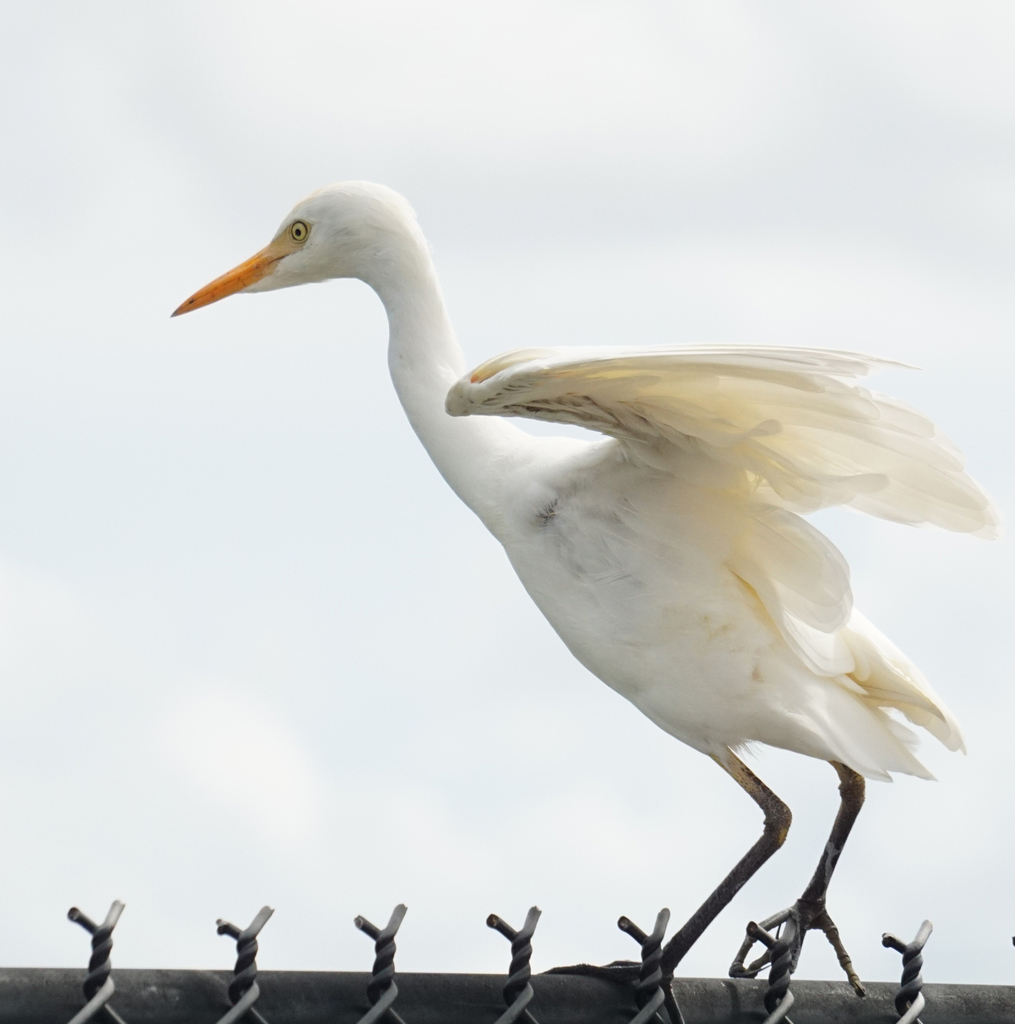
Western Cattle Egret
Photo © Eridan Xharahi
Photo © Eridan Xharahi — CC BY 4.0 — Source: iNaturalist #62829441Identification
The western cattle egret is a stocky heron with a relatively short thick neck, sturdy bill, and hunched posture. It measures 46–56 cm in length with a wingspan of 88–96 cm, and weighs 270–512 g. Non-breeding adults are predominantly white with a yellow bill and greyish-yellow legs. During breeding season, adults develop striking orange-buff plumes on the back, breast and crown, while the bill, legs and irises briefly turn bright red prior to pairing. Males are marginally larger with slightly longer breeding plumes than females. Juvenile birds lack coloured plumes and have a black bill. The positioning of the egret's eyes allows for binocular vision during feeding.
Range & Habitat
Originally native to parts of southern Spain and Portugal, tropical and subtropical Africa, and western Asia, the western cattle egret has undergone one of the most rapid and wide-reaching natural expansions of any bird species. It now occurs throughout the tropics, subtropics and warm temperate zones, having successfully colonised much of the New World in the last century. The species has spread from Africa into southern Africa, and crossed the Atlantic to establish itself throughout the Americas from Canada to South America, while expanding across Europe from the Iberian Peninsula eastward.
Unlike other herons, western cattle egrets exploit drier and open habitats. Their feeding habitats include seasonally inundated grasslands, pastures, farmlands, wetlands and rice paddies. They nest in colonies, usually near bodies of water and often alongside other wading birds, building platform nests of sticks in trees or shrubs.
Behaviour & Diet
The western cattle egret maintains a special relationship with cattle and other large grazing mammals. They often accompany these animals, catching insect and small vertebrate prey disturbed during grazing. Remarkably, they remove ticks and flies from livestock—a mutualistic relationship that benefits both species, though it has been implicated in spreading tick-borne animal diseases. Some populations are migratory while others show post-breeding dispersal. The species is largely silent except at breeding colonies, where adults give a quiet, throaty rick-rack call.
Adult cattle egrets have few natural predators, but birds and mammals may raid nests, and chicks may succumb to starvation, calcium deficiency or disturbance from larger birds. The species' dramatic range expansion is closely linked to human farming and livestock keeping, which created ideal foraging opportunities worldwide.
Best Time & Places to See It
Western cattle egrets are now widespread across tropical, subtropical and warm temperate regions globally. They are commonly encountered in agricultural areas, particularly around pastures and farmland where cattle graze. Look for them in seasonally inundated grasslands, rice paddies, and near wetlands, often in the company of livestock herds. Some populations are migratory, so sightings may vary seasonally depending on location. Their presence is now established across much of the Americas, Europe, Africa and Asia.
Photography Tips
The breeding plumage—with its distinctive orange-buff head and body plumes and bright red bill and legs—offers the most striking photographic opportunities. Capture birds during the breeding season when they congregate in colonies near water and in trees. Their association with cattle provides opportunities for behavioural shots showing them foraging alongside livestock. The bird's relatively short stature and hunched posture are characteristic features worth emphasizing. Their quiet nature makes them approachable, though colonies are often sensitive to disturbance during nesting season; maintain distance to avoid stressing birds and causing nest abandonment.
Lake Mburo National Park
Mabamba Swamp
Murchison Falls National Park
Alpilles Regional Nature Park
Amboseli National Park
Arenal Volcano National Park
Arusha National Park
Avesnois Regional Nature Park
Bangweulu National Park
Nothing matches these filters.
No community photos yet. Log in to add the first one.
No community observations of this species yet.