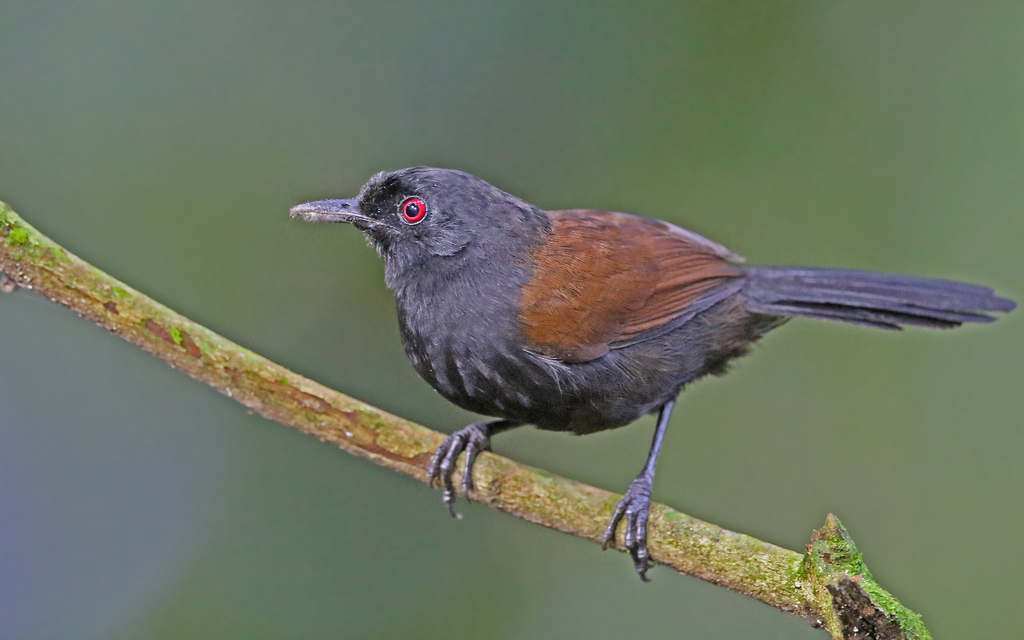
Western Fire-eye
Photo © Christoph Moning
Photo © Christoph Moning — CC BY 4.0 — Source: iNaturalist photo #160326197Identification
The Western Fire-eye is a small antbird measuring 16 to 18 cm in length, with a distinctive bright red iris that gives the species its common name. Males are unmistakable, displaying glossy black plumage with a partially hidden white patch between their scapulars and blackish gray underwing coverts. Females show remarkable variation across subspecies: some have light rufescent brown upperparts with white superciliums and buffy underparts, while others are predominantly sooty black with chestnut-brown mantles, or display dark reddish-brown plumage with distinctive head markings. All individuals share the conspicuous red eye that characterizes this genus.
Range & Habitat
The Western Fire-eye is distributed across the western Amazon Basin and Andes, found in Bolivia, Brazil, Colombia, Ecuador, Paraguay, and Peru. Six subspecies occupy different regions, from western Ecuador and northwestern Peru through the Colombian and Ecuadorian Andes, the Peruvian highlands, and southern lowlands in Bolivia, Brazil, and Paraguay. The species primarily inhabits dense understory vegetation in lowland and foothill evergreen forests, favoring the edges of primary forest, mature secondary growth, and natural clearings created by fallen trees. Elevational range varies by region, from near sea level in western Ecuador to 2,500 m in Colombia and up to 2,200 m in Bolivia and Peru.
Behaviour & Diet
The Western Fire-eye is a year-round resident throughout its range. It forages singly, in pairs, or in family groups, hunting primarily on the ground and within 3 meters of it, though occasionally reaching 5 meters high. This insectivorous species captures a wide variety of prey including orthopterans, beetles, ants, wasps, moths, and butterflies in both adult and larval stages, supplemented by spiders, centipedes, and small lizards up to 11 cm long. Characteristic behaviors include hopping between short feeding stops while pumping the tail, and capturing prey through gleaning, reaching, jumping, lunging from perches, and tossing aside leaf litter. A notable behavior is regular attendance at army ant swarms, where multiple family groups may congregate to capture prey flushed by the ants, though the species is subordinate to obligate ant-followers.
Best Time & Places to See It
The Western Fire-eye is a year-round resident, offering opportunities for observation throughout the year. In Brazil, breeding activity peaks between August and November, which may influence local activity levels. The species is found at forest edges, in second-growth forest, and in gaps created by fallen trees—habitats that are often easier to access than primary forest interior. Look for this bird in suitable elevations within its range: lowland forests in Brazil and Paraguay, foothill forests throughout the Andes, and higher elevation montane forest in Peru, Ecuador, Colombia, and Bolivia. Patient observation of understory vegetation, particularly near army ant swarms when they occur, will increase the chances of sighting.
Photography Tips
The bright red iris is the defining field mark and should be your primary focus when photographing this species. Males are relatively straightforward subjects with their glossy black plumage, though care should be taken to capture the subtle white scapular patch. Females present a greater challenge due to plumage variation among subspecies; research the subspecies in your target region beforehand. The bird's habit of foraging low in dense vegetation and pumping its tail as it hops provides recognizable behavior to capture. Early morning light is essential for revealing the plumage details and the characteristic red eye. Use a fast shutter speed to freeze the bird's active foraging movements, and position yourself patiently near understory edges and clearings where the bird is most visible.
Cerros de Amotape National Park
District of San Jacinto, Ecuador
+246 birds+1 mammals
Arid mountains rise abruptly from Peru's northwestern frontier, their slopes clothed in xerophytic scrubland and seasonal deciduous forest that transforms these Andean foothills into one of…
VIEW NATIONAL PARKSumaco Napo-Galeras National Park
Loreto, Ecuador
+563 birds+4 mammals
Where Ecuador's Amazon transitions into cloud forest, a massive shield volcano rises from the emerald lowlands of Orellana Province, anchoring one of the continent's most biodiverse…
VIEW NATIONAL PARKAntisana National Park
Quijos, Ecuador
+432 birds+21 mammals
Where the eastern Andean slopes descend into the Amazon basin, Antisana National Park sprawls across roughly 2,500 square kilometers of some of South America's most dramatic…
VIEW NATIONAL PARKNatural Serranía de los Churumbelos National Park
Santa Rosa, Colombia
+70 birds+2 mammals
Where the western cordillera of Colombia rises toward the Pacific watershed, the Serranía de los Churumbelos unfolds across more than 3,200 square kilometers of some of…
VIEW NATIONAL PARKGuácharos Cave National Natural Park
Acevedo, Colombia
+359 birds
High in the Andean foothills of southern Huila, where mist-laden slopes rise above 1,600 metres, lies a landscape carved by underground rivers and crowned by karst…
VIEW NATIONAL PARKChapada dos Guimarães National Park
Brazil
+450 birds+1 mammals
Where weathered sandstone plateaus rise above the cerrado grasslands of central Brazil, Chapada dos Guimarães National Park protects 624 square kilometres of ecological transition zone that…
VIEW NATIONAL PARKYanachaga–chemillén National Park
Palcazu, Peru
+639 birds+6 mammals
Where the eastern slopes of Peru's central cordillera plunge into cloud forest, Yanachaga–Chemillén National Park protects nearly three thousand square kilometres of montane wilderness that few…
VIEW NATIONAL PARKManu National Park
Manu, Peru
+892 birds+26 mammals
Across the eastern slopes of the Peruvian Andes, tropical rainforest descends into the Amazon basin with a complexity that few terrestrial ecosystems match. Manu National Park…
VIEW NATIONAL PARKBahuaja Sonene National Park
San Pedro de Putina Punco, Peru
+602 birds+8 mammals
Where the Madre de Dios and Heath rivers converge in southeastern Peru rises one of South America's most biodiverse wilderness regions: a vast protected realm of…
VIEW NATIONAL PARKTingo Maria National Park
Mariano Dámaso Beraún, Peru
+423 birds
Where the eastern slopes of the Peruvian Andes descend toward the Amazon basin, the landscape fractures into a maze of limestone ridges, humid gorges, and cloud-wrapped…
VIEW NATIONAL PARKCordillera Azul National Park
Pampa Hermosa, Peru
+322 birds+1 mammals
Where the eastern Andes descend into the western Amazon basin, Cordillera Azul National Park sprawls across nearly 38,000 square kilometres of some of Peru's most pristine…
VIEW NATIONAL PARKNo community photos yet. Log in to add the first one.
No community observations of this species yet.