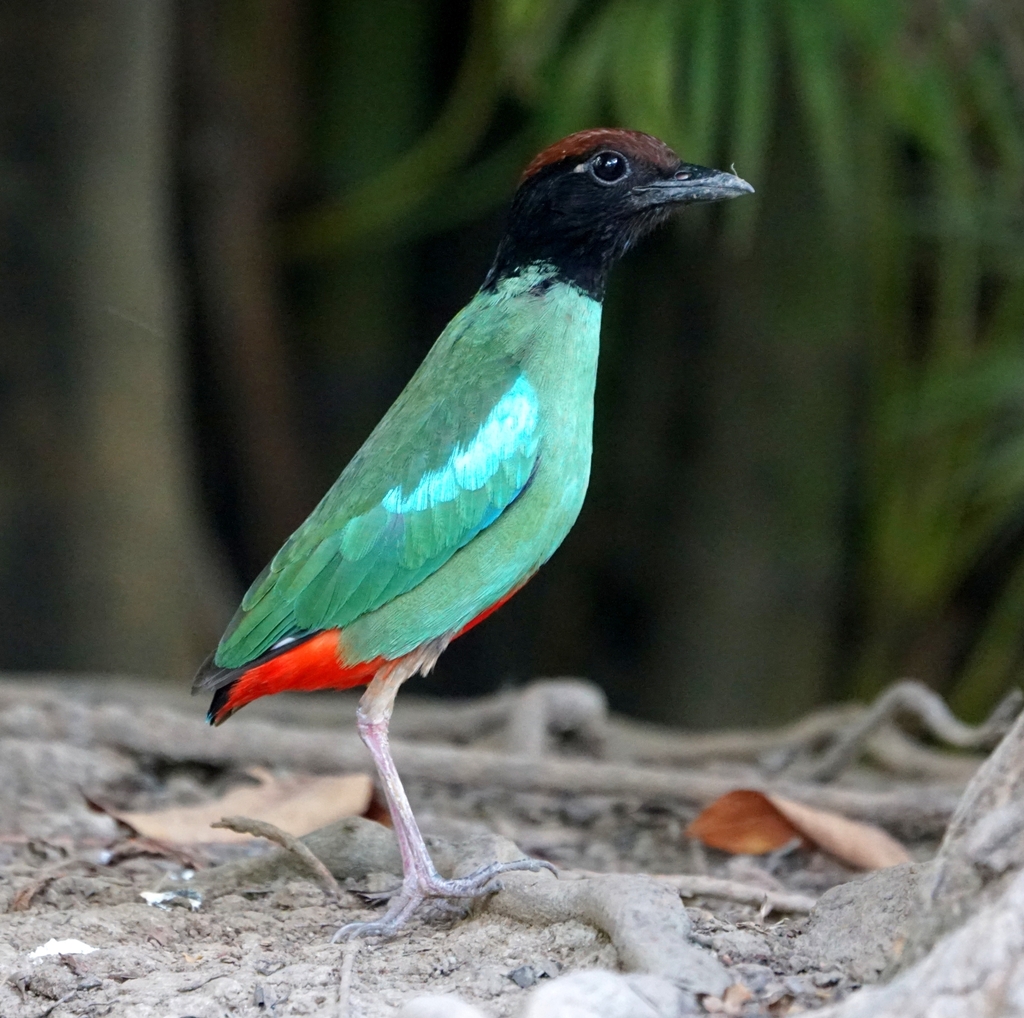
Western Hooded Pitta
Photo © Focus Saranpat Ouilapan
Photo © Focus Saranpat Ouilapan — CC BY 4.0 — Source: iNaturalist #208460744Identification
The western hooded pitta is a small passerine, measuring 16 to 19 cm in length and weighing between 42 to 70 grams. Its striking plumage makes it relatively easy to identify: a distinctive black head topped with a chestnut crown contrasts sharply with its predominantly green body and wings. This compact bird's bold colouration pattern is characteristic of the pitta family, making it an unmistakable sight for birdwatchers in its range.
Range & Habitat
The western hooded pitta is common throughout eastern and southeastern Asia and maritime Southeast Asia. Its range encompasses diverse regions, from north India and south China through Indochina, the Malay Peninsula, Sumatra, Java, Borneo, the Philippines, and various island groups including the Sangihe Islands. Six recognised subspecies are distributed across this vast territory, each adapted to slightly different regional conditions.
This adaptable species inhabits several forest types as well as plantations and other cultivated areas. Its willingness to occupy human-modified landscapes alongside natural forest environments contributes to its widespread distribution and common status across its range.
Behaviour & Diet
The western hooded pitta is primarily a ground forager, spending much of its time searching the forest floor for insects and their larvae, supplementing its diet with berries. It is a highly territorial bird, and its presence is often announced by distinctive fluty double-noted whistle calls—a characteristic "qweeek-qweeek" sound that can be heard constantly from its territories, sometimes even throughout the night.
The breeding season extends from February to August, during which time pairs remain strongly territorial. Both parents participate in nest construction on the ground and share responsibility for incubating eggs and caring for fledglings, demonstrating the species' cooperative breeding behaviour.
Best Time & Places to See It
The extended breeding season from February to August offers excellent opportunities for observation, as birds are vocal and active during this period. The species' common status throughout its range means sightings are fairly reliable in suitable habitat across eastern and southeastern Asia, the Malay Peninsula, the Indonesian archipelago, and the Philippines.
Forest areas, particularly those with accessible ground cover and nearby cultivated lands, offer the best chances of encounters. Listen for the distinctive territorial calls, which provide a reliable audio cue to the bird's presence even when visual contact proves difficult.
Photography Tips
The western hooded pitta's striking black and chestnut head contrasts beautifully with its green plumage, making it a rewarding photographic subject when successfully located. Since the bird forages primarily on the ground, positioning yourself low and remaining patient will increase your chances of capturing natural behaviour.
The bird's vocal nature means that locating individuals by sound is an effective strategy. Early morning hours, when territorial calling is most frequent, provide optimal conditions for both observation and photography. The extended breeding season offers sustained opportunities for fieldwork and image capture.
Orang National Park
Rangagarapathar, India
+298 birds+1 mammals
Where the Brahmaputra's floodplains meet the foothills of Assam, Orang National Park unfolds across a mosaic of riverine grasslands, forests and wetlands that pulse with the…
VIEW NATIONAL PARKHat Noppharat Thara-Mu Ko Phi Phi National Park
Ao Nang, Thailand
+253 birds+9 mammals
Where limestone karsts rise dramatically from turquoise waters, Hat Noppharat Thara-Mu Ko Phi Phi National Park unfolds across a mosaic of beach, mangrove forest, and island…
VIEW NATIONAL PARKKhao Yai National Park
Prachantakham District, Thailand
+377 birds+46 mammals
Evergreen dipterocarp forest blankets the rolling terrain of this national park in eastern Thailand, where limestone hills rise abruptly from the forest floor and seasonal streams…
VIEW NATIONAL PARKKaziranga National Park
Kohora, India
+422 birds+26 mammals
Dawn breaks over the floodplains of the Brahmaputra, where tall grasslands stretch endlessly beneath monsoon-heavy skies. This sprawling wilderness of northeastern Assam is a mosaic of…
VIEW NATIONAL PARKBako National Park
Kuching, Malaysia
+210 birds+17 mammals
Weathered sandstone cliffs rise dramatically from the South China Sea, their ochre faces sculpted by millennia of wind and tide into a landscape of extraordinary geological…
VIEW NATIONAL PARKTaman Negara National Park
Kampong Samas, Malaysia
+393 birds+48 mammals
Where ancient rainforest meets limestone peaks, one of Southeast Asia's oldest protected wilderness preserves sprawls across 4,343 square kilometers of primordial landscape. Dipterocarp giants tower overhead,…
VIEW NATIONAL PARKGunung Mulu National Park
Long Seridan, Malaysia
+280 birds+39 mammals
Where granite monoliths pierce the rainforest canopy of Sarawak, an ancient limestone karst landscape reveals one of Southeast Asia's most biodiverse strongholds. Soaring peaks cloaked in…
VIEW NATIONAL PARKBerbak National Park
Tanjung Jabung Timur, Indonesia
+24 birds
Across the lowland peatswamps and tidal forests of eastern Sumatra's coast, Berbak National Park sprawls over more than 3,000 square kilometres of one of Southeast Asia's…
VIEW NATIONAL PARKGunung Palung National Park
Kayong Utara, Indonesia
+38 birds+1 mammals
Rainforest swells across the steep terrain of West Kalimantan, where ancient volcanic ridges rise abruptly from lowland swamps and weathered plateaus. Gunung Palung National Park encompasses…
VIEW NATIONAL PARKWay Kambas National Park
Lampung Timur, Indonesia
+237 birds+20 mammals
Across the low swamplands of eastern Lampung, where freshwater wetlands merge into tidal mangrove forests along the Sunda Strait, sprawls one of Sumatra's most vital sanctuaries.…
VIEW NATIONAL PARKNo community photos yet. Log in to add the first one.
No community observations of this species yet.