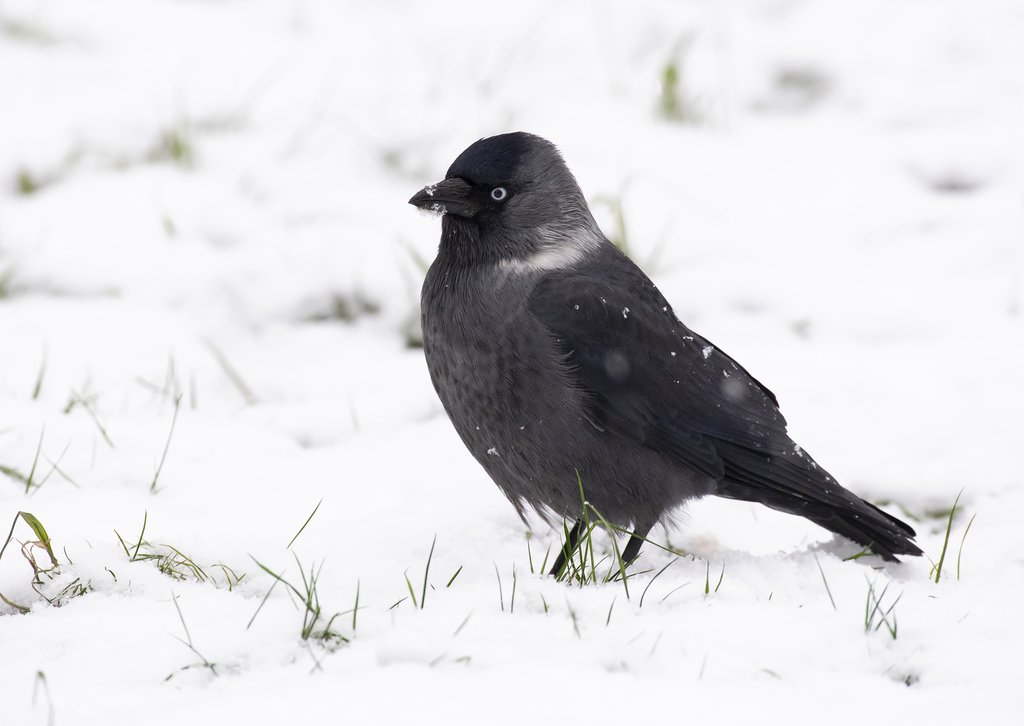
Western Jackdaw
Photo © Griha Hasanov
Photo © Griha Hasanov — CC BY 4.0 — Source: iNaturalist photo #173003326Identification
The western jackdaw is a compact corvid measuring 34–39 centimetres in length. Its most distinctive features are its predominantly black plumage contrasted with a pale grey nape and, most notably, its striking pale iris—a characteristic that immediately sets it apart from larger, darker-eyed crows. Four subspecies are recognised across its range, differing mainly in the tone of their head and nape plumage, ranging from darker to paler greyscale.
Range & Habitat
This adaptable species is found across Europe, western Asia, and western North Africa. Most populations are resident year-round, though northern and eastern populations migrate south during winter. The western jackdaw thrives in remarkably diverse habitats, from farmland and open woodland to coastal cliffs and increasingly in urban settings, where it has become a familiar and vocal presence in towns and cities.
Behaviour & Diet
Western jackdaws are highly gregarious and social birds, living in small groups with complex social hierarchies. They are notably intelligent, having been observed using tools—a behaviour shared with their corvid relatives. Vocally expressive, they communicate through a variety of calls that have inspired their common names throughout history.
As omnivorous and opportunistic feeders, jackdaws display remarkable dietary flexibility. They consume a wide variety of plant material and invertebrates, readily supplementing their diet with food waste from urban areas. They are monogamous breeders, constructing simple stick nests in cavities found in trees, cliffs, or buildings. Females lay approximately five pale blue or mint green eggs with brown to grey speckles, incubating them alone. Young birds fledge within four to five weeks.
Best Time & Places to See It
Western jackdaws are present year-round across much of their European range, making them accessible to travellers and birders throughout the seasons. Look for them in farmland, open woodland, and especially in urban parks and town centres where they gather in small, noisy flocks. Coastal cliffs and areas near historic buildings—where they nest in cavities—are particularly rewarding locations.
Photography Tips
The pale iris is the key field mark to capture; photograph the head at angles that catch the light in the eye. Their gregarious nature means they're often found in small groups, offering opportunities for flock photography. Urban and coastal settings provide varied backdrops. Early morning is ideal for capturing their activity and the subtle grey tones of the nape against black plumage. Their vocal and animated behaviour makes them engaging photographic subjects, particularly during breeding season when they're active around nesting sites.
Abruzzo, Lazio and Molise National Park
Aggtelek National Park
Alpilles Regional Nature Park
Alta Murgia National Park
Altai Tavan Bogd National Park
Appennino Lucano Val d’Agri Lagonegrese National Park
Asinara National Park
Åsnens National Park
Avesnois Regional Nature Park
Nothing matches these filters.
No community photos yet. Log in to add the first one.
No community observations of this species yet.