Identification
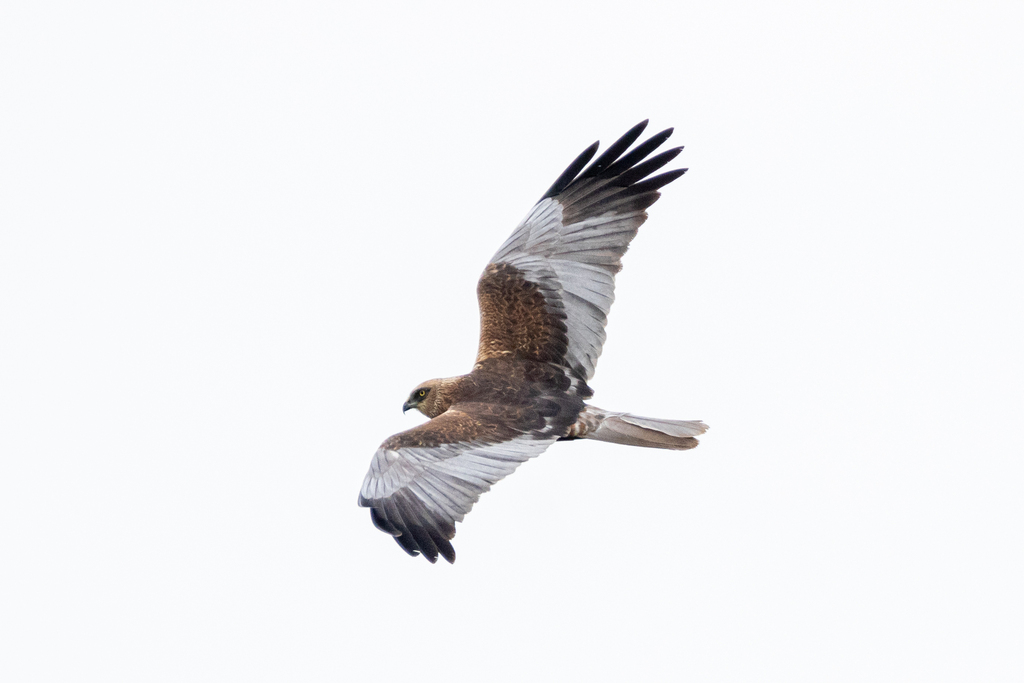
The western marsh harrier is a large, bulky bird of prey measuring 48 to 56 cm in length with a wingspan of 115 to 130 cm. It is noticeably larger than other European harriers and shows striking sexual dimorphism. Males display mostly cryptic reddish-brown plumage with lighter yellowish streaks, particularly prominent on the breast, while the head and shoulders are pale greyish-yellow. Their wings are characteristically three-colored in flight: brown forewing, grey secondary and tertiary feathers, and black primary wingtips. Females are almost entirely chocolate-brown with a conspicuously lighter yellowish head, throat, and shoulders that contrast sharply with their darker eye area. Juveniles resemble females but typically have less yellow on the shoulders. A rare dark morph exists, particularly in the eastern part of the range, where juveniles may appear entirely black in flight. Both sexes have yellow legs, feet, and facial markings.
Range & Habitat
This species has a wide breeding range extending from Europe and northwestern Africa through Central Asia to Mongolia, Lake Baikal, and northwestern China. It breeds across nearly every European country except mountainous regions and subarctic Scandinavia, and is rare but increasing in Great Britain, having spread as far as eastern Scotland. Most populations are migratory or dispersive, wintering in southern Europe, the Sahel, Nile basin, Great Lakes region of Africa, Arabia, the Indian subcontinent, and Myanmar. The resident subspecies harterti is found year-round in Morocco, Algeria, and Tunisia.
Western marsh harriers are strongly associated with wetland areas rich in common reed, though they also frequent farmland and grassland bordering marshland. They are territorial during breeding season and less social than other harriers, though this reflects their habitat preferences rather than inherent behavior. In winter, they gather at favored roost sites, with notable concentrations observed in places like Keoladeo National Park in Rajasthan, India, where around 100 individuals assemble in tall grassland each November and December.
Behaviour & Diet
The western marsh harrier is a characteristic harrier, defined partly by its circling flight pattern—the genus name Circus derives from the Ancient Greek word for circle. While specific hunting and feeding behaviors are not detailed in available sources, like other harriers the species is a predator adapted to hunting over open and wetland terrain. Males weigh 400 to 650 grams while females are heavier at 550 to 800 grams, with females' greater size potentially allowing them to tackle larger prey. The species exhibits territorial behavior during the breeding season and shows some tendency to gather at concentrated food sources.
Best Time & Places to See It
The best opportunities to observe western marsh harriers depend on whether you are visiting breeding or wintering grounds. In Europe, the breeding season offers chances to see them across their wide range, particularly in wetland-rich areas of central and eastern Europe. In winter, large concentrations gather in milder regions: the Sahel and Nile basin in Africa are productive locations, as is the Indian subcontinent. The most reliably accessible winter viewing site is Keoladeo National Park in Rajasthan, India, where approximately 100 birds congregate each November and December in tall grassland habitats. Spring and autumn migrations also present opportunities in intermediate regions along their range.
Photography Tips
Photographing western marsh harriers requires understanding their preferred habitats and flight patterns. The species' distinctive circling flight makes it visible from considerable distances, allowing photographers to position themselves in open areas bordering marshland or grassland. Males' three-colored wing pattern—brown, grey, and black—is most clearly visible in flight from below or the side, making elevated positions valuable. Females' chocolate-brown plumage with contrasting pale head and dark eye-patch are diagnostic features worth capturing. Early morning and late afternoon light in winter roost sites like Keoladeo National Park will illuminate these birds during their most predictable, concentrated periods. Patient observation of their soaring and quartering flight over reed beds and grassland will yield the best action shots.