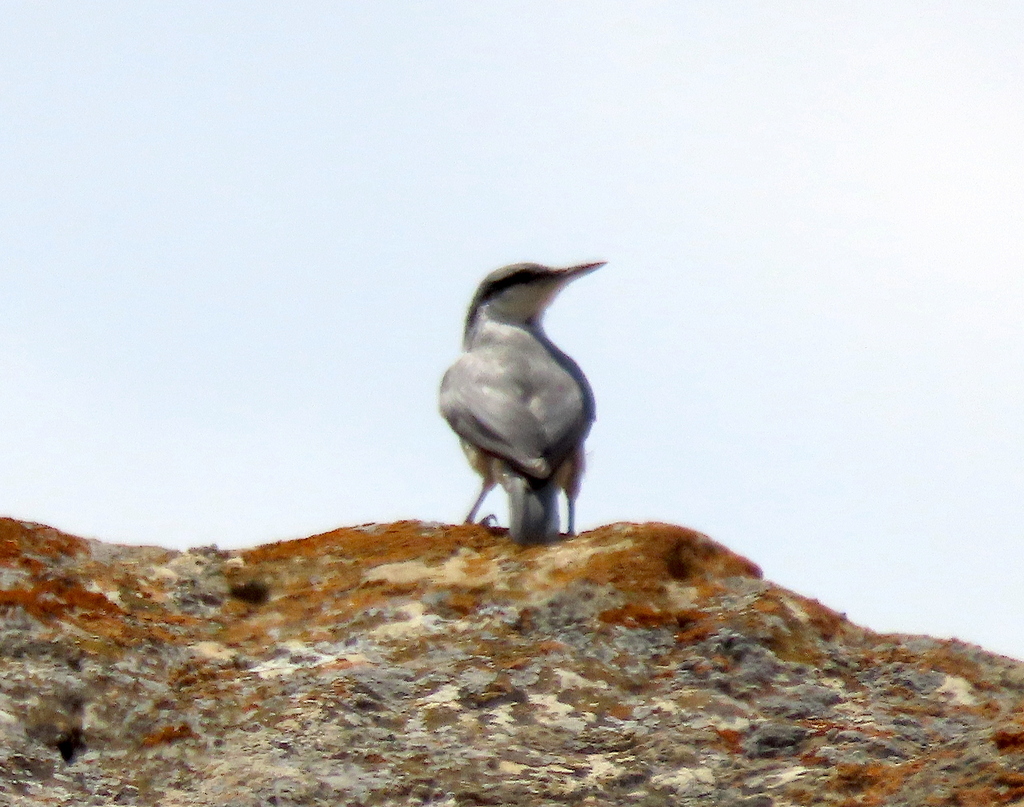
Western Rock Nuthatch
Photo © Mayela y Ramón
Photo © Mayela y Ramón — CC BY-SA 4.0 — Source: iNaturalist #122146749Identification
The western rock nuthatch is a small passerine measuring 13.5 cm long, slightly smaller than the Eurasian nuthatch. It displays the characteristic nuthatch features: a notably large head, short tail, and powerful bill and feet. The species is notably long-legged and long-billed compared to most of its relatives. The nominate subspecies (S. n. neumayer) of Southeast Europe and the Middle East shows dark grey upperparts with a long, well-marked black eyestripe, white throat, and underparts shading to buff on the belly. Sexes are similar in appearance, with young birds presenting slightly duller versions of adult plumage. Two subspecies occurring in the Zagros Mountains and southern Iran are paler grey above with much weaker eyestripes.
Range & Habitat
The western rock nuthatch breeds from Croatia east through Greece and Turkey to Iran, with three recognized subspecies distributed across this range. This species is largely resident throughout the year, though some post-breeding dispersal occurs. Birds at the highest altitudes may move to lower elevations during winter months.
The species is closely associated with bare rocky habitats, particularly in mountainous areas where suitable rock formations provide essential shelter and feeding sites. It is common in suitable habitat across most of its range.
Behaviour & Diet
The western rock nuthatch is highly territorial and constructs distinctive flask-shaped nests from mud, dung, and hair or feathers, typically built within rock crevices, caves, or under rock overhangs. The entrance is sealed with mud, and the interior is lined with softer materials. Decorative items may be pushed into nearby crevices and cracks near the nest entrance. The species lays 4–10 white eggs speckled with yellow.
This nuthatch feeds on insects and spiders during summer months, supplemented by seeds and snails in winter. It forages on the ground and characteristically wedges larger food items into rock crevices, hammering them open with its powerful bill. It will also flycatch for aerial prey. The species produces a tsik call and a trilled tui tui tui song.
Best Time & Places to See It
The western rock nuthatch is most reliably encountered in rocky mountainous regions throughout its range from Croatia and Greece through Turkey to Iran. The nominate subspecies is particularly well-represented across Southeast Europe, Turkey, and the Middle East. The species is common in suitable habitat and can be found year-round in most locations, though high-altitude populations may be more easily accessed during warmer months before their winter descent.
Photography Tips
The western rock nuthatch's association with rocky, mountainous terrain makes it an exciting subject for wildlife photographers. Look for birds foraging on rock faces and ground areas, where their characteristic behavior of wedging food into crevices provides compelling photographic opportunities. The species' distinctive black eyestripe and contrasting plumage make it visually striking when photographed in good light. Patient observation near suitable rocky habitats will reward photographers with opportunities to capture this territorial bird at its nest sites and feeding areas.
Mount Parnitha National Park
Municipal Unit of Acharnes, Greece
+137 birds+4 mammals
Where pine-clad ridges rise abruptly from the Attica plains, Mount Parnitha National Park unfolds across nearly 4,000 hectares of Mediterranean mountain wilderness. The park's defining character…
VIEW NATIONAL PARKSounio National Park
Municipal Unit of Ayios Konstantinos, Greece
+103 birds
Where rocky headlands plunge into the Aegean Sea along Attica's southeastern coast, Sounio National Park preserves a landscape shaped by millennia of human presence yet alive…
VIEW NATIONAL PARKButrint National Park
Vagalat, Albania
+140 birds+3 mammals
Where the Ionian coast meets ancient alluvial plains, Butrint National Park spans a landscape of extraordinary ecological complexity that has shaped human settlement for three millennia.…
VIEW NATIONAL PARKOlympos National Park
Pieria Regional Unit, Greece
+137 birds+3 mammals
Where the Thessalian plains give way to soaring limestone massifs, Olympos National Park rises as one of the Aegean's most dramatic mountain wilderness areas. This IUCN…
VIEW NATIONAL PARKKerkini Lake National Park
Serres, Greece
+291 birds+18 mammals
Where the Strymon River widens into a sprawling freshwater lake hemmed by the Rhodope Mountains, Kerkini National Park unfolds across northern Greece as one of southeastern…
VIEW NATIONAL PARKNo community photos yet. Log in to add the first one.
No community observations of this species yet.