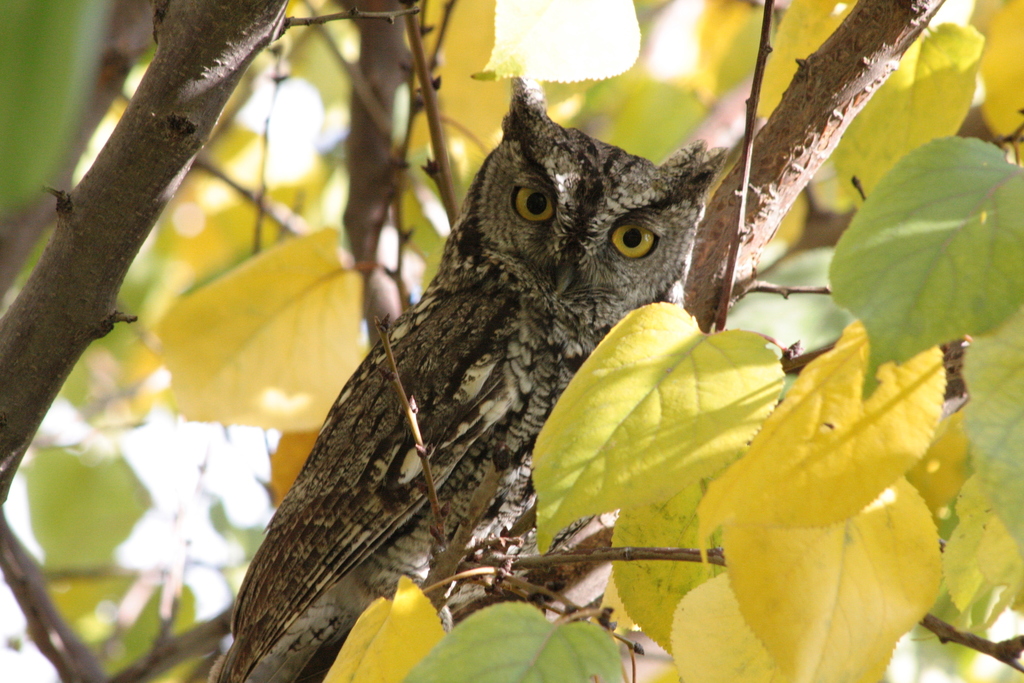
Western Screech Owl
Photo © Rocio Reybal
Photo © Rocio Reybal — CC BY 4.0 — Source: iNaturalist photo #87475442Identification
The western screech owl is a small owl averaging 22 cm in length with a wingspan of 55 cm and weighing around 143 g, though northern populations are notably larger than southern ones. Females are larger than males. The bird displays brown or dark gray plumage with distinctive streaking on the underparts, providing effective camouflage against tree bark. It has a round head with prominent ear tufts, striking yellow eyes, and a yellowish bill. Unlike some screech owl relatives, there is no red morph. Adults are larger than whiskered screech owls and have larger feet and more heavily streaked plumage.
Identification can be challenging as the western screech owl closely resembles both the whiskered and eastern screech owls. For accurate field identification, listening to vocalizations is most reliable. The bird's appearance alone may not be sufficient for definitive species identification.
Range & Habitat
The western screech owl is native to Canada, the United States, Mexico, Guatemala, El Salvador, Honduras, Costa Rica, and Nicaragua. It inhabits a diverse range of environments including temperate forests, subtropical and tropical montane forests, shrubland, desert, rural fields, and suburban parks and gardens. The species is a permanent resident throughout its range.
Behaviour & Diet
These nocturnal hunters are active at dawn, dusk, and throughout the night, relying on their excellent hearing and night vision to locate prey. They typically wait on perches before swooping down on unsuspecting prey, though they also catch insects in flight. Their diet is opportunistic and varies seasonally by location, consisting mainly of small mammals such as mice, rats, flying squirrels, and bats; birds including northern cardinals and white-throated sparrows; and large insects like cicadas. They also take small trout, annelid worms, scorpions, crayfish, reptiles, amphibians, and occasionally larger prey such as mallard ducks and cottontail rabbits.
During breeding season, males attract females by bringing food and creating clicking noises. Pairs engage in mutual preening and duet singing. They nest in natural or excavated tree cavities, typically 1 foot in diameter and up to 1.5 feet deep, found in oaks, willows, cottonwoods, and cacti at heights of 10 to 30 feet. Clutches contain 2–7 eggs. The male provides food to the brooding female and continues feeding after hatching; the female remains with young for three weeks, then both parents hunt for two weeks until fledging.
Best Time & Places to See It
Western screech owls are year-round residents throughout their range, making them observable in any season. They are best located by listening for their distinctive vocalizations, particularly during breeding season when calling is most frequent. Their primary calls include an accelerating series of short whistles at increasing tempo or a short-then-long trill falling slightly at the end. They also produce barking, chuckling, and high-pitched screeches. Suitable habitats include open woods, mixed woodlands at forest edges, desert regions, and suburban areas with mature trees. Visiting known breeding territories during dawn or dusk hours increases chances of observation.
Photography Tips
Photographing western screech owls requires patience and knowledge of their behavior. Locate birds by sound, listening carefully at dawn, dusk, and night for their distinctive vocalizations. Once a roosting bird is found, approach cautiously and use a headlamp with a red filter to avoid disturbing it. Since the owl's cryptic plumage blends seamlessly with tree bark, scan cavity entrances and low perches systematically.
Nest boxes and manmade shelters attract these owls and provide reliable photography opportunities with minimal disturbance when accessed responsibly. Use fast film or high ISO settings for low-light conditions. The bird's yellow eyes and ear tufts make for compelling portrait shots. Capture behavioral images during hunting sequences at night using motion-triggered camera setups, or photograph birds delivering food to nesting cavities during the breeding season when activity is greatest.
Arizona in Winter
Nothing matches these filters.
Alaska Maritime National Wildlife Refuge
Arches National Park
Big Bend National Park
Bosque del Apache National Wildlife Refuge
Bryce Canyon National Park
Cabeza Prieta National Wildlife Refuge
Canyonlands National Park
Capitol Reef National Park
Carlsbad Caverns National Park
Nothing matches these filters.
No community photos yet. Log in to add the first one.
No community observations of this species yet.