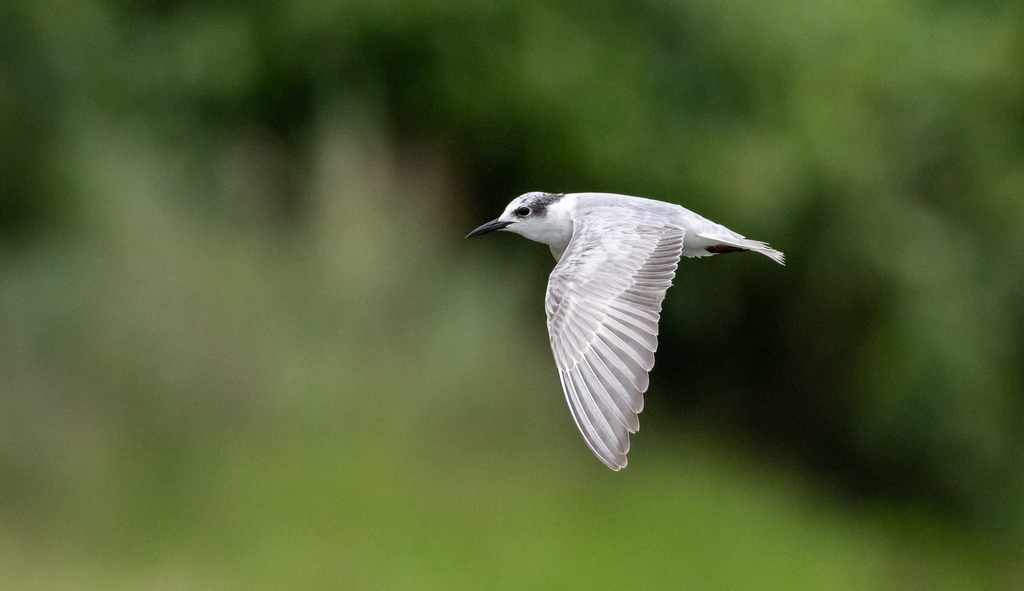
Whiskered Tern
Photo © Forest Botial-Jarvis
Photo © Forest Botial-Jarvis — CC BY 4.0 — Source: iNaturalist photo #242285138Identification
The whiskered tern is the largest of the marsh terns, combining features that recall both common terns and black terns. In breeding plumage, adults display a distinctive black cap, white cheeks, dark grey upperparts and underparts, red legs, and a red bill (29–34 mm in males, more stubby at 25–27 mm in females). The short, forked-looking tail and dark grey colouring are characteristically marsh-tern traits, while the strong bill and confident flight recall larger tern species. A key field mark year-round is the pale grey rump.
Seasonal and age-related plumage varies considerably. In winter, the forehead becomes white and the entire body plumage pales to a much lighter grey. The black ear-coverts join the hindcrown to form a distinctive C-shaped band, with mottled white above creating a characteristic head pattern. Juveniles show a ginger, scaly back and resemble winter adults, while first-winter birds display intermediate plumage with patchy ginger on the back. The call is a characteristic krekk.
Range & Habitat
Whiskered terns exist as several geographical races differing mainly in size and minor plumage details. Tropical populations are resident year-round, while European and Asian birds undertake long migrations, wintering south to Africa and the Indian subcontinent. Recent records confirm their presence in southern India during migration, such as a tagged individual spotted at Manakudi Bird Sanctuary, Kanniyakumari District of Tamil Nadu in April 2021.
This species breeds in colonies on inland marshes, where they sometimes nest amongst black-headed gulls, apparently gaining some protection from this association. They favour freshwater wetland habitats during breeding season and disperse to coastal and inland waters during migration and winter.
Behaviour & Diet
Whiskered terns are colonial breeders, gathering in groups on marsh habitat during the breeding season. The presence of black-headed gulls in these colonies suggests a commensalist relationship, where the terns benefit from the vigilance and defensive behaviour of the larger gulls.
These terns are versatile foragers, hunting small fish, amphibians, insects, and crustaceans. They typically feed by dipping and diving from flight, hunting over open water within their wetland habitats.
Best Time & Places to See It
Breeding whiskered terns can be found at inland marsh colonies during the breeding season. For northern hemisphere observers, spring and early summer offer the best opportunity to encounter breeding adults in full plumage. Migratory birds can be found en route to and from wintering grounds in Africa and the Indian subcontinent, with sightings recorded in southern India during April.
Winter visitors to African and Indian wetlands may encounter whiskered terns in their paler winter plumage. Locations with suitable inland marsh habitat and shallow freshwater bodies are most productive.
Photography Tips
The whiskered tern's striking breeding plumage—with its black cap, white cheeks, and dark grey body—makes it a rewarding subject during breeding season. The distinctive C-shaped head marking and red bill and legs provide excellent focal points. Use fast shutter speeds to capture the bird's agile flight when it dips to the water to feed.
Winter birds present a more subtle challenge, requiring attention to the fine details of the paler plumage and the characteristic head pattern. Backlighting can enhance the pale rump, a useful field mark. Colonial breeding sites offer opportunities for behaviour shots, though approach carefully to avoid disturbing nesting birds.
Private Full-Day Birdwatching Tour from Lisbon to the Tagus Estuary
Week-long Birdwatching Programme in Northern & Central Portugal
Nothing matches these filters.
Kanha Tiger Reserve
Mabamba Swamp
Minneriya National Park
Murchison Falls National Park
Queen Elizabeth National Park
Abijata-Shalla Lakes National Park
Addo Elephant National Park
Agulhas National Park
Aketajawe Lolobata National Park
Nothing matches these filters.
No community photos yet. Log in to add the first one.
No community observations of this species yet.