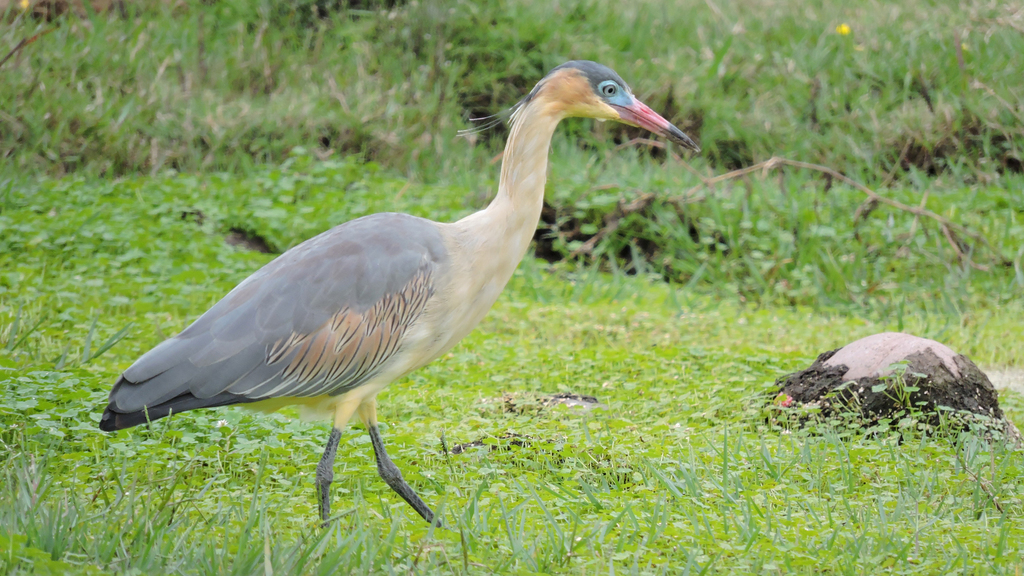
Whistling Heron
Photo © Federico Muñoz
Photo © Federico Muñoz — CC0 1.0 — Source: iNaturalist photo #131146899Identification
The whistling heron is a medium-sized heron measuring 53 to 64 cm in length, with a distinctive appearance that varies subtly between its two subspecies. Standing birds present an overall gray impression, but in flight they reveal conspicuous white rear parts including the lower back, belly, and tail. The upperparts are blue-gray, while the sides of the head, neck, breast, and scapular area are white with gold or buff staining—a coloration that varies from individual to individual. The southern subspecies has a darker crown and crest with cinnamon-colored upper wing coverts, while the northern subspecies displays slate-gray crown and honey-colored wing coverts. All birds share a distinctive bill that is pink with blue-violet at the base and black at the tip, greenish legs that are notably short, and a fairly large area of bare bluish skin around the eye. Juveniles follow the same pattern but appear duller overall.
The species is perhaps best identified by its remarkable call—a loud, flute-like whistle rendered as "kleeer-er" or "wueeee," described as high, reedy, melodious, and far-carrying. In flight, the whistling heron is distinctive among herons, employing fast, duck-like wingbeats and typically not retracting its neck fully as other herons do.
Range & Habitat
The whistling heron inhabits two distinct regions across South America. The northern subspecies, fostersmithi, occurs in the Llanos and Orinoco basin of Colombia and Venezuela, while the southern subspecies, sibilatrix, ranges from eastern Bolivia and Paraguay through western and southern Brazil, Uruguay, Chile, and northeastern Argentina. Recent records suggest the species may be expanding its range northward and eastward in Brazil. While some populations make seasonal movements, others remain year-round in their territories.
This species favors seasonally flooded savanna and open waterlogged terrain, often occupying drier grassy situations than other herons. It occurs at elevations up to 500 meters, with occasional sight records from higher elevations. Importantly, it prefers regions where open areas are interspersed with woodlots, as it roosts in trees. The whistling heron shows remarkable adaptability to human-altered landscapes, thriving in pastures and along roadsides, and frequently perches on fenceposts. It actually benefits from deforestation and some agricultural development, making it a successful heron of dry tropical country.
Behaviour & Diet
The whistling heron feeds on small dryland and marsh animals, employing diverse hunting techniques. It characteristically holds still but also walks slowly, and will use more active strategies including running after prey or catching flying insects such as dragonflies from a standing position. Remarkably, it has even been recorded pirating food from other birds, such as an aplomado falcon. The species may allow humans to approach fairly closely without abandoning a productive feeding spot, making it relatively approachable for observers.
Unlike most herons, the whistling heron nests solitarily rather than in colonies. During courtship, birds fly back and forth and glide in circles. Nests are loosely constructed of sticks in mature trees, typically 4 meters up in species such as eucalyptus or araucaria. Clutches normally contain three or four pale blue, speckled eggs measuring around 4.7 × 3.6 cm. Incubation lasts approximately 28 days, and young fledge 42 days after hatching, though nest and nestling survival rates are modest at 28% and 40% respectively, with storms being a significant cause of loss. Unusually for herons, whistling herons care for their young after fledging, with juveniles begging for food by hissing with drooped wings.
Best Time & Places to See It
The whistling heron is common in many areas throughout its range, though patchily distributed. In northeastern Venezuela, it shows seasonal absence from November to January but remains year-round in other areas such as Buenos Aires Province, Argentina. Because the species benefits from human-altered habitats and is not averse to pastures and agricultural areas, it can often be found in accessible locations. Look for it in open grassy areas adjacent to woodlots where it can roost, or watch for birds perched on fenceposts in mixed-use landscapes.
The species typically feeds alone or in pairs but may congregate in groups up to 100, particularly before roosting for the night, making late afternoon an excellent time for observation. Its far-carrying, distinctive whistled calls make it relatively easy to locate by ear, and its adaptability to human-modified landscapes means it is accessible to travelers throughout its range.
Photography Tips
The whistling heron's striking coloration in flight—particularly the contrasting white rear parts against blue-gray upperparts—makes it a rewarding photographic subject when captured in action. The bird's relatively short, greenish legs and distinctive facial skin pattern should be prioritized in close-range portraits, as these features aid identification and showcase the species' unique characteristics. The bare bluish skin around the eye is particularly striking and worth emphasizing.
Because the whistling heron often allows humans to approach closer than many other heron species, particularly when feeding, photographers have good opportunities for detailed shots. The bird's fast, duck-like wingbeats make flight photography challenging but striking—anticipate takeoff using the species' distinctive slow, drawn-out whistle as a warning signal. Late afternoon hours, when birds congregate before roosting, offer the best opportunities to photograph multiple individuals and potentially capture the species' characteristic flute-like calls in action.
Emas National Park
Brazil
+333 birds+23 mammals
Across the high plateaux of central Brazil, where the cerrado grasslands roll toward distant horizons under an immense sky, Emas National Park anchors one of South…
VIEW NATIONAL PARKSerra do Cipó National Park
Brazil
+379 birds+5 mammals
Where granite escarpments rise above the Atlantic Forest transition zone in southeastern Brazil, Serra do Cipó National Park unfolds across a landscape of dramatic ridges, cascading…
VIEW NATIONAL PARKYasuní National Park
Aguarico, Ecuador
+601 birds+43 mammals
Where the western Amazon basin converges with Ecuador's Orellana Province, lowland rainforest reaches toward the horizon in an unbroken canopy of staggering botanical density. Yasuní National…
VIEW NATIONAL PARKNatural Sierra de Chiribiquete National Park
Solano, Colombia
+359 birds+27 mammals
Massive table-top mountains rise abruptly from the lowland rainforest of southeastern Colombia, their sheer sandstone cliffs and isolated summits creating some of the most dramatic topography…
VIEW NATIONAL PARKNatural Chingaza National Park
Junín, Colombia
+285 birds+6 mammals
Where the Andes rise above three thousand metres in the Cundinamarca region, high-altitude grasslands and cloud forests converge in a landscape shaped by both geology and…
VIEW NATIONAL PARKNatural el Cocuy National Park
Güicán, Colombia
+313 birds+3 mammals
Where the Andes rise to their highest peaks in Colombia's eastern cordillera, El Cocuy National Park sprawls across more than 6,600 square kilometers of some of…
VIEW NATIONAL PARKMorrocoy National Park
Municipio Silva
+290 birds
Where the Caribbean coast of northwestern Venezuela meets protected coastal waters, a mosaic of mangrove forests, sandy beaches, and coral reef systems defines Morrocoy National Park.…
VIEW NATIONAL PARKNatural Sumapaz National Park
Cubarral, Colombia
+368 birds+1 mammals
Where the Andes descend toward the Amazon basin, the high páramo grasslands of Sumapaz National Park sprawl across more than five thousand square kilometers of Meta…
VIEW NATIONAL PARKEl Tamá National Park
Toledo, Colombia
+435 birds
Where the Andes descend toward the Caribbean coastal lowlands of northern Colombia, El Tamá National Park sprawls across nearly 3,800 square kilometres of montane forest, cloud…
VIEW NATIONAL PARKNatural Sierra de la Macarena National Park
Vista Hermosa, Colombia
+566 birds+15 mammals
Across nearly 20,000 square kilometres of Colombia's Meta Department, the terrain rises from lowland savanna into Andean foothills through a mosaic of gallery forests, palm-fringed wetlands,…
VIEW NATIONAL PARKItatiaia National Park
Brazil
+519 birds+12 mammals
Where granite peaks pierce the Atlantic rainforest canopy in southeastern Brazil, Itatiaia National Park rises as one of the country's oldest and most ecologically vital protected…
VIEW NATIONAL PARKPeixe National Park Lagoon
Brazil
+293 birds+4 mammals
Where the coastal plains of Rio Grande do Sul meet the Atlantic, Peixe National Park Lagoon sprawls across nearly 2,200 square kilometres of shallow waters, reed…
VIEW NATIONAL PARKSuperagui National Park
Brazil
+246 birds+2 mammals
Where the Atlantic rainforest meets the subtropical coast of Paraná, Superagui National Park sprawls across more than 1,000 square kilometres of one of Brazil's most biodiverse…
VIEW NATIONAL PARKSaint-Hilaire/Lange National Park
Brazil
+225 birds
Subtropical Atlantic forests rise and fall across the plateaus of inland Paraná, where Saint-Hilaire/Lange National Park protects nearly 578 square kilometres of Brazil's most biodiverse woodland…
VIEW NATIONAL PARKSerra do Itajaí National Park
Brazil
+227 birds+2 mammals
Where the Atlantic rainforest rises steeply from the coastal plains of Santa Catarina, Serra do Itajaí National Park spreads across 1,136 square kilometres of montane wilderness…
VIEW NATIONAL PARKSerra da Bocaina National Park
Brazil
+441 birds+5 mammals
Where the escarpment of the Serra da Bocaina rises sharply from the Atlantic coastal plain, tropical rainforest cloaks steep mountainsides that climb toward peaks exceeding 2,000…
VIEW NATIONAL PARKIguaçu National Park
Brazil
+387 birds+17 mammals
Where the Paraná Plateau plunges toward the Atlantic watershed, six thousand square kilometers of subtropical rainforest cling to steep gorges and river valleys in this corner…
VIEW NATIONAL PARKIlha Grande National Park
Brazil
+233 birds
Across the subtropical plateaus and Atlantic forest remnants of southern Brazil, a vast protected landscape spanning nearly 4,600 square kilometers safeguards one of the continent's most…
VIEW NATIONAL PARKSão Joaquim National Park
Brazil
+222 birds+9 mammals
Where the southern Brazilian highlands rise above the Atlantic Forest, São Joaquim National Park protects nearly 1,000 square kilometers of montane terrain that shifts between temperate…
VIEW NATIONAL PARKSerra dos Órgãos National Park
Brazil
+446 birds+13 mammals
Granite peaks thrust skyward through the Atlantic Forest canopy in the mountains immediately north of Rio de Janeiro, their bare rock faces rising above a landscape…
VIEW NATIONAL PARKChapada dos Guimarães National Park
Brazil
+450 birds+1 mammals
Where weathered sandstone plateaus rise above the cerrado grasslands of central Brazil, Chapada dos Guimarães National Park protects 624 square kilometres of ecological transition zone that…
VIEW NATIONAL PARKChapada dos Veadeiros National Park
Brazil
+324 birds+6 mammals
Where granite plateaus rise above the cerrado savanna in central Brazil, Chapada dos Veadeiros National Park unfolds across 6,665 square kilometres of some of the world's…
VIEW NATIONAL PARKPantanal Matogrossense National Park
Brazil
+322 birds+17 mammals
Where the flooded forests of central Brazil meet vast seasonally inundated grasslands, Pantanal Matogrossense National Park sprawls across nearly 2,900 square kilometers of one of the…
VIEW NATIONAL PARKBrasília National Park
Plano Piloto, Brazil
+338 birds+15 mammals
Cerrado grassland and scattered woodland sweep across the central Brazilian plateau where this national park sprawls across more than a thousand square kilometres of the Federal…
VIEW NATIONAL PARKAraucárias National Park
Brazil
+231 birds+3 mammals
Where the southern Brazilian highlands rise into cool temperate forest, Araucárias National Park protects one of the Atlantic Forest's most distinctive ecosystems across 506 square kilometres…
VIEW NATIONAL PARKSerra Geral National Park
Brazil
+211 birds+2 mammals
Where basalt cliffs and sandstone escarpments rise above the subtropical forests of southern Brazil, Serra Geral National Park preserves one of the Atlantic region's most dramatic…
VIEW NATIONAL PARKCampos Gerais National Park
Brazil
+143 birds
Where rolling plateaus rise above the Atlantic forest escarpment in Paraná's interior, Campos Gerais National Park unfolds across 539 square kilometers of highland grassland and forest…
VIEW NATIONAL PARKEl Palmar National Park
Distrito Sexto, Argentina
+244 birds+14 mammals
Across the Paraná River floodplain in northeastern Argentina, palms rise from wetland and grassland in a landscape shaped by water and time. El Palmar National Park…
VIEW NATIONAL PARKCampos del Tuyú National Park
Argentina
+169 birds+5 mammals
Subtropical forest graces the borderlands where Misiones Province meets Paraguay, a landscape shaped by the Paraná Plateau's weathered topography and the warm, humid climate of northeastern…
VIEW NATIONAL PARKRío Pilcomayo National Park
Argentina
+271 birds+13 mammals
Where the Río Pilcomayo cuts through northeastern Argentina's subtropical lowlands, a sprawling mosaic of wetlands, grasslands, and seasonally flooded forests creates one of South America's most…
VIEW NATIONAL PARKIguazú National Park
Puerto Iguazú, Argentina
+346 birds+15 mammals
Where the Paraná Plateau plunges toward the Atlantic watershed, nearly 800 square kilometers of subtropical rainforest drape across Misiones Province in a landscape carved by millennia…
VIEW NATIONAL PARKLos Cardones National Park
Argentina
+193 birds+6 mammals
Where the Andes descend into northwestern Argentina, Los Cardones National Park sprawls across nearly 1,200 square kilometres of one of South America's most distinctive high-altitude desert…
VIEW NATIONAL PARKEl Rey National Park
Municipio de Las Lajitas, Argentina
+317 birds+4 mammals
Where the eastern slopes of the Andes descend into northwestern Argentina's subtropical transition zone, El Rey National Park unfolds across 841 square kilometers of dramatically varied…
VIEW NATIONAL PARKCalilegua National Park
Municipio de Calilegua, Argentina
+288 birds+8 mammals
Where the eastern Andean slopes plunge into northwestern Argentina's humid subtropics, nearly 2,645 square kilometers of steep terrain and luxuriant forest compose one of South America's…
VIEW NATIONAL PARKParque Provincial Pampa del Indio
Laguna Limpia, Argentina
+231 birds+4 mammals
Across the flat horizons of Chaco Province, where the Paraná River system spills into vast wetlands and grasslands, Parque Provincial Pampa del Indio protects one of…
VIEW NATURE RESERVECaño Negro National Wildlife Refuge
Caño Negro District, Costa Rica
+486 birds+16 mammals
Where the San Juan River's seasonal floodplain opens into expansive wetlands, Caño Negro Wildlife Sanctuary sprawls across one of Central America's most productive freshwater ecosystems. This…
VIEW WILDLIFE SANCTUARYNo community photos yet. Log in to add the first one.
No community observations of this species yet.