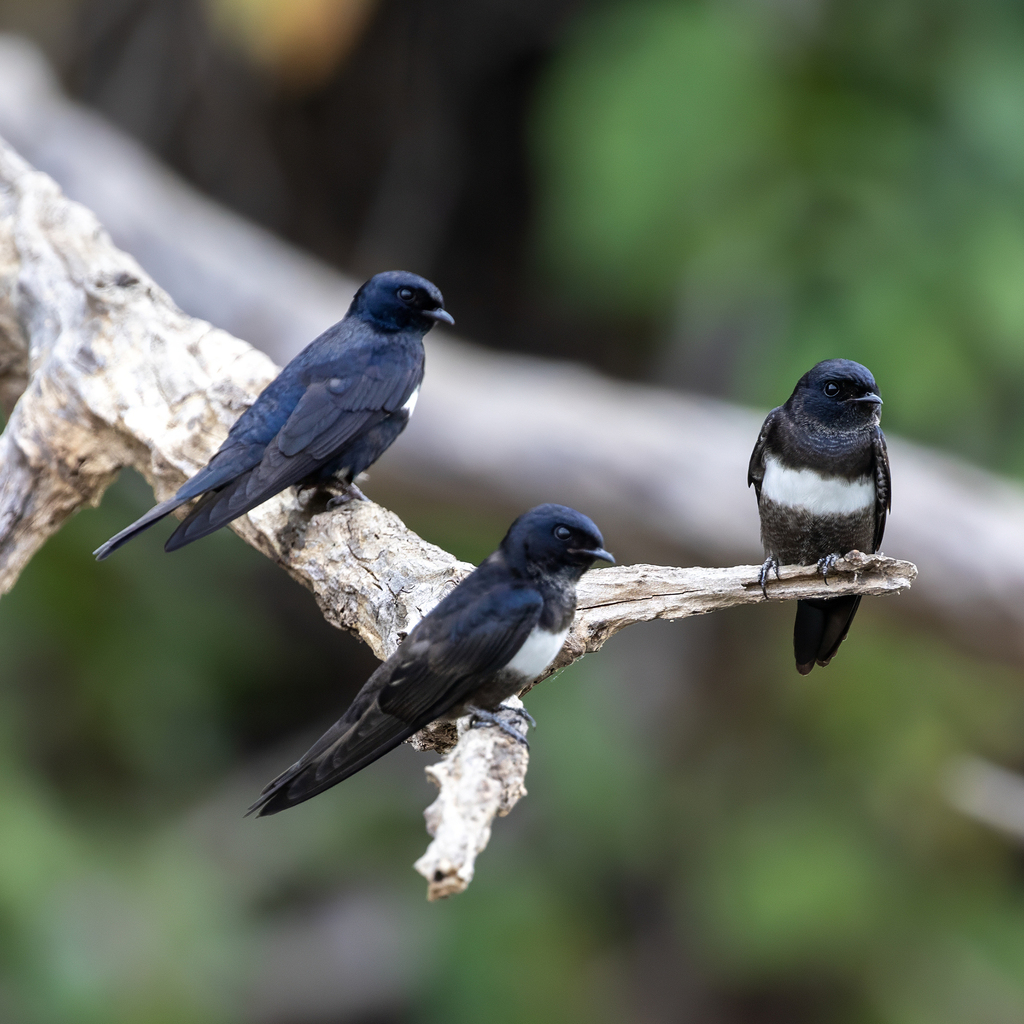
White-banded Swallow
Photo © Dan Vickers
Photo © Dan Vickers — CC BY 4.0 — Source: iNaturalist #260867538Identification
The white-banded swallow is a medium-sized swallow, measuring approximately 15 cm in length with a wingspan of 92–108 mm. Its striking plumage is predominantly black with a distinctive white breast band, white thighs, and white bars on the wing edges. The feathers display a blue-black lustre, and the bird features a deeply forked tail. Juveniles are duller and browner, with shorter and paler feathers. The sexes are similar in appearance, though females average slightly heavier than males. Do not confuse this species with the black-collared swallow, which has white underparts and throat rather than the characteristic white-banded pattern.
In the field, listen for a sharp ti-ti-tur call, and watch for a distinctive buzzy z-z-z-z-ee-eep vocalization given in flight.
Range & Habitat
This non-migratory species is found throughout northern and central South America, with a range spanning Bolivia, Brazil, Colombia, Ecuador, French Guiana, Guyana, Peru, Suriname, and Venezuela. White-banded swallows inhabit tropical lowland evergreen forests near water, showing a strong preference for both blackwater and whitewater rivers in forested areas. They are particularly frequent near blackwater rivers in Colombia and Venezuela, where they nest on rocky outcrops. Generally occurring below 800 metres, the species occasionally ranges up to 1,400 metres in Colombia. They are rarely found over lakes but may appear over forested clearings.
Behaviour & Diet
These insectivorous swallows are aerial foragers, flying rapidly in zigzag patterns or circles above water and occasionally skimming the surface. They forage low over the water and sometimes hunt near forests, clearings, and grassy areas with bushes. While they typically forage alone or in small groups, they occasionally associate with black-collared swallows and white-winged swallows, though they usually remain closer to rocks and outcroppings. They rest on boulders and small rocky outcrops above water between feeding bouts.
Breeding birds nest in burrows, either digging their own or utilizing abandoned burrows, particularly in riverbanks when water levels are low. The nest is constructed from dry grass. These swallows breed alone or in small colonies, with clutches of four to five white eggs. At dusk, birds gather in small roosts.
Best Time & Places to See It
To find white-banded swallows, target rocky rivers and forested waterways throughout the Amazonian region. Focus your search on blackwater and whitewater river systems in Colombia, Venezuela, Brazil, and Peru, where birds forage actively during daylight hours. Look for them skimming low over river surfaces, particularly near rocky outcrops where they perch between feeding flights. Early morning and late afternoon often provide the best visibility and activity levels. Non-migratory populations are present year-round, making this species accessible to travellers at any time.
Photography Tips
The white-banded swallow's rapid, erratic flight demands a fast shutter speed (minimum 1/2000s) and continuous autofocus. Position yourself on elevated riverbanks or rocky outcrops to capture birds at eye level or slightly above as they forage. The striking contrast between black plumage and white markings photographs well in bright tropical light, but watch for harsh shadows on the breast band. Back-lighting during early morning can illuminate the blue-black lustre of the feathers beautifully. The deeply forked tail is a diagnostic feature—frame your shots to showcase this characteristic profile. Patient waiting near nesting and roosting sites at dawn or dusk may reward you with perched birds, offering opportunities for detailed portraits.
Amacayacu National Park
Amazônia National Park
Anavilhanas National Park
Bahuaja Sonene National Park
Campos Amazónicos National Park
Encontro das Águas State Park
French Guiana Amazonian Park
Jaú National Park
Manu National Park
Nothing matches these filters.
No community photos yet. Log in to add the first one.
No community observations of this species yet.