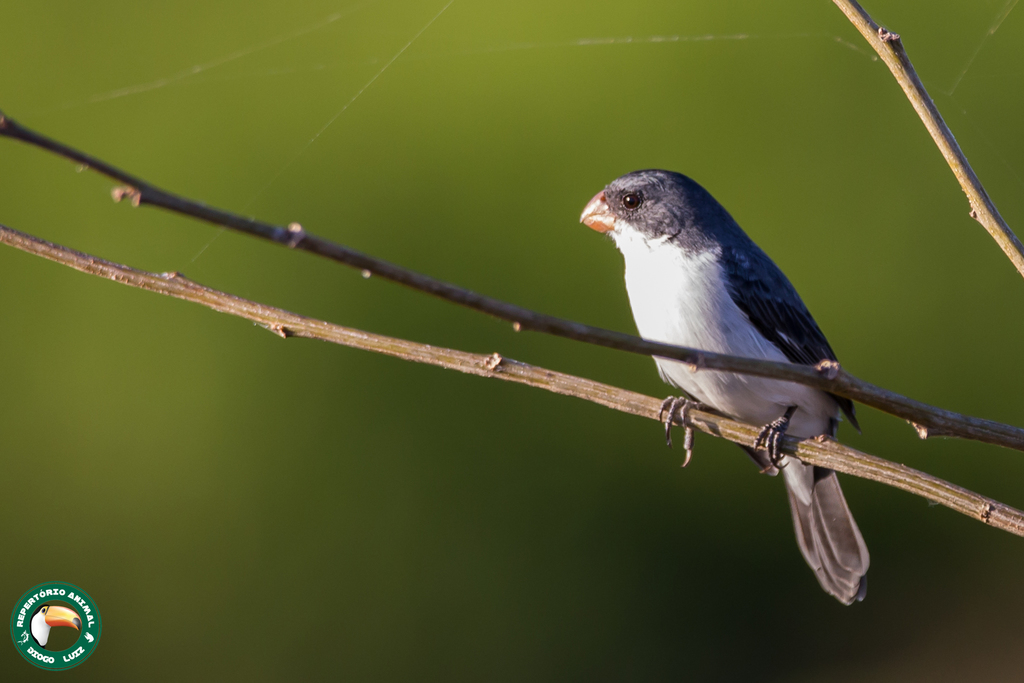
White-bellied Seedeater
Photo © Diogo Luiz
Photo © Diogo Luiz — CC BY 4.0 — Source: iNaturalist photo #45661533Identification
The white-bellied seedeater is a small but rather large seedeater for its genus, measuring 11 to 12.5 cm in length with a notably longish tail and a short, thick, rounded bill. The species is strongly sexually dimorphic. Males of the nominate subspecies display a dark gray head with a slightly darker lore region, contrasting sharply with a white throat and submoustachial area. The upperparts are dark gray with a thin white rump band, while the wings show white bases on the primaries visible as a patch on the closed wing. The underparts are almost entirely white with grayish sides and flanks. Females are warm tawny brown above with pale tawny-brown throats and bellies, intermediate-coloured breasts and flanks, and lack the striking contrast of males. All birds have dark brown irises and blackish legs; males sport an orange-pink bill while females have a blackish one. Other subspecies show notable variations: S. l. bicolor males are black rather than gray, S. l. cinereola is smaller with more gray on the flanks, and S. l. mexianae has entirely white underparts.
Range & Habitat
This species has a disjunct distribution across South America, with different subspecies found in Suriname, Brazil, Paraguay, Bolivia, and Argentina, with vagrant records from French Guiana, Peru, and Uruguay. The white-bellied seedeater inhabits shrubby grasslands and adjacent forest edges, invariably near water sources, at elevations up to 800 m. It is considered frequent to uncommon throughout its Brazilian range, though many local populations have been lost to trapping and habitat destruction.
Behaviour & Diet
Mostly sedentary and year-round resident, the white-bellied seedeater shows evidence of some seasonal movements. It feeds primarily on grass seeds and seeds of other plants, supplemented with insects, typically foraging while clinging to plant stems singly or in pairs rather than in flocks. Breeding occurs at least during November and December in eastern Brazil, with pairs constructing cup nests from grass roots and spider web, often lined with white fluff from Calotropis milkweed, positioned 2.5 to 4.5 m above ground near water. Clutches consist of two white eggs spotted with black and brown; females incubate alone while both parents feed the young.
Best Time & Places to See It
The white-bellied seedeater is best sought in shrubby grasslands and forest-edge habitats near permanent water sources across its range in central and southern Brazil, Paraguay, Bolivia, and northern Argentina. The breeding season in eastern Brazil during November and December offers good opportunities for observation. Its sedentary habits and preference for specific wetland-edge habitats mean that locating suitable sites with knowledgeable local guidance significantly improves sighting chances.
Photography Tips
The sexual dimorphism of this species makes capturing both males and females rewarding for a complete portfolio. Males with their striking gray-and-white plumage are more conspicuous and easier to photograph against grassland backgrounds. Early morning light will best reveal the subtle tonal differences between subspecies. The bird's habit of foraging while clinging to plant stems provides natural perching opportunities; position yourself downwind near water-edge vegetation where birds are most active. A telephoto lens of at least 400-600 mm will be necessary to frame these small birds effectively, and patience is essential as they often forage singly or in pairs in scattered locations.
Brasília National Park
Chapada Diamantina National Park
Chapada dos Guimarães National Park
Emas National Park
Encontro das Águas State Park
Guirá State Park
Iguaçu National Park
Iguazú National Park
Ilha Grande National Park
Nothing matches these filters.
No community photos yet. Log in to add the first one.
No community observations of this species yet.