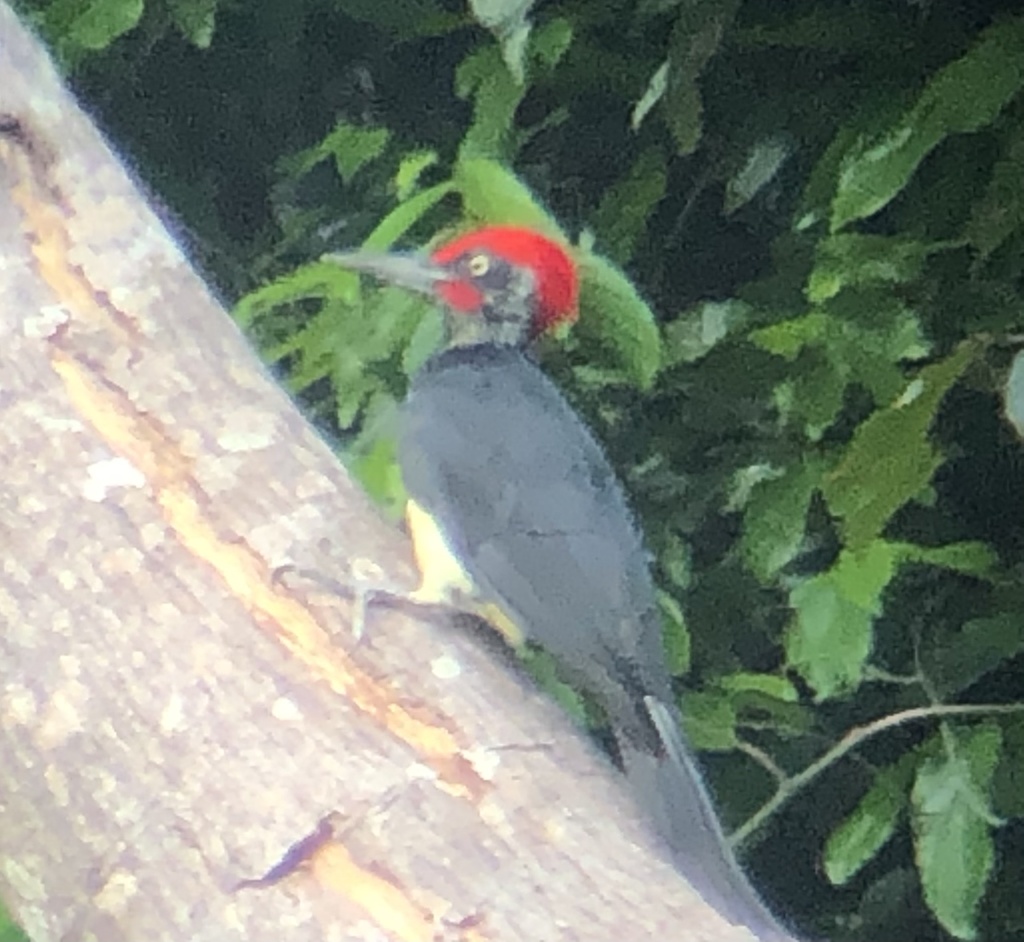
White-bellied Woodpecker
Photo © Jean-Paul Boerekamps
Photo © Jean-Paul Boerekamps — CC0 1.0 — Source: iNaturalist #72875190Identification
The white-bellied woodpecker is among the largest living woodpecker species, ranging from 40 to 48 cm in length and weighing between 197 and 350 g. It ranks third in size among Asian woodpeckers, comparable to the great slaty woodpecker and black woodpecker, and is closely related to the North American pileated woodpecker. The species is predominantly black, with plumage variations depending on subspecies. The subspecies hodgsonii, found in India, is characterized by whitish underwing coverts and a white rump, though the face lacks white markings. Juveniles of the nominate race may display white streaks on the throat. Morphological and vocal differences between subspecies are substantial enough that some may warrant classification as separate species.
Range & Habitat
This species inhabits evergreen forests across the tropical Indian subcontinent and Southeast Asia. The 14 recognized subspecies occupy distinct geographical ranges, from the Western Ghats and central India to Thailand, Laos, Myanmar, and various islands of Southeast Asia including the Philippines, Borneo, and Palawan. The species favors large dead trees for nesting, often positioning them beside rivers or within open forest settings. Although naturally shy, white-bellied woodpeckers can surprisingly adapt to areas near well-used human tracks and disturbed regions, demonstrating some flexibility in habitat tolerance.
Behaviour & Diet
White-bellied woodpeckers are typically solitary or found in pairs, occasionally accompanied by a third bird. Solitary individuals may spend an hour foraging at a suitable tree. Their diet consists primarily of insects obtained from under bark, particularly ants and grubs, though they sometimes consume fruit. The species produces distinctive vocalizations, including a loud laugh-like chiank call and dramatic drumming that intensifies during breeding season. They roost within tree holes and possess a repertoire of calls ranging from sharp, short kuk notes to more complex kyuk, kew, and kee-yow calls, with longer vocalizations typically preceding flight.
Best Time & Places to See It
The breeding season, primarily from January to May (with peak activity January to March depending on subspecies and region), offers the best opportunity to observe and hear this species. During this period, their loud drumming and vocalizations become more prominent and frequent. Evergreen forest habitats near dead trees, particularly those beside rivers or in open forest settings, increase the likelihood of encounters. The subspecies hodgsonii in India is particularly active during these months. However, naturalists should be patient and observant, as the species remains fundamentally shy despite its impressive size and vocal intensity.
Photography Tips
Photographers should focus on areas with large dead trees in appropriate forest habitat, as these are essential feeding and nesting sites. Early morning during breeding season will maximize opportunities to capture drumming behavior and loud vocalizations. The species' large size and predominantly black plumage provide striking photographic subjects, particularly when whitish markings are visible on certain subspecies. Patient observation of a single tree may yield extended foraging sequences lasting up to an hour. Given their shyness, maintaining distance and using telephoto lenses is advisable. The distinctive white rump and underwing coverts of hodgsonii make this subspecies particularly photogenic.
Phou Khao Khouay National Protected Area
Thaphabath District, Thailand
+113 birds
Where the Annamite Mountains descend into central Thailand's monsoon forests, Phou Khao Khouay National Protected Area sprawls across rugged limestone terrain interlaced with river valleys and…
VIEW NATIONAL PARKPeriyar National Park
Mlappara, India
+232 birds+4 mammals
Dawn breaks over mist-shrouded ridges where the Western Ghats tumble toward Kerala's spice-scented lowlands. Here, ancient tropical forests envelope a glittering artificial lake, creating a mosaic…
VIEW NATIONAL PARKPampadum Shola National Park
Vattavada, India
+258 birds+14 mammals
Where misty shola forests cling to the high plateaus of the Nilgiri Mountains, ancient evergreen remnants create a world apart. This 2,316-hectare reserve protects one of…
VIEW NATIONAL PARKBandipur National Park
Hirehalli, India
+302 birds+19 mammals
Where the Western Ghats descend into the Deccan plateau, ancient deciduous forests blanket a landscape carved by the Nugu River. Bandipur unfolds across 880 square kilometres…
VIEW NATIONAL PARKNagarahole Tiger Reserve
Nalkeri Forest, India
+323 birds+23 mammals
Where granite escarpments rise above dense deciduous forests and the Kabini River carves through pristine wilderness, one of India's most biodiverse landscapes unfolds across the Western…
VIEW NATIONAL PARKBako National Park
Kuching, Malaysia
+210 birds+17 mammals
Weathered sandstone cliffs rise dramatically from the South China Sea, their ochre faces sculpted by millennia of wind and tide into a landscape of extraordinary geological…
VIEW NATIONAL PARKTaman Negara National Park
Kampong Samas, Malaysia
+393 birds+48 mammals
Where ancient rainforest meets limestone peaks, one of Southeast Asia's oldest protected wilderness preserves sprawls across 4,343 square kilometers of primordial landscape. Dipterocarp giants tower overhead,…
VIEW NATIONAL PARKPenang National Park
Balik Pulau, Malaysia
+107 birds+2 mammals
Granite peaks rise abruptly from the Andaman Sea where tropical rainforest clings to steep slopes in one of Malaysia's oldest protected landscapes. Mangrove forests fringe the…
VIEW NATIONAL PARKTaman Negara Bukit Lambir National Park
Miri, Malaysia
+153 birds+7 mammals
Rainforest cascades down sandstone ridges where crystal streams carve through ancient geology, creating a landscape of profound biological richness in Sarawak's interior. This 68-square-kilometre sanctuary protects…
VIEW NATIONAL PARKGunung Mulu National Park
Long Seridan, Malaysia
+280 birds+39 mammals
Where granite monoliths pierce the rainforest canopy of Sarawak, an ancient limestone karst landscape reveals one of Southeast Asia's most biodiverse strongholds. Soaring peaks cloaked in…
VIEW NATIONAL PARKTaman Nasional Baluran
Situbondo, Indonesia
+189 birds+9 mammals
Across the northeastern tip of East Java, where monsoon winds sweep down from the Bali Strait, a landscape of contrasts unfolds within 374 square kilometres of…
VIEW NATIONAL PARKWest Bali National Park
Gerokgak, Indonesia
+240 birds+8 mammals
Across West Bali's northwestern reaches, where the Indian Ocean meets volcanic slopes and limestone cliffs plunge toward turquoise shallows, sprawls a protected realm of roughly 325…
VIEW NATIONAL PARKWay Kambas National Park
Lampung Timur, Indonesia
+237 birds+20 mammals
Across the low swamplands of eastern Lampung, where freshwater wetlands merge into tidal mangrove forests along the Sunda Strait, sprawls one of Sumatra's most vital sanctuaries.…
VIEW NATIONAL PARKBaima Snow Mountain National Nature Reserve
Diqing Tibetan Autonomous Prefecture, China
+204 birds+3 mammals
High-altitude ridges and steep-sided valleys define this reserve in northwestern Yunnan, where elevations surge from around 3,000 metres to peaks above 4,100 metres. The terrain supports…
VIEW NATURE RESERVENo community photos yet. Log in to add the first one.
No community observations of this species yet.