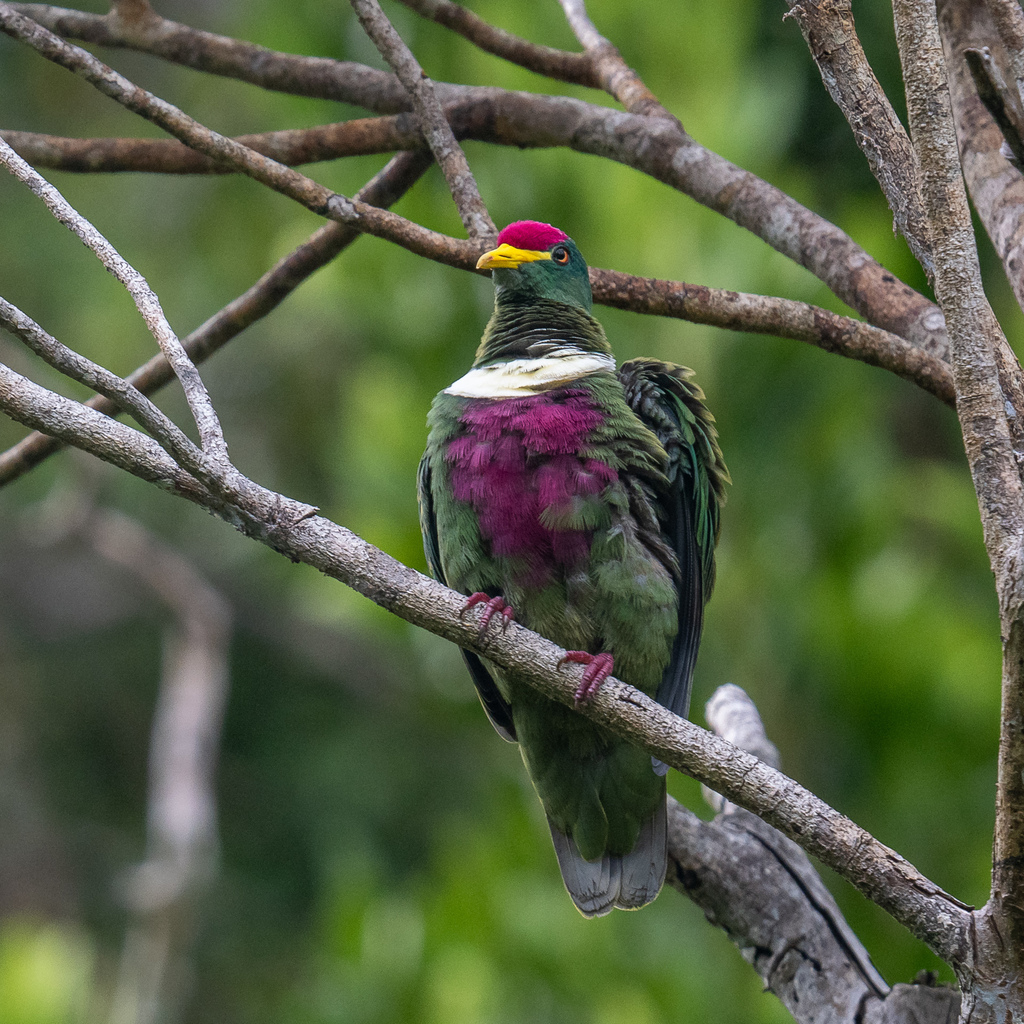
White-bibbed Fruit Dove
Photo © Piotr Lukasik
Photo © Piotr Lukasik — CC BY 4.0 — Source: iNaturalist #257576939Identification
The white-bibbed fruit dove is a compact pigeon measuring 23.5 to 26 centimeters in length, noticeably smaller than an African collared dove but with a more robust build and characteristically short, rounded tail. The species exhibits striking sexual dimorphism: males sport a distinctive purple head cap, while females are clothed almost entirely in green plumage. Both sexes share the species' most distinctive feature—a large, crescent-shaped white band across the chest, which may show a yellowish tinge in some subspecies. The overall plumage is predominantly dark green, with an elongated, narrow purple spot on the belly. The bright yellow beak is conspicuous, and tail feathers are typically bright yellow, though some subspecies display yellow bellies and green tail feathers instead.
Range & Habitat
This fruit dove inhabits the Maluku Islands, New Guinea, the Bismarck Archipelago, and numerous islands bordering New Guinea, with particular concentrations on Buru, Seram, and Karkar. The species favors subtropical and tropical moist lowland and montane forests, showing a strong preference for primary mountain forest, though it occurs at lower densities in secondary growth. In New Guinea, it typically occurs between 1,000 and 3,260 meters elevation, but on smaller islands such as those in the Aru Islands Regency, it also inhabits lowland areas. It is predominantly a canopy species, spending most of its time in the upper levels of the forest.
Behaviour & Diet
The white-bibbed fruit dove is a specialized frugivore, plucking fruit from branches but seldom feeding on the ground. Its breeding behavior is notably atypical for New Guinea fruit pigeons: rather than laying the single egg characteristic of most fruit pigeons in the region, this species lays two eggs. The nest is constructed from twigs, a simple structure befitting its arboreal lifestyle.
Best Time & Places to See It
Travellers seeking this species should focus on primary mountain forests across its range, particularly on the larger islands of Buru, Seram, and Karkar, where it is relatively common. The bird's preference for the canopy means that patience and good binoculars are essential. Dawn hours often provide the best viewing opportunities when the dove is actively foraging among fruiting trees.
Photography Tips
The white-bibbed fruit dove's canopy preference and preference for dense forest present significant photographic challenges. A telephoto lens of at least 400mm is recommended to capture distant subjects in the treetops. Early morning light often provides the clearest opportunities, as the bird is more active and visible when feeding on fruiting branches. The male's striking purple head cap and contrasting white chest band photograph well when lit from the side, while females present a more subtle but elegant study in green tones.
No community photos yet. Log in to add the first one.
No community observations of this species yet.