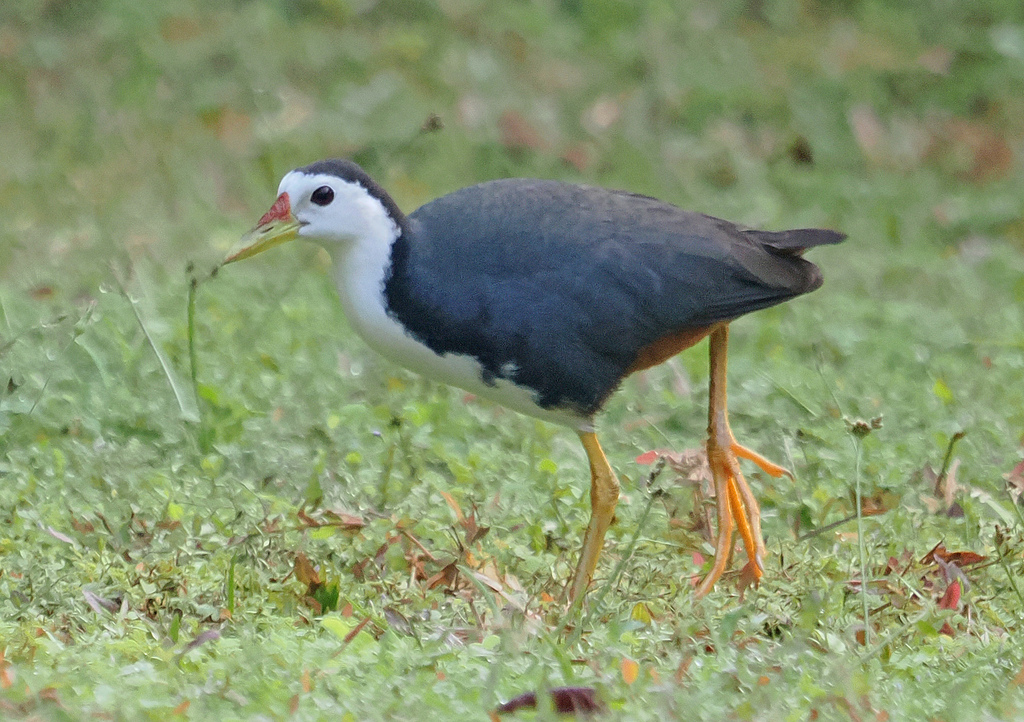
White-breasted Waterhen
Photo © Judy Gallagher
Photo © Judy Gallagher — CC BY-SA 4.0 — Source: iNaturalist photo #629959738Identification
The white-breasted waterhen is a distinctive rail measuring 32 cm in length, easily recognized by its dark slaty-grey upperparts and flanks contrasted with a clean white face, neck, breast, lower belly and undertail. Adults have cinnamon or white colouring on the lower belly and undertail coverts. The bill and legs are bright yellow, and the body is characteristically flattened laterally—an adaptation for moving through dense reed beds and undergrowth. The short tail is often held cocked upright as the bird walks. Immature birds are noticeably duller versions of adults, while downy chicks are entirely black. Sexes are similar in plumage, though females are slightly smaller than males.
Range & Habitat
This waterbird is widely distributed across South and Southeast Asia, from Pakistan east to Indonesia, with populations varying across multiple subspecies found from Sri Lanka through mainland India to the islands of the Andamans, Nicobars, Java, Sulawesi and the Lesser Sundas, extending west to Arabia and east nearly to Japan. They are permanent residents throughout their range, though they make short-distance movements and are known to colonize new areas readily. Their breeding habitat comprises marshes across tropical Asia, typically in the plains, though they have been recorded at higher elevations such as 1300 m in Nainital and 1500 m in Kerala's High Range.
While most commonly found near freshwater marshes, these adaptable birds also inhabit brackish water and coastal areas, including volcanic islands where freshwater is scarce, such as Barren Island in the Andamans. They have proven to be early colonizers on newly formed volcanic landscapes.
Behaviour & Diet
Unlike most secretive rails, white-breasted waterhens are remarkably bold and often seen stepping slowly through open marshes, drains, and even near busy roads with their tails held upright and jerked as they walk. They are usually encountered singly or in pairs as they forage along waterbody edges, probing with their bills in mud and shallow water or picking up food by sight. They primarily consume insects—particularly beetles—small fish which they carefully wash in water, aquatic invertebrates, and seeds and grains.
These birds are largely crepuscular, being most active at dawn and dusk, when they produce loud, repetitive croaking calls—particularly during the breeding season following the first rains. The Andamans population is noted for making distinctive duck-like quacks. Breeding occurs mainly from June to October, with both sexes sharing incubation duties over a clutch of 6-7 eggs and caring for chicks. Chicks possess a remarkable escape behaviour, diving underwater to evade predators.
Best Time & Places to See It
The breeding season from June to October, particularly just after the first rains, offers the best viewing opportunities, as birds are more vocal and active during this period. White-breasted waterhens inhabit marsh systems throughout tropical Asia, and their boldness compared to other rails means they are relatively easy to locate in suitable habitat. Look for them stepping slowly along the edges of freshwater marshes, in reeds, and along drainage systems, particularly during early morning and evening hours when crepuscular activity peaks.
Photography Tips
The bird's habit of foraging in open areas and walking with its tail prominently cocked makes it more approachable than most rails, offering good photography opportunities. Focus on capturing the striking contrast between dark upperparts and white underparts in good light. Early morning and dusk provide atmospheric lighting conditions that coincide with peak activity. Patient positioning near marsh edges where birds regularly forage will yield the best results, particularly during breeding season when birds are more active and vocal.
Kanha Tiger Reserve
Minneriya National Park
Bako National Park
Bandhavgarh National Park
Bandipur National Park
Banke National Park
Bardiya National Park
Chitwan National Park
Doi Inthanon National Park
Nothing matches these filters.
No community photos yet. Log in to add the first one.
No community observations of this species yet.