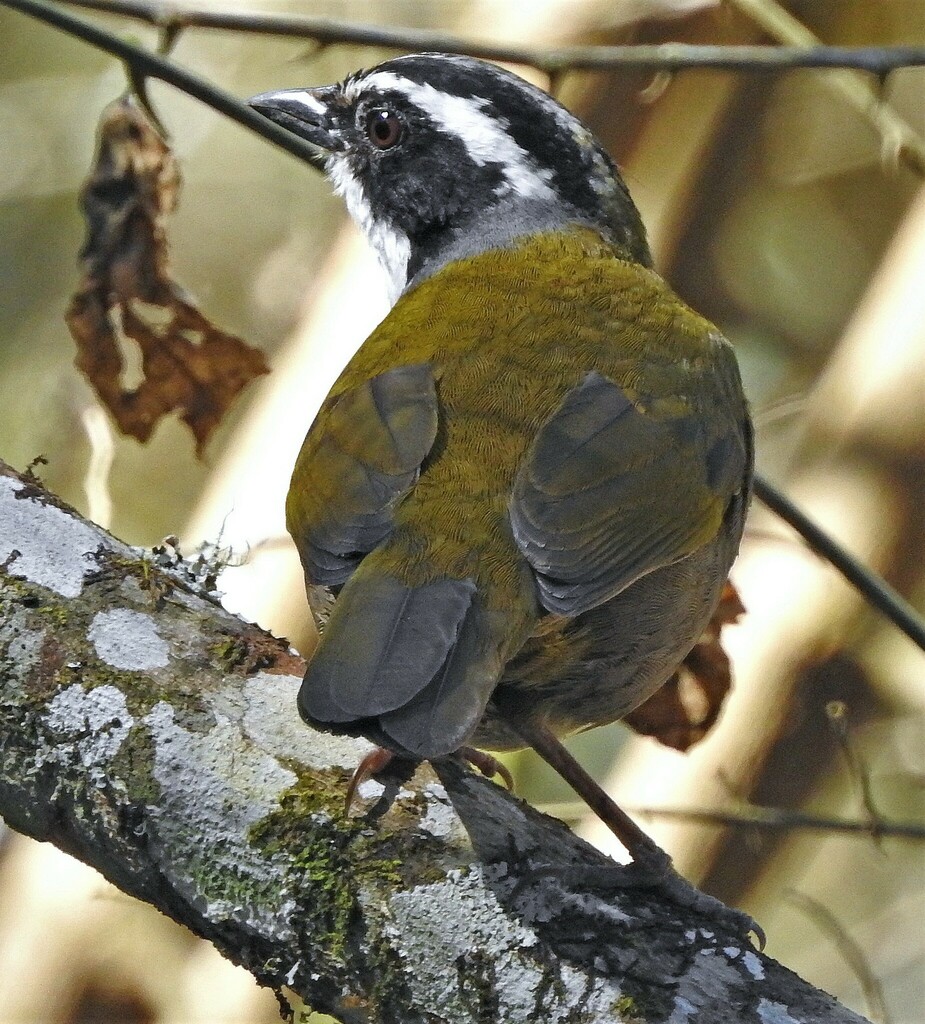
White-browed Brushfinch
Photo © Hugo Hulsberg
Photo © Hugo Hulsberg — CC0 1.0 — Source: iNaturalist #138902133The white-browed brushfinch (Arremon torquatus) is a species of bird in the family Passerellidae, the New World sparrows. It is found in Argentina, Bolivia, and Peru. == Taxonomy and systematics == The white-browed brushfinch has a complicated taxonomic history. It was formally described in 1837 with the binomial Embernagra torquata. It was later reassigned to genus Buarremon which was still later merged into genus Atlapetes. Further study resulted in Buarremon's being resurrected. The species Buarremon torquatus was called the "stripe-headed brushfinch". In 2008, taxonomists began merging Buarremon into Arremon; by that time the "stripe-headed brushfinch" had acquired multiple subspecies. Following a study published in 2010 and some earlier studies, taxonomists began splitting the "stripe-headed brushfinch" into eight species. The nominate subspecies A. torquatus, now with three subspecies, was renamed the white-browed brushfinch. The white-browed brushfinch has three subspecies, the nominate A. t. torquatus (Lafresnaye & d'Orbigny, 1837), A. t. fimbriatus (Chapman, 1923), and A. t. borellii (Salvadori, 1897). == Description == The white-browed brushfinch is about 19 cm (7.5 in) long and weighs 30 to 36 g (1.1 to 1.3 oz). The sexes have the same plumage. Adults of the nominate subspecies have a black crown with a gray stripe…
El Rey National Park
Municipio de Las Lajitas, Argentina
+317 birds+4 mammals
Where the eastern slopes of the Andes descend into northwestern Argentina's subtropical transition zone, El Rey National Park unfolds across 841 square kilometers of dramatically varied…
VIEW NATIONAL PARKCalilegua National Park
Municipio de Calilegua, Argentina
+288 birds+8 mammals
Where the eastern Andean slopes plunge into northwestern Argentina's humid subtropics, nearly 2,645 square kilometers of steep terrain and luxuriant forest compose one of South America's…
VIEW NATIONAL PARKNo community photos yet. Log in to add the first one.
No community observations of this species yet.