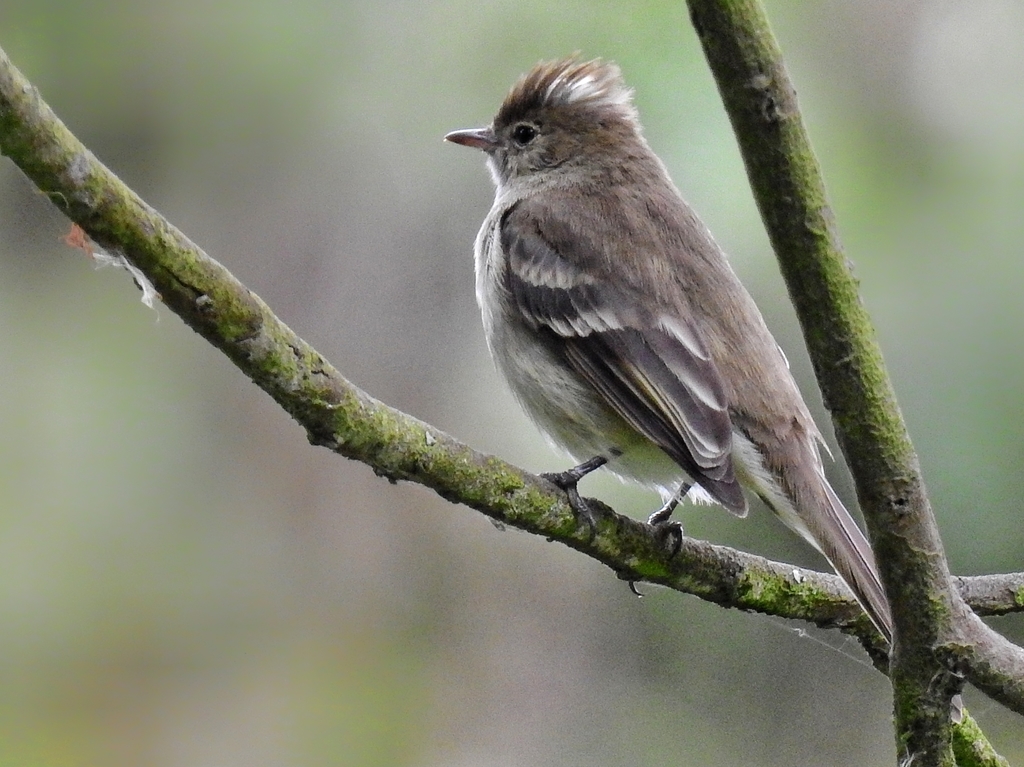
White-crested Elaenia
Photo © Esteban Poveda
Photo © Esteban Poveda — CC BY 4.0 — Source: iNaturalist photo #172792366Identification
The white-crested elaenia is a small tyrant flycatcher, measuring 13.5 to 15 cm in length. Its most distinctive feature is a small, bushy crest with a partially hidden white or creamy-white stripe running through the centre. The nominate subspecies (E. a. albiceps) displays dull olive to olive-gray plumage on the head and upperparts, with whitish lores and eyering. The wings are dusky with white or whitish wing bars, while the tail is dusky with narrow olive edges. The underparts are light gray to whitish, with a grayish-brown breast. Both sexes are identical in plumage. The bird has a dark brown iris, black or dark gray bill with a pale mandible base, and dark legs. Other subspecies show subtle variations: some are paler overall, others have less prominent crests or eyerings, and a few display pale yellow washes on the belly.
Range & Habitat
The white-crested elaenia occurs across the Andes of South America, found in Bolivia, Chile, Colombia, Ecuador, and Peru. Elevational ranges vary by region: up to 3,200 m in Colombia, 1,500–2,800 m in Ecuador, and between 800–3,500 m on Peru's western slopes and 1,000–3,300 m on eastern slopes. The species inhabits forest edges, open woodlands, secondary forest, and scrublands, with a preference in many areas for drier intermontane valleys. Most subspecies are year-round residents, though E. a. modesta undergoes seasonal movements between the western and eastern sides of the Andes.
Behaviour & Diet
White-crested elaenias typically forage singly, gleaning insects and plucking fruit while perched or briefly hovering. They frequently join mixed-species feeding flocks and often congregate at fruiting trees with other individuals and species. While the full diet composition remains unstudied, it is known to include both insects and fruit. The subspecies E. a. modesta appears to breed between December and February, but breeding seasons for other populations remain undocumented. Longevity data from banding studies suggests individuals can reach at least eight years and two months old.
Best Time & Places to See It
Year-round resident populations make the white-crested elaenia accessible throughout the year across much of the Andes. The species is most reliably encountered in subtropical and temperate forest edges and open woodlands at appropriate elevations. Fruiting trees are particularly productive locations, where small flocks may gather. Intermontane valleys with drier conditions than surrounding slopes offer good viewing opportunities. The subspecies E. a. modesta may be most easily found on the eastern slopes of the Andes during the austral winter months (June–August).
Photography Tips
The white-crested elaenia's small size and preference for perching while foraging make it approachable with patience. Position yourself near fruiting trees, where multiple individuals may gather, providing excellent photographic opportunities. The bird's subtle plumage and small crest are best captured in soft, directional light that highlights the white stripe through the crown. Watch for its gleaning and hovering foraging behaviour, which can produce dynamic flight shots. The dark iris and pale mandible base offer useful identification markers for close-up photography. Early morning visits to forest edges and open woodlands increase encounter rates, particularly in areas where mixed-species flocks congregate.
Alerce Costero National Park
Antisana National Park
Bahuaja Sonene National Park
Baritú National Park
Brasília National Park
Cabo de Hornos National Park
Cajas National Park
Calilegua National Park
Catimbau National Park
Nothing matches these filters.
No community photos yet. Log in to add the first one.
No community observations of this species yet.